
A family reaches the cinema counter and discovers a small but important detail beside the film’s name: UA 13+. The child is eleven. Does that label mean entry is automatically refused? Is it a warning, or a legal age ban? The answer matters before you pay for tickets, and it is easy to misunderstand the new-looking numbers.
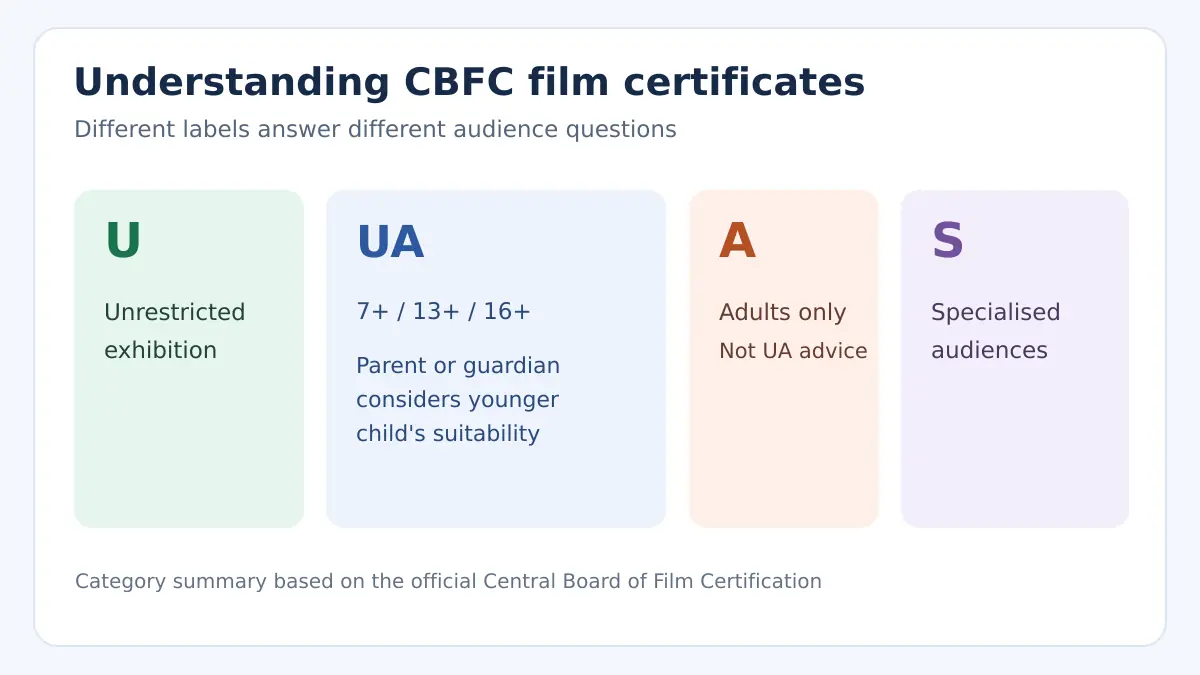
Quick answer: India’s Central Board of Film Certification (CBFC) lists U, UA 7+, UA 13+, UA 16+, A and S certification categories. U is unrestricted. A is for adults. S is for specified specialised audiences. The three UA markers offer age-specific parental or guardian guidance; they should not be casually read as identical to the legally adult-only A classification. The exact certificate, cinema policies and suitability for an individual child still need checking.

What does each CBFC rating mean?
The CBFC is India’s statutory film-certification body for public exhibition of films. It assesses films under the Cinematograph Act and applicable certification rules. Certification is different from a newspaper critic’s star rating, a streaming service’s recommendation or a cinema’s ticket price category. The relevant question is who may view the certified film and what guidance accompanies that classification.
| Certificate | Meaning in practical terms | What viewers should remember |
|---|---|---|
| U | Unrestricted public exhibition | Not a promise that every scene will appeal to very young children |
| UA 7+ | Unrestricted public exhibition with guidance for the age marker | Parent/guardian considers suitability for a child below seven |
| UA 13+ | UA category carrying a 13+ advisory marker | Parent/guardian considers suitability for a child below thirteen |
| UA 16+ | UA category carrying a 16+ advisory marker | Parent/guardian considers suitability for a child below sixteen |
| A | Exhibition restricted to adults | Not the same as UA parental guidance |
| S | Exhibition restricted to members of a specialised class | A limited-audience classification; not a general family category |
In the official CBFC description, the UA age markers guide the parent or guardian’s judgement about a child younger than the indicated age. That is an important distinction. A ticket-booking app might display a compact badge without explaining the underlying rule. Read the full certification context and any individual cinema admission conditions before deciding.
Why were UA 7+, UA 13+ and UA 16+ introduced?
A single broad UA label could not convey whether a film was likely to concern a parent of a six-year-old in the same way as a parent of a fifteen-year-old. The newer age markers provide finer guidance. The CBFC’s current FAQ identifies U, UA in its three age-based forms, A and S as its prescribed categories, and its website references the Cinematograph (Certification) Rules, 2024.
The label is still a certification classification, not a detailed content synopsis. Two films with the same UA 13+ marker may feel very different to different families. A tense horror sequence, a portrayal of substance use, rough language or emotionally difficult subject matter can affect younger viewers differently. Those examples are reasons to look closer, not claims that every film in a category contains those elements.
Can a younger child watch a UA 13+ or UA 16+ film?
This is the question most often lost in short social posts. The CBFC describes the UA age markers as guidance for parents and guardians about whether children below the indicated age should see the film. They are not described on the CBFC homepage in the same terms as an A certificate restricted to adult audiences.
That does not mean every cinema booking or entry experience will be the same. A multiplex, event organiser or ticket platform may communicate its own admission and documentation procedures, and local compliance practices matter. Check the current certification, read the venue’s rules and contact the cinema if your family’s situation is uncertain. Do not make a journey based only on an influencer’s claim that “13+ means strictly no one under 13,” or the opposite claim that “any child can enter any film.”
The difference between UA and A is not a small technicality
With UA, a parent’s or guardian’s judgement is part of the official advisory concept. An A classification is for adults. Trying to argue at the entrance that a parent has approved a minor’s entry to an A-rated movie confuses two very different categories. This distinction is particularly relevant for cinema-going groups buying tickets for teenagers.
There is another trap: film certification is not a measure of artistic quality. A brilliant film may be A-rated; a forgettable one may carry U. “Family-friendly” in a promotional description is also not a substitute for the formal certificate. Ask the simple question first—what has actually been certified?—then decide whether the film suits you.
How to check a film’s certification before booking
1. Find the exact title and language version
Start with the film’s official publicity and the cinema listing. Pay attention to the language, release version and any apparent changes in certificate information. A film’s trailer, a short online clip and its final feature are not interchangeable evidence of the film’s classification. Do not rely on a recycled poster from months before release.
2. Use the official CBFC information as your reference point
Visit the Central Board of Film Certification website for its current category descriptions, certification information and official notices. If you are comparing screenshots, prefer the information corresponding to the final certified release. A badge typed into a social-media post is not an official certificate.
3. Ask the cinema about its entry policy
If travelling with a minor, ask the venue what it requires at admission, particularly if the listing is unclear. Confirm the age category, whether an adult must accompany the child under its procedures, and what proof of age may be needed for A-rated admissions. Contacting the operator before payment can avoid wasted travel and uncomfortable arguments at the gate.
4. Make an individual suitability decision
Parents may want to look at an age-sensitive review or discussion of potentially disturbing themes. Consider the child, not merely their birthday. Two children of the same age may respond differently to jump scares, violence or intense grief. The certificate offers a framework; it does not know the viewer.
Are film certificates the same as OTT age labels?
No. The CBFC certification described here applies to film certification for public exhibition. Streaming services have content-classification and information arrangements under a separate framework, so an OTT maturity badge should not automatically be described as an identical CBFC theatrical certificate. If a film later appears online, check the platform’s displayed classification and parental-control tools independently.
For people comparing premium screenings, the film’s certificate also does not tell you which projection or sound experience is being sold. Our cinema accessibility booking guide explains another set of features worth confirming before buying tickets.
Common ticket-booking misunderstandings
“UA 16+ is the same as A.” No. The CBFC lists UA 16+ as an age-marked UA classification and A separately as adults-only. “U means a film was made for toddlers.” No. U means unrestricted exhibition; content may still be boring, loud or upsetting for a particular young child. “Five stars means it is safe for children.” No. Critics’ ratings judge a film’s quality or entertainment value, not statutory admission classification. “The trailer tells me the final film’s rating.” Not necessarily; use final information for the actual release.
Frequently asked questions
Is UA 13+ a legal ban on every child under 13?
The CBFC’s published wording describes UA 13+ as an unrestricted exhibition category carrying guidance for a parent or guardian assessing a younger child’s suitability. Check the individual theatre’s current booking and admission procedures as well.
Can a parent take a minor to an A-rated film?
An A certificate restricts public exhibition to adults. Parental permission is not the same mechanism as the UA category.
What does S mean on a film certificate?
S is for a specialised class of audience. It is not a general youth or all-ages category.
Does the rating tell me whether a movie is good?
No. Film certification and critical reviews answer different questions. Read the certificate for audience eligibility and guidance, and read reviews for storytelling, performance and craft.