
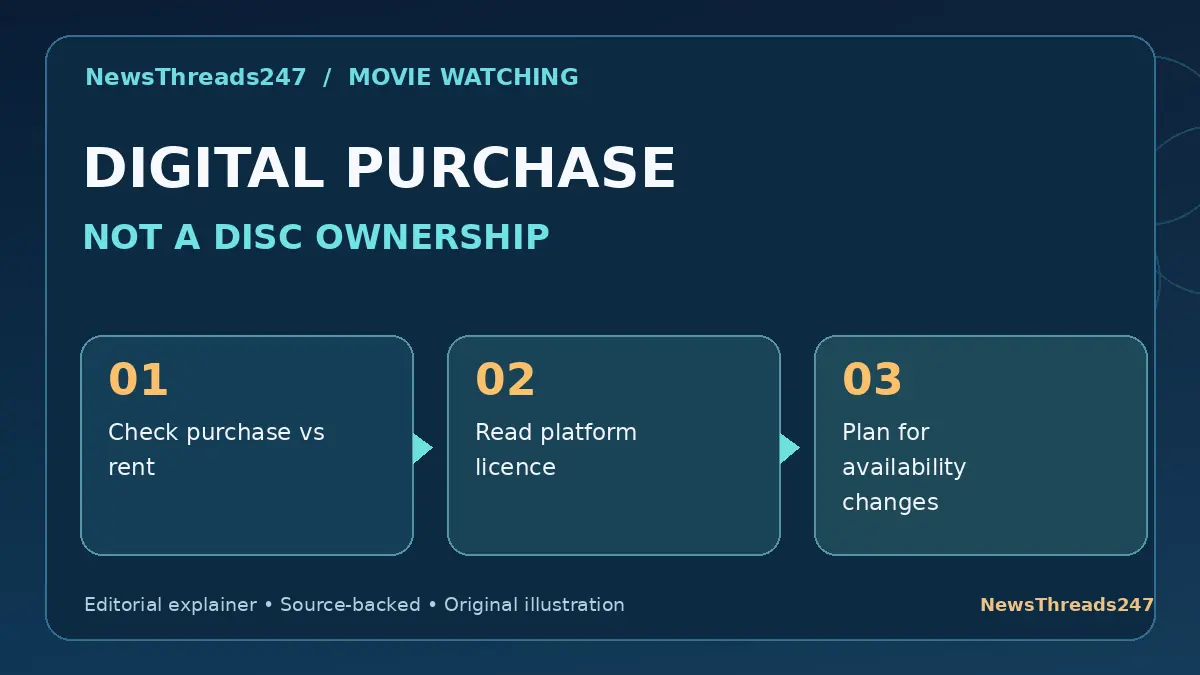
You press ‘Buy’ beside a movie and expect it to join your permanent collection. Then you discover the store’s terms mention licences, access restrictions and possible title removal. That does not make every digital purchase a bad decision, but it does mean you need to know what the purchase actually provides.
This guide compares subscription viewing, rental windows and longer-term digital purchases using platform terms and consumer guidance. It separates a convenient viewing entitlement from unrestricted ownership of the underlying film.
Table of Contents — Expand or Collapse
- The Same Film Can Be Sold Three Different Ways
- Subscription: Access During a Plan, Not a Permanent Library
- Rental: A Specific Viewing Window
- Digital Purchase: What ‘Buy’ Usually Provides
- Offline Download Does Not Always Mean Ownership
- A Worked Comparison: One Film, Three Decisions
- Country, Language and Device Restrictions
- What Happens if the Store or Rights Change?
- A Practical Pre-Purchase Checklist
- Frequently Asked Questions
- Sources and Editorial Disclosure
The Same Film Can Be Sold Three Different Ways
One movie page may display three choices: watch with a subscription, rent for a lower one-time price, or buy a digital copy for a higher price. Those buttons represent different access arrangements, even though the film on the screen looks the same.
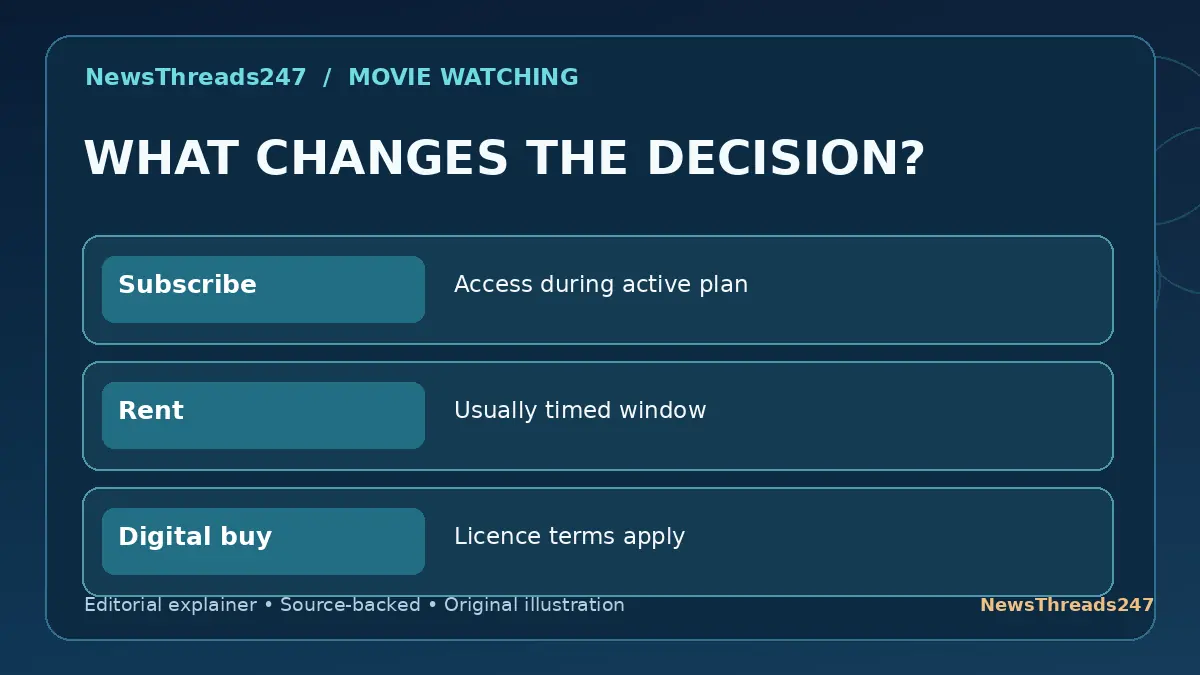
A subscription typically grants access to a changing catalogue while the plan remains active. A rental is limited by a viewing window. A digital purchase generally aims to provide ongoing access through the retailer, but the detailed licence and availability rules still matter.
The U.S. Federal Trade Commission has warned consumers that buying a digital item often gives a licence rather than unrestricted ownership of the underlying movie. That does not mean every purchase is worthless or automatically temporary; it means the exact terms should be understood before spending.
Subscription: Access During a Plan, Not a Permanent Library
When a film is marked ‘included with subscription’, you are paying for access to a service rather than acquiring a continuing entitlement to that particular title. The catalogue can change with territorial contracts, licensing windows and platform decisions.
A film available this month may leave next month. Downloading it for offline viewing is often a way to watch within the subscription’s rules, not an unrestricted copy that remains playable after the account or entitlement expires.
Check whether an offer is part of the base subscription or an additional channel, purchase or rental. Some platforms show all formats in one search result; failing to read the small label can create an unexpected charge even when you already pay for the service.
Rental: A Specific Viewing Window
A digital rental usually permits a film to be watched for a limited period. Many services have one period to begin viewing and another shorter period after playback starts. These periods vary by retailer, territory and title.
Amazon’s published Prime Video usage rules describe rental restrictions and note that terms can vary. Rather than assuming all rentals always last 48 hours or 30 days, read the timer shown on the transaction screen for the exact title.
For a film night with friends, the practical questions are simple: Can the movie be started on the intended date, can playback be completed within the available window, and are all intended devices supported? A low rental price is not useful if the access period expires before the gathering.
Digital Purchase: What ‘Buy’ Usually Provides
A digital purchase normally creates a longer-term viewing entitlement associated with an account and compatible devices. It is different from owning the copyright and can also differ from possessing an independently playable file or physical disc.
Amazon’s terms give customers a limited personal-use licence and say purchased titles will generally remain available, while acknowledging that content-provider restrictions or other circumstances can interrupt later access. Apple’s India support also says purchased content generally remains available but may become unavailable for redownload if rights change.
These disclosures are important precisely because many buyers understandably hear ‘buy’ as meaning permanent, unrestricted control. A digital marketplace can offer meaningful long-term convenience while still conditioning access on software, accounts, territory and licences.
Offline Download Does Not Always Mean Ownership
A download can mean several different things. An app may store encrypted video data for temporary offline playback, with the app still checking entitlement or enforcing time limits. Another service may allow a purchased title to be downloaded to a compatible device for longer-term access.
Apple advises customers who want continued access to purchased content to download it on a compatible device they possess. That is platform-specific guidance; it does not mean every downloadable file from every retailer is freely transferable or playable without the original software.
Ask whether the downloaded video works without a current plan, whether it can be transferred to a replacement device, whether the app needs periodic validation and whether it remains accessible after an account is closed. Avoid violating digital-rights protections while trying to test these limits.
A Worked Comparison: One Film, Three Decisions
Imagine a fictional movie that your family wants to watch once this weekend. It is included in a subscription you already pay for, available to rent for a small fee and sold digitally at a higher price. For a single viewing, the existing subscription may be sufficient, subject to the title remaining in the catalogue until the chosen night.
If the film is not in a current plan, a rental may offer good value. Read its activation and playback window before pressing play. Buying could be reasonable if the family expects repeated viewings, but only after checking what the retailer actually guarantees and which devices can access the purchase.
For someone assembling a personal film collection over many years, the decision changes. The permanence and transferability of access may matter more than the immediate price. Consider legitimate physical media or a service whose terms meet your preservation needs where available.
Country, Language and Device Restrictions
Digital movie rights are frequently territorial. A film’s available language, subtitle tracks, playback quality and purchase options can vary between India, the United States and other countries. A purchase made in one market should not be assumed to work with identical rights after a permanent move abroad.
Streaming resolution can also depend on supported hardware, internet connection, app capabilities and licensing. Paying for a 4K option does not guarantee every television, web browser or travelling device will receive the same resolution.
Check the account’s country or region, supported-device list and language options at the actual purchase page. Avoid workarounds that breach service terms or create account risk, particularly when paying for a large digital library.
What Happens if the Store or Rights Change?
Retailers may continue providing access to many purchased films for years. But rights agreements, store closures, account rules and DRM systems can affect future availability. The FTC’s consumer advice encourages buyers to examine these limits instead of assuming the button labelled ‘Buy’ gives unrestricted ownership.
Movies Anywhere, a United States service, explicitly describes eligible movies as licensed entitlements rather than ownership interests in the underlying content. Its terms do not govern every retailer or Indian market, but illustrate the distinction between a digital entitlement and copyright ownership.
If a purchased movie disappears, preserve the purchase confirmation and check the retailer’s support procedure and applicable consumer protections. Do not assume one universal refund rule across platforms or jurisdictions.
A Practical Pre-Purchase Checklist
Before paying, identify the transaction: subscription access, rental, digital purchase or pay-per-view. Check the price, any taxes, viewing duration, permitted devices, download rights, languages and stated availability limitations.
Consider how often you genuinely expect to watch the title. A cheaper transaction may be best for a one-off viewing, while a purchased entitlement might suit repeated viewing. If the film is important as an enduring family record or collection, investigate the preservation options rather than relying only on an attractive store label.
The same attention to access conditions applies to offline entertainment more generally. Our Netflix downloads and expiry explainer covers the separate problem of titles saved inside an app for travel.
A budget example: compare the total, not the button
Imagine one fictional film is offered at ₹129 to rent, ₹499 to buy digitally, and is also included in a streaming subscription costing ₹199 for a month. These figures are illustrative, not current quotes from any platform. A person watching the film once may spend less on a rental than on a purchase. If they already subscribe to the service for other programmes, watching it inside the existing subscription may add no separate transaction, although access ends when entitlement or catalogue availability ends. A digital purchase may be useful for repeated viewing, but that value depends on the licensing terms and continuing availability.
Two rentals at ₹129 would cost ₹258, still less than the hypothetical ₹499 purchase. But that arithmetic does not settle every case: a rental might have a short start window, a device restriction or an expiry after playback begins. A purchase might allow repeated access or family sharing under certain conditions, but it can still be subject to account and rights limitations. The right comparison is not merely the largest versus smallest advertised price; it is the access you need, how often you will use it, and what happens when the licence or subscription changes.
An offline download may still be tied to an app or account
Suppose a traveler downloads a purchased film to a tablet and then changes phones. It is tempting to assume the video file can simply be copied like a photograph. Many commercial services use digital rights management (DRM) and playback authorization. As the U.S. Federal Trade Commission explains, buying digital media can provide a licence to use content rather than unrestricted possession of a transferable file. The service’s app, account, location and device rules may therefore matter.
Check whether the platform permits downloads at all, whether the chosen device can store them, how long offline playback remains authorized and whether a periodic internet connection is required. A downloaded item can be unavailable after rights change or after a subscription ends. Do not disable DRM or use unverified ‘converter’ apps to work around these restrictions; apart from legal and account concerns, such tools may expose devices to malware. If reliable offline viewing is essential, confirm the precise option before travel rather than on a flight.
Language, family profiles and accessibility affect the value
A film available in one territory may not include the same dub, subtitle track or audio-description option in another. The artwork and title can look identical while the viewing experience differs. Before paying, check the actual title page for languages, closed captions, audio description and supported devices. If someone in the household needs those features, a cheaper rental with missing accessibility support may not be a better deal.
Family sharing, simultaneous playback, casting, child profiles and watching across countries are governed by service-specific rules. A purchased title does not necessarily grant every member of a family unrestricted use on every screen. Confirm the retailer’s current terms for the intended account and region. If a film is for a family outing or a child, its certificate and content suitability are separate from the purchase mode and must be checked independently.
Keep receipts and the exact product listing, including the word ‘rent’ or ‘buy’ and any displayed expiry terms. If access fails, use the retailer’s official support route with the transaction details. Refunds are not automatic merely because a viewer misunderstood a licence; eligibility depends on the applicable terms and consumer protections. These steps create a more useful record than a screenshot of a streaming search result with no price or date.
Frequently Asked Questions
Does buying a digital movie mean owning its copyright? No. Consumer transactions usually provide access rights under licence terms, not transfer of the film’s copyright.
Will a digital purchase always be available forever? Not necessarily. Retailer terms can provide broad ongoing access while acknowledging rights-related or other availability limitations.
Can a subscription download play after cancellation? Usually subscription downloads remain subject to entitlement and playback restrictions. Check that service’s current rules.
Is a rental always 48 hours? No. The timer can vary by platform and title. Confirm the conditions presented at checkout.
Is the same digital film available in every country? No. Availability, audio, subtitle and purchase rights vary with region and licensing.
Sources and Editorial Disclosure
Primary sources: U.S. FTC — Digital Purchases and Ownership; Prime Video Terms of Use; Prime Video Usage Rules; Apple India — Purchasing Films and Other Digital Media; and Movies Anywhere Terms (US).
Editorial disclosure: This article compares the terms publicly provided by the named services as of November 2026. It does not claim that NewsThreads247 tested a purchase, received compensation from a platform or provides jurisdiction-specific legal advice. All illustrations are original explanatory graphics. Review whenever retailers change licence or download terms.