
You return to your car after a few days of parking, turn the key or press the start button, and hear a series of clicks. The dashboard may light up, but the engine does not start. It is tempting to buy a new battery immediately or ask another driver for jumper cables. Yet the most useful first decision is to identify what the car actually does when you attempt to start it.
A weak 12-volt battery is common, but poor cable connections, a failed charging system, starter faults, a key or immobilizer issue and other engine problems can cause different forms of a no-start condition. A successful jump-start may get you moving without establishing why the battery discharged. Replacing the battery without testing can therefore leave the original problem unresolved.
This practical guide is for drivers of conventional petrol and diesel vehicles and for general orientation. Modern hybrids and electric vehicles can have special low-voltage battery locations and manufacturer-specific starting procedures, so their owners must follow the handbook. The article does not replace a technician’s test or roadside assistance.
Start With the Sound Your Car Makes
The first thirty seconds of observation can save an unnecessary purchase. Record whether the dashboard lights are unusually dim, whether you hear a single click or repeated clicks, whether the starter spins the engine at normal speed and whether a warning lamp appeared before you parked. These are not proof of one specific failure, but they help a workshop investigate.
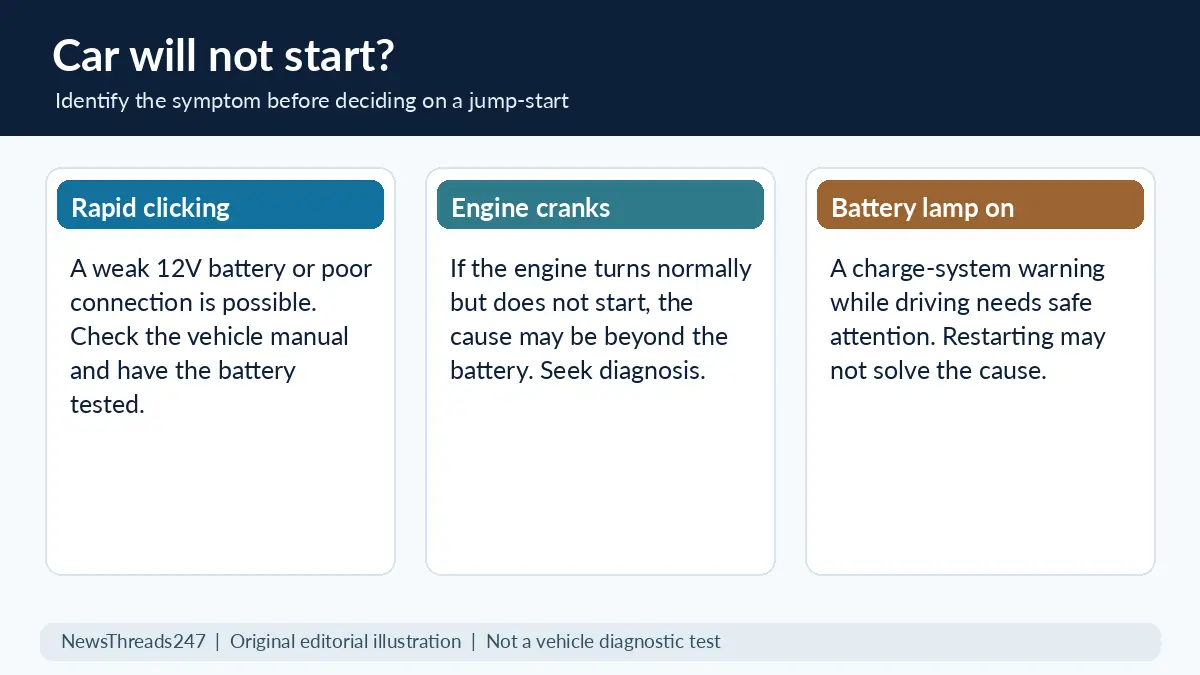
Rapid clicking and slow cranking. The starter requires substantial current, and a weak battery or high resistance at a loose or corroded connection may prevent it from turning the engine properly. Battery age, temperature, recent short drives and an accessory left on are useful history to provide. The same symptom can have other causes, so ask for a test rather than a guess.
Normal cranking without ignition. If the starter turns the engine at its usual speed but the engine never fires, fuel delivery, ignition, immobilizer or other engine-management issues may be involved. Repeated jump-start attempts can waste time and damage equipment. A qualified technician should diagnose it instead.
No response at all. Check the correct gear or selector position, brake or clutch requirements for your model, visible dashboard messages, and the owner’s manual for key-fob battery or immobilizer procedures. Do not bridge terminals or bypass electrical safeguards to force the engine to start.
For cars with automatic start-stop or advanced electronics, dashboard behavior can differ. Use the exact model-specific instructions instead of treating an online diagram as a universal guide. An electronic system that looks inactive may still contain live circuits.
Why a Dead Battery Is Only One Possibility
The 12V battery stores electrical energy used for starting and powering many vehicle circuits. When its charge is low or its ability to deliver current has deteriorated, a car may struggle to crank. But there is a distinction between a battery that is discharged and a battery that has failed internally. The former may recover after proper charging and testing; the latter may need replacement.
An alternator or charging-system problem can prevent the battery from receiving sufficient charge while the engine runs. A vehicle may start after a jump and later stop again if the charging system cannot sustain electrical demand. In an older car, a corroded terminal, worn belt or faulty electrical connection may contribute to symptoms that resemble battery failure.
Modern battery-management systems may require registration or initialization when replacing the battery. Some vehicles have sensors at the negative terminal; others specify a particular AGM, EFB or flooded-battery type. Choosing a physically similar battery without checking specifications can cause long-term faults or poor performance.
AAA advises testing the battery after a jump rather than assuming that restarting means it is healthy. A useful workshop check includes battery condition, cable and terminal condition, and charging-system performance. Ask for a printout or a clear explanation of what failed.
What a Charging-System Warning Means
The dashboard battery symbol is often misunderstood as a direct measurement of battery age. On many conventional vehicles it indicates that the charging system is not working properly while the engine is running. That may involve the alternator, drive belt, wiring or another component.
If the charging warning appears while driving, reduce unnecessary electrical demand when safe and follow the owner’s manual. The car may eventually lose electrical power or stall. Find a safe stopping place and arrange a professional assessment rather than assuming a newly purchased battery will solve the problem.
AAA’s jump-start guidance explicitly cautions that a charging warning that remains on, or an engine that dies again after restarting, can point to a charging fault that repeated jump-starts will not fix. Do not keep attempting to restart a vehicle in a dangerous roadside position.
Before You Try a Jump-Start
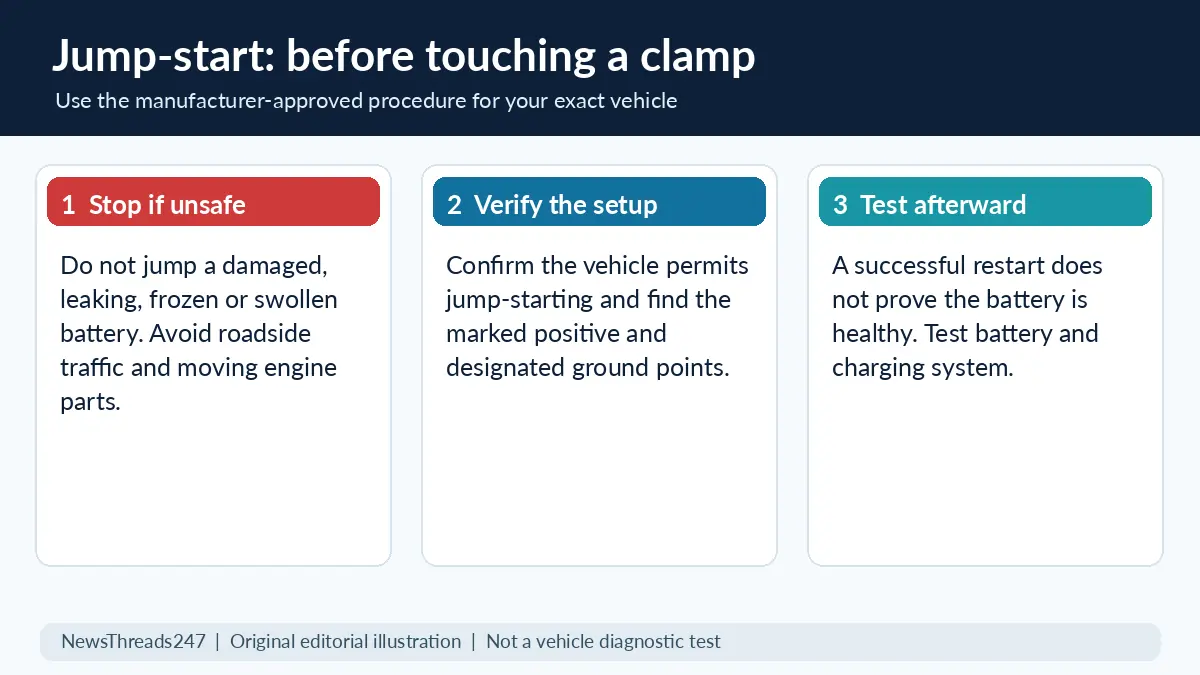
Safety is the first gate, not a footnote. If the car is on a live traffic lane, near moving vehicles, inside an unsafe enclosed space or in an unfamiliar hazardous location, arrange roadside help rather than handling cables. Set the parking brake and follow your local breakdown procedures.
Never attempt to jump a battery that is visibly cracked, swollen, leaking, frozen or giving off signs of damage. Lead-acid batteries can release flammable hydrogen gas, and a spark can cause injury. Keep tools and jewelry from bridging terminals. Consult the battery label and vehicle manual for compatible 12V systems.
Vehicles must not touch when using another car for a jump. Switch off accessories and follow the manufacturer’s approved connection points; some batteries are located under seats or in the luggage area and have separate jump posts. Electric or hybrid vehicles in particular may have special rules for jump-starting and supplying current to other vehicles.
A portable jump pack may be useful when there is no donor car, but the operator must verify its compatibility and follow both manuals. Reverse-polarity protection is a safety feature on some packs, not a reason to ignore instructions. A fully discharged or internally damaged battery may still require service.
How to Decide Whether Jump-Starting Is Appropriate
For conventional compatible vehicles, AAA’s August 2026 guide explains the usual sequence: the positive clamp goes to the designated positive connection of the discharged vehicle, then to the donor’s positive battery connection; a negative clamp goes to the donor’s negative terminal, and the remaining negative clamp goes to an approved unpainted grounding point away from the discharged battery.
That description is not an instruction to override a manufacturer’s specific procedure. Some models use remote jump posts, prohibit conventional connection methods, or advise professional assistance. If the manual differs, follow it. If you cannot identify the correct terminals, stop and ask a qualified person.
Once connected as the manual directs, the donor system or approved jump pack may provide enough current to start the vehicle. Do not lean over batteries, allow loose clamps to touch metal, or let cables get near fan belts. Follow the instructed disconnection order after a successful start.
If a vehicle refuses to start after a limited number of careful attempts, stop. There is no benefit in repeatedly experimenting with clamp positions or increasing engine revs indiscriminately. Call a breakdown service or mechanic who can check the system without risking damage.
What to Do After the Engine Starts
A jump-start answers one narrow question: can the vehicle be started with temporary electrical assistance? It does not tell you why the battery was weak, how much charge it now holds or whether the alternator is working correctly.
AAA recommends having the battery tested as soon as possible after a successful jump. A short drive may add some charge in certain conditions, but it is not a reliable substitute for a diagnostic test or appropriate charging. A deeply discharged battery may need controlled charging away from the road.
If the charging-system warning stays lit, lights dim dramatically or the engine begins to run abnormally, find a safe place and arrange assistance. Avoid a long trip based only on the fact that the starter worked once. Ask the technician for the measured result and the suspected cause, not simply a yes-or-no recommendation to buy a battery.
A professional can check battery health, alternator or charging output, terminal connections, grounds and possible parasitic electrical drains. This is especially valuable if the vehicle has discharged repeatedly after being parked for several days.
If the Engine Still Will Not Start
A vehicle that continues to click after correct assistance may have a severely discharged or damaged battery, high resistance at a connection, a starter fault or another electrical issue. A normal cranking speed with no ignition points toward a different diagnostic branch.
Do not interpret every no-start as a battery problem. The key fob may not be recognized; an automatic car might not detect Park or Neutral; or an engine-control fault may have stored diagnostic codes. A technician can inspect the electronic and mechanical causes instead of repeatedly trying different batteries.
If roadside support is called, describe exactly what happened: the car had been parked for four days, the headlights had been left on, clicking occurred, a jump did or did not work, and whether a warning lamp remains illuminated. These details help prioritize checks.
Battery Testing Versus Replacing It
Battery replacement should follow evidence and compatibility. A workshop load or conductance test can help assess available starting capability; alternator and connection tests are separate. A flat battery may not be permanently ruined, and a relatively new battery may still fail when abused or defective.
The correct replacement depends on the vehicle’s specified battery technology, capacity, cold-cranking requirement, size and terminal arrangement. India and the United States have different battery-market labels and vehicle variants, so generic recommendations based on one model year can be wrong.
Keep the invoice, warranty and test record. If you suspect a recurring discharge, request a parasitic-draw investigation after obvious causes are excluded. Simply replacing a battery every time the car goes flat can conceal a wiring or accessory fault.
Ask the service centre whether the vehicle requires an electronic battery registration step or reset after replacement. This varies by manufacturer and should be done as specified rather than guessed.
What Makes a Battery Go Flat While Parked
A parked vehicle still uses some electricity for security systems, modules and connected features. Ordinary background consumption is expected, but excessive standby current from a fault or aftermarket device can discharge a battery. An ageing battery or long periods without sufficient recharging can also contribute.
The cause might be mundane: an interior light left on, a USB accessory drawing current, repeated short trips, or a terminal with a poor connection. Avoid unplugging random fuses on modern cars in an attempt to diagnose the problem. Doing so can affect safety systems and create new electrical faults.
If your car is parked for extended periods, consult the handbook about a compatible maintenance charger, storage mode or service recommendation. Not every battery or vehicle can be treated with the same external charger. Consider manufacturer instructions for hybrids and EVs separately.
Three Common Situations Explained
Scenario 1 — the car is silent after a week parked. The driver notices weak interior lights and slow cranking, then a jump works. That result is consistent with a low battery, but not proof that replacement is required. The sensible next step is a battery and charging test, followed by checking for continuing discharge if it happens again.
Scenario 2 — the battery warning came on while driving. The car later stalls and will not restart. A jump may briefly help, but the charging system or drive belt could have failed. Arrange service rather than continuing a journey on temporary power.
Scenario 3 — the starter sounds normal, but the engine never fires. Replacing the battery without investigation may be an expensive distraction. A mechanic should check the engine-management and fuel/ignition systems according to the vehicle type.
Preparing for a long trip also means checking basic recovery equipment. Our tyre repair kit pre-trip guide covers a different roadside breakdown risk that is easy to overlook.
Frequently Asked Questions
Can a car battery be dead even if the dashboard lights work?
Yes. Dashboard lights use much less current than the starter. Enough power for accessories does not guarantee the battery can crank the engine. A battery test is more informative.
Will a jump-start fix a bad alternator?
No. It may start the engine temporarily, but a charging fault can leave the battery discharged again or cause the engine to stop. Have the charging system tested.
Should I jump-start an electric or hybrid car?
Only if the vehicle manufacturer explicitly permits the specified low-voltage procedure. High-voltage systems and model-specific jump points require extra care. Never improvise.
Do I need to replace the battery after every jump-start?
Not automatically. The battery could be discharged but otherwise serviceable. AAA recommends testing its health and the charging system to identify the underlying problem.
What if the engine cranks strongly but will not start?
The cause may involve fuel, ignition, immobilizer or engine controls rather than an undercharged battery. Ask a qualified technician to diagnose it.
Sources, Editorial Method and Safety Disclosure
This article uses general automotive safety and troubleshooting guidance. It is not a diagnosis of a particular car. The manufacturer owner’s manual controls battery type, jump terminals, disconnection order, charging-system warnings and any procedure-specific restrictions.
- AAA, August 2026 — How to Jump Start a Car: safety checks, cable procedure and battery testing after a jump.
- AAA — How to Safely Jump-Start a Car: charging warning light and need for diagnosis.
- RAC — How to Jump-Start a Car: safe compatibility checks and the special importance of the vehicle manual.
- Consumer Reports — Jump-Start and Battery Testing: routine battery condition and maintenance.
Image disclosure: The featured mechanic photograph is an original AI-assisted conceptual illustration, not a specific vehicle repair. The two embedded graphics are original NewsThreads247 explainers and are not diagnostic measurements.
Safety disclaimer: Batteries can expose people to acid, high current and explosive gas. Never jump a damaged, frozen or leaking battery. If the location is unsafe, call roadside support. This article cannot replace your specific vehicle’s instructions or a trained professional’s diagnosis.