

A family lights a few diyas for Diwali, places incense near the prayer area and closes the windows to keep out street noise and firework smoke. The room feels festive. What is less obvious is that flames and smouldering incense also release material into the indoor air. Even when the visible smoke fades, that air has not necessarily returned to the condition it was in before the lamps were lit.
There are two real needs here. Families want to observe traditions in the ways that matter to them. They also need a practical way to limit indoor smoke, particularly when children, older relatives or people with breathing difficulties are present. Neither need should be dismissed. The answer is not to describe every diya as a medical crisis or to pretend a pleasant fragrance means air is clean.
The U.S. Environmental Protection Agency (EPA) identifies burning candles as a source of indoor particulate matter and explicitly recommends adequate ventilation if candles or incense are burned indoors. The World Health Organization (WHO) also names incense among indoor pollution sources that complicate the advice to stay inside during episodes of outdoor air pollution. These recommendations point toward source control, appropriate ventilation and realistic exposure reduction, not a magic filter or universal open-window rule.
What Burning Candles and Incense Adds to Indoor Air
Combustion changes a fuel into heat and a mixture of gases and particles. A visible flame does this, and so does a smouldering incense stick. The size, amount and composition of the emissions depend on the fuel, ingredients, combustion conditions and how many items are burning. The EPA explains that indoor particulate matter comes from cooking, candles, other combustion sources and outdoor air entering the building.
Particles are not all the same size. Some are sufficiently small to travel deep into the lungs. The EPA notes that particle exposure can aggravate asthma and affect lung function. This is a general public-health concern; it does not mean every brief exposure causes the same harm to every individual or that the medical effects of a particular household ritual have been measured here.
The important distinction is between smoke that is visible and pollutants that are present. Incense may make the source more noticeable because a ribbon of smoke travels into the room. A small, steadily burning candle may appear cleaner, but lack of a visible plume is not a reliable air-quality test. An electronic candle produces no combustion smoke; a scented spray creates different types of emissions and should not automatically be treated as the same as a flame-free solution.
If a family lights several lamps near a window, another few near the prayer area and incense in a small closed room, the sources add up. That does not permit a precise estimate of pollution without measuring the room. It does support a practical decision: choose fewer sources indoors and avoid leaving smoke to accumulate in occupied enclosed spaces.
Why Diwali Can Create a Difficult Ventilation Choice
Diwali may involve two air-quality pressures at once. Inside the home, diyas, candles, incense and sometimes cooking release particles. Outside, firework smoke and traffic can also worsen particle levels. Opening a window can dilute pollutants generated indoors, but it can also bring polluted outdoor air inside.
This is why a simple instruction such as ‘open every window when lighting incense’ can be unsuitable in some circumstances. The EPA advises keeping windows closed when outdoor particulate pollution is high. WHO similarly warns that remaining indoors does not guarantee protection if indoor sources remain active or outdoor pollution enters through the building.
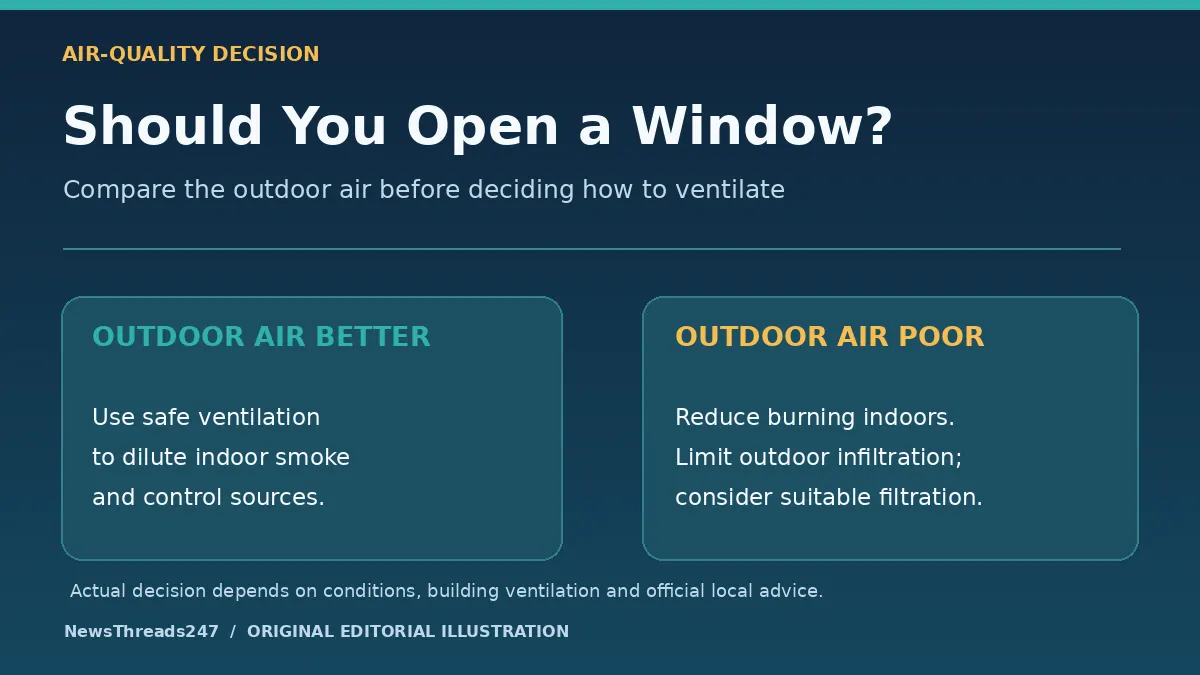
The right decision changes with conditions. On a day when outdoor air is reasonably clean, safe ventilation may help remove indoor pollutants. During a severe outdoor-pollution episode, reducing or eliminating indoor combustion sources becomes particularly important, while limiting outdoor infiltration and considering suitable filtration may be more reasonable.
An air-quality index gives context for outdoor pollution but does not tell you the exact concentration inside a particular room. Building type, window position, fans, air leakage and activities all affect the relationship. Check current local air-quality information, any public-health advisory and what is actually happening in your home instead of using a fixed holiday rule.
Incense, Diyas, Wax Candles and Flameless Alternatives
Each source has a different practical purpose. A diya may have cultural or religious significance and use an oil-fed wick. A wax candle may provide decoration or light. Incense produces fragrance and can be part of worship. None of these should be flattened into one identical product category simply because combustion occurs.
For indoor air, however, the common question is whether something is burning. When it is, particles and other combustion by-products may be released. Changing fragrance or colour is not proof that emissions disappear. Marketing labels such as ‘natural’, ‘herbal’, ‘organic’ or ‘smokeless’ should not be accepted as independently verified health claims without relevant emissions testing.
Battery-operated lamps and electric lights do not burn a combustible wick during use. Where a ritual or decorative choice allows them, they can reduce indoor combustion sources. The U.S. Fire Administration also recommends flameless alternatives for candle fire prevention. That does not mean a battery-operated light is equivalent to every traditional practice; families can choose where a real flame is essential and where electric light is acceptable.
The practical approach is selective rather than accusatory. A family might keep a small, supervised traditional lamp in an appropriate area, use electric lights for general decoration and avoid burning many incense sticks in a closed living room. This respects the occasion while reducing the number and duration of indoor smoke sources.
A Practical Source-Control Plan Before Lighting Anything
Begin with the occupied room. Is the prayer area small or poorly ventilated? Will a child sit near the source for an extended period? Is someone at home sensitive to smoke or fragrance? Are many candles planned even though electric lighting would serve the same visual purpose? These questions identify where small adjustments may matter most.
Choose a stable, non-combustible surface and reduce combustible decoration around real flames. This article focuses on indoor air rather than placement hazards, but fire risk cannot be separated entirely from any advice involving burning materials. The U.S. Fire Administration says candles should be kept at least 12 inches from anything that burns, placed in stable holders and extinguished when a room is left or people go to sleep.
Before lighting incense, decide how much will be used and for how long. A single brief use in a better-ventilated area generally represents a different source scenario from prolonged burning of many sticks in an enclosed space. This is a qualitative source-control point, not a quantified guarantee of safety for either situation.
Keep the occupied breathing space in mind. Do not deliberately direct smoke toward a child, an older relative or someone who reports respiratory discomfort. If a person experiences symptoms, stop the exposure and follow appropriate health advice. Do not persist merely because the scent has a traditional or reassuring association.
Ventilation, Exhaust Fans and Air Cleaners: Different Jobs
Ventilation replaces or exchanges air. When outdoor air is cleaner and conditions allow, opening windows or using appropriate exhaust can help reduce accumulated indoor pollutants. But a fan that merely circulates air inside a sealed room may spread the plume without removing it.
A kitchen hood vented outdoors can remove cooking emissions at their source, but it is not automatically a substitute for ventilation in a distant prayer area. A recirculating kitchen chimney also works differently from an outside-vented hood. Our kitchen ventilation guide explains those mechanical differences in depth.
A suitable portable air cleaner with an effective particle filter can reduce airborne particles within its operating conditions. It does not remove every gas, extinguish a fire or make it safe to produce unlimited smoke indoors. Room size, filter design, fan setting, placement and maintenance affect the results. An ionizer marketed as ‘air purification’ should not automatically be equated with a properly specified particle filter; the EPA warns against ozone-generating air-cleaning devices for occupied spaces.
Source control still comes first. If a household can reasonably use fewer burning items, a shorter burn period or flame-free decorations for part of the display, those choices reduce emissions before filtration or ventilation is asked to handle them. This is usually more straightforward than adding smoke deliberately and expecting a small appliance to erase it.
Should You Open the Windows During Firework Smoke?
It depends on the relative conditions inside and outside. If the local outdoor air is very polluted because of fireworks, opening large windows can increase the amount of outdoor particle pollution entering the room. If the outdoor air is comparatively clean, opening a safe, appropriately placed window can improve air exchange when indoor smoke is present.
During heavy pollution, the EPA recommends reducing sources of indoor particles, keeping windows and doors closed when appropriate, and considering portable air cleaners or improved filters. It is particularly important not to worsen indoor air by burning many candles or incense sticks while trying to avoid outdoor smoke.
A family in a busy urban neighbourhood might compare outdoor conditions in the evening with those later at night. They could choose to complete any necessary short indoor burning before outdoor firework pollution becomes severe, reduce further burning as conditions worsen, and use appropriate filtration if available. That is an illustrative plan, not a statement about actual hour-by-hour air quality in a particular city.
Do not seal off necessary safety ventilation for fuel-burning equipment without professional advice. A home with a gas water heater, fireplace or other combustion appliance may have installation-specific requirements. Air exchange must be considered alongside those systems rather than decided solely by closing every opening.
What About Children and People With Breathing Problems?
The EPA identifies particulate matter as a concern particularly for people with asthma and other sensitivity to particle exposure. Children also have different breathing and activity patterns from adults. That is enough reason to be considerate about where indoor smoke is released, without claiming an exact medical outcome for any one festival evening.
If someone already experiences coughing, wheezing or irritation around smoke or fragrance, do not treat those symptoms as a challenge to overcome for the sake of tradition. Reduce exposure and seek medical advice when appropriate. People with established respiratory conditions should follow their own clinician’s guidance, including any treatment or action plan.
Some families have practical choices about which area to use. If a traditional flame is part of a ceremony, it may be possible to conduct the ritual in a more appropriately ventilated space and allow sensitive people to remain away from the plume. But outdoor placement can introduce wind and fire-safety hazards, so location must be assessed, not assumed safe.
A portable air cleaner may help with particles but is not a medical device that guarantees prevention of asthma symptoms. Strong perfume is not a reliable replacement for the smell of combustion, and masking smoke with additional fragrance can introduce other irritants. The best approach is to ask what can be reduced at the source.
Fire Safety Still Matters Alongside Air Quality
A low-smoke or well-ventilated setup can still be a fire hazard if a candle sits near curtains, paper decorations, bedding or loose fabric. Conversely, a carefully secured lamp may still add particles to indoor air. These are related but separate risks that require different precautions.
The U.S. Fire Administration recommends stable holders, at least 12 inches of clearance from combustible items and extinguishing candles before leaving a room or going to sleep. Keep children and pets from knocking into open flames and do not leave a burning wick unattended on balconies or near doorways.
For a more detailed placement audit focused specifically on real diyas, entrances and puja areas, see our Diwali diya fire-safety guide. This article deliberately concentrates on the less visible issue: smoke and indoor-air exposure.
Electric lights remove the open-flame and combustion issue during use, but they still need safe electrical installation and appropriate product selection. Do not overload outlets, damage cables or use non-weatherproof decorative lights outdoors. Solving one risk should not mean overlooking another.
Three Realistic Household Scenarios
Scenario 1: Small apartment, closed windows, many incense sticks. The family notices a lingering haze and strong scent. The most direct improvement is to reduce the number and duration of burning sources, keep people away from the plume, and ventilate safely when outdoor air permits. A fragrance diffuser is not automatically a scientifically verified clean-air alternative.
Scenario 2: Home with a toddler and a relative with asthma. The family wants a traditional puja but has practical reasons to limit smoke exposure. A supervised small flame in a suitable area, fewer incense sources and flame-free decorative lights elsewhere may reduce unnecessary indoor burning. Anyone with symptoms should follow their medical action plan and consider avoiding the smoky room.
Scenario 3: A city experiencing heavy outdoor firework smoke. The family closes road-facing windows and chooses not to burn additional incense indoors. An appropriate air filter may help manage particles. When outdoor conditions improve, safe ventilation can be reconsidered. The key is not an arbitrary rule about windows: it is reducing total exposure from both indoor and outdoor sources.
The scenarios are editorial illustrations, not measurements from actual homes. They show why the same recommendation does not fit every family, building or evening.
A Short Decision Framework for Any Festival Evening
Before lighting: identify the cultural purpose and choose the smallest practical number of burning sources. Ask whether a flame-free decoration can serve part of the display. Keep flames away from combustible materials and people who are sensitive to smoke.
During the ceremony: supervise every flame, avoid letting smoke concentrate in one occupied corner, and use safe ventilation only when outdoor conditions and the building’s needs allow. Do not assume a strong scent is a measure of freshness.
Afterward: extinguish and verify that wicks and embers are out. If outdoor air is clean enough, appropriate ventilation may help remove lingering emissions. If outdoor pollution is high, reduce further indoor sources and consider suitable filtration. Clean any soot safely according to the surface and equipment instructions rather than dispersing it into the room.
This is a framework to support sensible decisions, not a demand to change every family’s religious practices in the same way. The choice should respect tradition, health needs and the actual conditions of the home.
Frequently Asked Questions
Does incense cause indoor air pollution?
Burning incense is an indoor combustion source. WHO identifies incense burning among indoor pollution sources, and the EPA recommends adequate ventilation when burning incense indoors. Exposure depends on the amount burned and the conditions.
Are candles safer for indoor air than incense?
There is no universal answer covering all candles and incense products. Both can produce combustion emissions, and product formulation, burn conditions and duration matter. Avoid declaring any untested item emission-free.
Should all windows be opened during Diwali?
Not automatically. When outdoor air is heavily polluted, opening windows can introduce more particles. Consider outdoor conditions, indoor sources, building requirements and local health advisories.
Can an air purifier remove diya or incense smoke?
A suitable particle filter can reduce some airborne particles. It cannot eliminate every gas, prevent fire or compensate for unlimited smoke production. Reducing sources remains important.
Are battery-operated candles a useful alternative?
They provide light without an active flame during normal use and are recommended by the U.S. Fire Administration as a fire-safety alternative. Families can decide where such lighting is appropriate while using traditional lamps selectively.
What if someone coughs or wheezes around incense?
Reduce their exposure and follow relevant medical guidance. People with known respiratory conditions should follow individualized care instructions; this editorial is not a diagnosis or treatment guide.
Sources, Method and Editorial Disclosure
U.S. EPA — Sources of Indoor Particulate Matter provides the key indoor particle sources, source-control recommendations, ventilation cautions and advice about candles and incense. WHO — Air Pollution: Personal Interventions and Risk Communication explains how incense, cooking and outdoor infiltration complicate decisions about remaining indoors during polluted periods. U.S. Fire Administration — Candle Fire Safety provides clear flame-placement, supervision and flameless-alternative guidance. U.S. EPA — Wildfires and Indoor Air Quality provides additional background on reducing indoor particle sources when outside air is polluted.
Research scope: This is an editorial synthesis of public agency guidance, not an indoor-air monitoring study, a test of incense brands or an estimate of the medical risk from one particular family ceremony. No actual household particulate measurements were collected. References to WHO’s broad household air pollution estimates should not be mistaken for mortality estimates attributable specifically to candles or incense.
Image disclosure: The featured illustration and two in-article diagrams are original NewsThreads247 conceptual graphics, not photographs of a measured home. Their labels are educational, not instrument readings.
Health and safety disclosure: This information is educational and not medical, firefighting or building-engineering advice. Anyone with respiratory symptoms should seek individualized clinical guidance, and households should follow local fire rules and applicable instructions for fuel-burning appliances.