
Gold shoppers searching for rates on Sunday, 8 November 2026, will encounter several different numbers. Retail listings may show 24K gold above Rs 14,300 per gram, a jeweller may quote a different price for a particular city, and the India Bullion and Jewellers Association (IBJA) may show an older official benchmark. These numbers are not necessarily errors: they describe different markets, timestamps or price components.
There is an essential date issue today. Sunday, 8 November, has no newly published IBJA opening or closing benchmark. IBJA says it does not issue its normal rates on Saturdays and Sundays, and its latest displayed prior trading-session close is Friday, 6 November 2026. This report therefore identifies that close explicitly rather than labeling it a new Sunday rate.
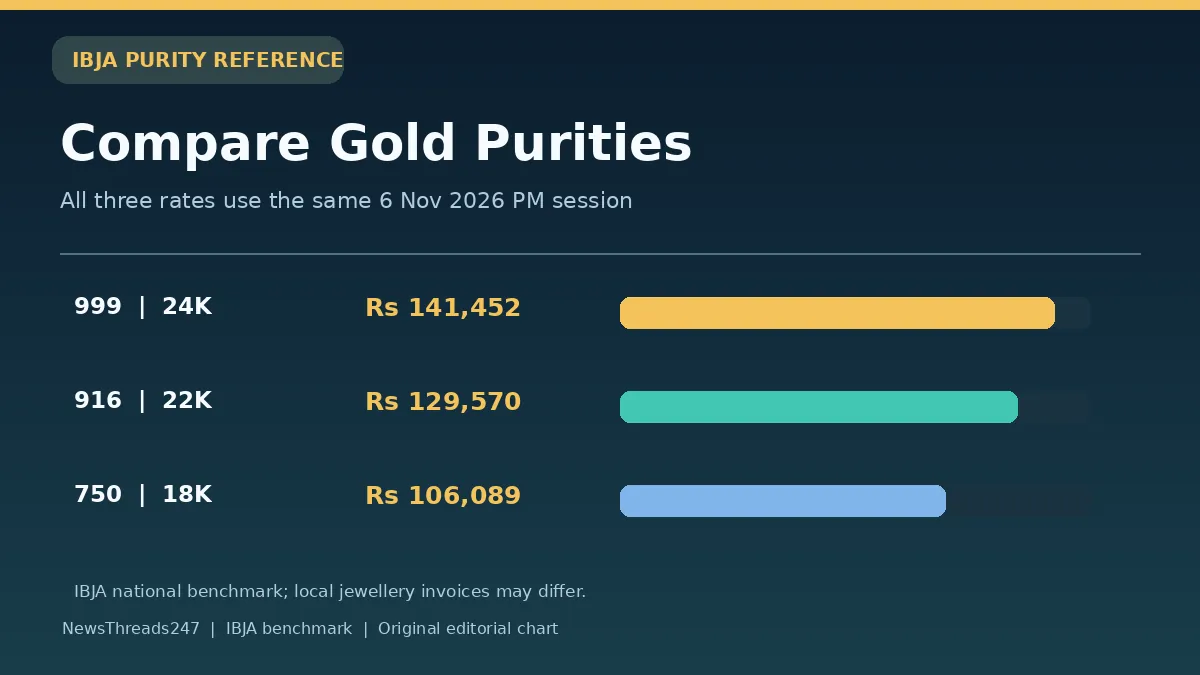
IBJA’s 6 November PM benchmark was Rs 1,41,452 per 10 grams for 999 purity (approximately 24K), Rs 1,29,570 for 916 purity (22K) and Rs 1,06,089 for 750 purity (18K). The figures exclude GST, making charges and the retail premium a shop may quote. Readers can use them as dated reference points while asking their jeweller for today’s actual written quotation.
Gold Rate Today: Latest Available IBJA Benchmarks
| Purity | IBJA PM per 10g | Exact per 1g | Source date |
|---|---|---|---|
| 999 (24K) | Rs 1,41,452 | Rs 14,145.20 | 6 Nov 2026 |
| 916 (22K) | Rs 1,29,570 | Rs 12,957.00 | 6 Nov 2026 |
| 750 (18K) | Rs 1,06,089 | Rs 10,608.90 | 6 Nov 2026 |
Each purity and weight uses the same 6 November 2026 closing session. Dividing the benchmark per 10 grams by ten gives a mathematical per-gram equivalent. That is not necessarily the amount a jeweller will charge for one gram or for a finished ornament.
IBJA’s 999, 916 and 750 labels describe the gold’s specified fineness. In ordinary jewellery language they correspond approximately to 24K, 22K and 18K. Fineness affects the amount of pure gold in the metal, but it is not the only item in a retail invoice.
The source’s holiday notation is important. Because no new IBJA price was released on Sunday, these rates are not a fresh trading signal. They should not be compared to an independently updated retail app as though both came from the same time and pricing methodology.
Why No New IBJA Rate Was Published on Sunday
India’s bullion reference prices are not posted on the same schedule as every commercial jewellery website. IBJA publishes opening and closing benchmarks on eligible business days and identifies weekends and holidays separately. Its own terms say that normal rates are not issued on Saturdays or Sundays.
Retail jewellers may still operate on a Sunday, especially during the festival season. A shop can offer a current consumer price based on its stock, local premiums, internal pricing policies and taxes. That does not mean IBJA has published another official AM or PM benchmark.
The truthful wording for this report is therefore ‘latest available IBJA close: 6 November’ rather than ‘IBJA live rate on 8 November’. The same distinction will matter on public holidays in future weeks.
When a site provides a Sunday number, check whether it means a carry-forward retail quote, an indicative average from commercial sources, an international spot conversion or a distinct local trade price. Without those labels, even a mathematically accurate number can mislead.
Did Gold Rise or Fall Against the Previous IBJA Close?
Compared with the IBJA PM close on Thursday, 5 November, Friday’s last recorded rate was lower across the three purities. The 999 benchmark fell from Rs 1,44,129 to Rs 1,41,452 per 10 grams, a decrease of Rs 2,677.
The 916 benchmark moved from Rs 1,32,022 to Rs 1,29,570, down Rs 2,452. The 750 benchmark moved from Rs 1,08,097 to Rs 1,06,089, down Rs 2,008. All are comparisons of consecutive published closing sessions, not Friday versus a new Sunday price.
These changes are useful historical information, but the fall does not automatically establish a lower invoice for every jewellery buyer. Retail quotes include items outside the IBJA base benchmark, and city demand or local premiums may move differently.
A person planning to purchase jewellery should compare the shop’s stated gold value, weight, purity, making charges, wastage or other stated fees, applicable tax and return terms rather than treat the headline change as the exact saving on the final bill.
Daily Gold Comparison: 3 to 6 November
| IBJA PM session | 999 (24K) | 916 (22K) | 750 (18K) |
|---|---|---|---|
| 3 Nov 2026 | Rs 1,37,576 | Rs 1,26,020 | Rs 1,03,182 |
| 4 Nov 2026 | Rs 1,41,622 | Rs 1,29,726 | Rs 1,06,217 |
| 5 Nov 2026 | Rs 1,44,129 | Rs 1,32,022 | Rs 1,08,097 |
| 6 Nov 2026 | Rs 1,41,452 | Rs 1,29,570 | Rs 1,06,089 |
The daily sequence shows why a single positive or negative news headline rarely captures the whole week’s movement. IBJA’s 999 PM close was Rs 1,37,576 on 3 November, rose to Rs 1,41,622 on 4 November, reached Rs 1,44,129 on 5 November and declined to Rs 1,41,452 on 6 November.
The 916 and 750 benchmarks followed the same broad pattern over those four dates. The table reports the PM series only; mixing an AM opening from one day with a PM closing from another can create an apparent jump that is partly a consequence of selecting inconsistent observations.
The graph modes below use dated observations, do not fill weekends with fabricated market prices and make clear when a comparison selects endpoints rather than a full calendar-period average.
Daily, Monthly and Yearly Gold Price Charts
Select a comparison period:
Daily — 3 to 6 November

Monthly — 30 October to 6 November

Yearly — November 2025 versus 2026
Charts show selected published sessions; weekends are not assumed to have a new IBJA price.
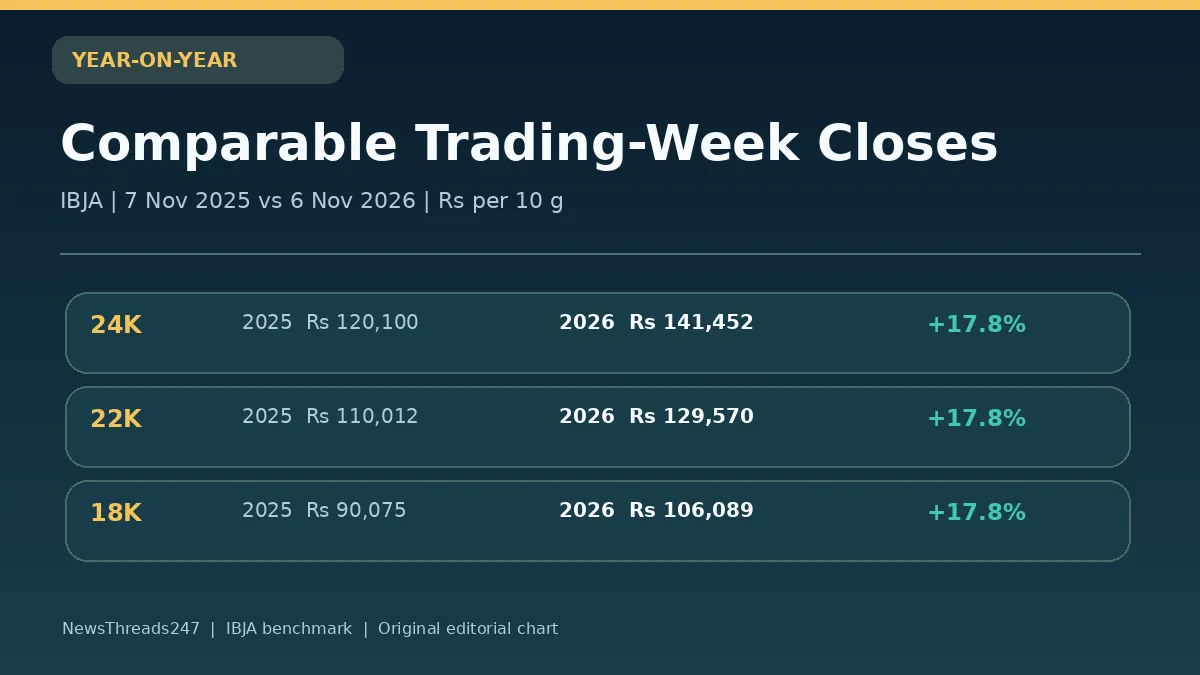
The daily chart covers four published November trading-session closes. The month comparison uses the last October session on 30 October and the latest available November session on 6 November; it is a comparison between two points, not a claim about October’s entire average. The annual comparison uses late-week PM closes on 7 November 2025 and 6 November 2026.
Charts are best read alongside the dates and the underlying values. A difference between two endpoints is a change over the interval, not necessarily a steady upward or downward trend on every day between them.
Month Comparison: 30 October Versus 6 November
The IBJA-sourced 30 October PM record shows 999 purity at Rs 1,40,054, 916 purity at Rs 1,28,289 and 750 purity at Rs 1,05,041 per 10 grams. By the 6 November closing session those figures had moved to Rs 1,41,452, Rs 1,29,570 and Rs 1,06,089.
That is an increase of Rs 1,398 for 24K, Rs 1,281 for 22K and Rs 1,048 for 18K over the selected endpoints. The relationship is not inconsistent with the fall from 5 November to 6 November: a price can fall on the final observed day and still be above the level recorded a week earlier.
The October values are drawn from a dated archive reproducing IBJA session data, while the November close is displayed directly by IBJA. Readers who need to assess a longer period should inspect additional sessions rather than draw broad conclusions from two dates.
Year Comparison: November 2025 Versus November 2026
IBJA’s archived 7 November 2025 closing sheet provides a comparable near-November reference: Rs 1,20,100 per 10 grams for 999, Rs 1,10,012 for 916 and Rs 90,075 for 750. The 6 November 2026 PM benchmarks are Rs 1,41,452, Rs 1,29,570 and Rs 1,06,089 respectively.
The selected comparison therefore shows an increase of Rs 21,352, Rs 19,558 and Rs 16,014 per 10 grams across 999, 916 and 750. Each is approximately 17.8 per cent above the earlier selected close. This is a nominal rupee-price comparison, not an inflation-adjusted investment return and not a prediction of future rates.
The dates are not identical calendar days, because weekends and market sessions differ. They are explicitly the last cited early-November benchmark sessions in the source records. A reader wanting a same-date annual return should use an appropriate consistent trading-day convention and verify any corporate or market adjustments that affect the comparison.
It would be misleading to describe this percentage as a return a jewellery buyer definitely earned. Jewellery purchase costs, resale deductions, making charges, taxes and the method of sale can materially change realized proceeds.
How Today’s Retail City Quotes Differ
A national IBJA benchmark is a reference price, not one compulsory retail selling price across every city. Retail websites may report city-level 24K, 22K and 18K averages and jewellers can quote different amounts. The values below are distinct from the IBJA table; they are indicative consumer listings from a commercial market tracker dated 8 November.
| City / tracker | 24K / 1g | 22K / 1g | 18K / 1g |
|---|---|---|---|
| Delhi | Rs 14,360 | Rs 13,175 | Rs 10,783 |
| Mumbai | Rs 14,357 | Rs 13,160 | Rs 10,768 |
| Kolkata | Rs 14,357 | Rs 13,160 | Rs 10,768 |
| Chennai | Rs 14,357 | Rs 13,160 | Rs 10,768 |
These indicative prices do not include all the charges that will appear on a final bill. They should not be combined into an arithmetic average with the IBJA wholesale-style benchmark. Instead, use them to understand why a shop in Delhi may quote differently from an indicative listing for Mumbai.
City pages update independently. A quote obtained from an actual shop can differ from an online table on the same date. Check that both quotes refer to the same purity, weight, time, tax treatment and charges before deciding one is ‘cheaper’.
A Jewellery Invoice Example Without Hidden Arithmetic
Suppose a customer asks about an 8-gram 22K ornament. Using only the 6 November IBJA PM benchmark for demonstration, the base metal reference would be 8 × Rs 12,957 = Rs 1,03,656. That is not the selling price of the finished ornament.
The jeweller may add a retail premium, making charges and taxes according to the applicable rules and invoice. Stone settings, gross weight versus net gold weight, wastage or design costs may also matter. The correct comparison is a transparent itemized written quote, not the headline 22K benchmark multiplied by weight alone.
For an actual purchase, ask for the BIS hallmark details, HUID verification where applicable, net gold weight, making charge basis, applicable taxes, buyback conditions and a proper invoice. Our gold jewellery hallmark and invoice checklist addresses those checks separately.
The figure shown here is an illustrative calculation using a publicly reported benchmark. It should not be interpreted as an offer to buy or sell metal at that price.
What Can Move Gold Prices Between Trading Sessions?
Domestic gold rates can respond to movements in international bullion prices and the rupee, as well as import costs, trading conditions and local retail demand. Different outlets can update their prices at different times even when they are referencing the same wider market.
A weekend can make the gap between a dated institutional reference and a shop’s indicative Sunday quote more visible. That gap does not necessarily imply an error or misconduct. It emphasizes why sources, dates, weights and tax treatment must be printed next to every figure.
Gold is not guaranteed to rise in the short term. Buyers should not use one week’s sequence to decide that the next session must reverse direction. The evidence here documents past observations only.
Frequently Asked Questions
What is India’s gold rate on Sunday, 8 November 2026?
The latest available IBJA PM benchmark is from 6 November: Rs 1,41,452 per 10g for 999, Rs 1,29,570 for 916 and Rs 1,06,089 for 750, excluding GST and making charges. There is no new IBJA Sunday benchmark.
Is IBJA’s 24K rate the same as a jeweller’s selling rate?
No. IBJA is a dated national reference benchmark. Retail rates can reflect local premiums, making charges, taxes and other invoice terms.
Why do online gold sites show different prices today?
They may use different retail sources, times, city assumptions, purities and tax treatments. Compare figures only when those attributes match.
How much did 24K gold change from 5 to 6 November?
IBJA’s 999 PM close fell by Rs 2,677 per 10 grams, from Rs 1,44,129 to Rs 1,41,452. This is not a fresh change recorded on Sunday.
Has gold increased compared with November 2025?
The selected IBJA PM close on 6 November 2026 was about 17.8 per cent higher than the recorded 7 November 2025 close for the purities compared. Dates and benchmarks are explicitly labeled.
Sources and Price Data Disclosure
India Bullion and Jewellers Association — Official Rates supplies the 2026 PM benchmark series and explains that normal weekend rates are not released. IBJA’s official 7 November 2025 archive PDF supplies the year comparison. Dated IBJA-sourced 30 October 2026 historical archive supports the selected month endpoint. Goodreturns India gold rates provides separately labelled indicative city consumer listings.
Editorial transparency: This report is published on 8 November 2026, but IBJA did not release an AM or PM benchmark today. The latest official reference used here is the 6 November PM session. No fresh Sunday institutional rate has been manufactured. All units in IBJA tables are per 10 grams and exclude GST and making charges. City retail listings follow a different methodology and are labelled separately.
Charts and images: The feature graphic and five chart/purity graphics are original NewsThreads247 visuals based on the cited data. They do not depict live commodity exchange feeds or independently audited jewellery transactions.
Financial disclaimer: The report is for information and comparison, not trading, investment or purchase advice. Actual buying and selling prices differ; confirm with your jeweller and check all charges, purity and invoice details.