
A cooker can produce a fragrant meal and a surprising amount of indoor air pollution at the same time. You may notice steam or the smell of frying, but some of the particles created by cooking are too small to see. Opening a window, switching on a chimney and running an air purifier are all commonly suggested responses. They do not, however, do the same job.
The most useful question is not which appliance looks more powerful. It is where the cooking air goes. Does a fan capture fumes at the stove and send them outdoors? Does a filter return treated air to the room? Or does a wall exhaust fan pull mixed room air towards a window? Each arrangement has strengths, limits and practical costs.
The U.S. Environmental Protection Agency (EPA) recommends using a stove range hood that vents outdoors where possible, including while cooking and for another 10–20 minutes afterwards. It also advises using back burners when practical and reducing charring. Those are actionable steps even in a modest kitchen, although the best arrangement still depends on the layout, appliances and outdoor air quality.
Why Cooking Changes Indoor Air
Indoor cooking emissions arise from two broad sources. The food, oil and heat can release fine particles, especially during high-temperature frying, grilling and charring. A fuel-burning stove can add combustion products of its own. The amounts vary according to the stove, food, fuel, ventilation and cooking technique; one kitchen does not have the same exposure as another.
A kitchen that smells strongly of frying is giving a useful clue that cooking material has entered the air. But lack of visible smoke does not prove the room is free of particles or gases. The EPA identifies cooking as a source of indoor particulate matter and recommends controlling sources as well as providing ventilation or filtration.
Think of an everyday scenario: dal is simmering on one burner while vegetables are being fried on another. The pan releasing the most smoke is on the front edge of the stove. A hood above the rear of the cooktop may capture less of that plume than it would if the same pan were placed on a back burner. Moving the pan where safe, lowering unnecessary heat and running an appropriate hood are separate decisions that can work together.
Odours also need interpretation. Smell can indicate some compounds but is not a reliable instrument for measuring exposure. A kitchen may feel better after a scent disappears while combustion gases or particles are still present. Good ventilation decisions therefore rely on how air is removed and on equipment maintenance, not only on whether the room smells fresh.
The Difference Between Ducted and Recirculating Hoods
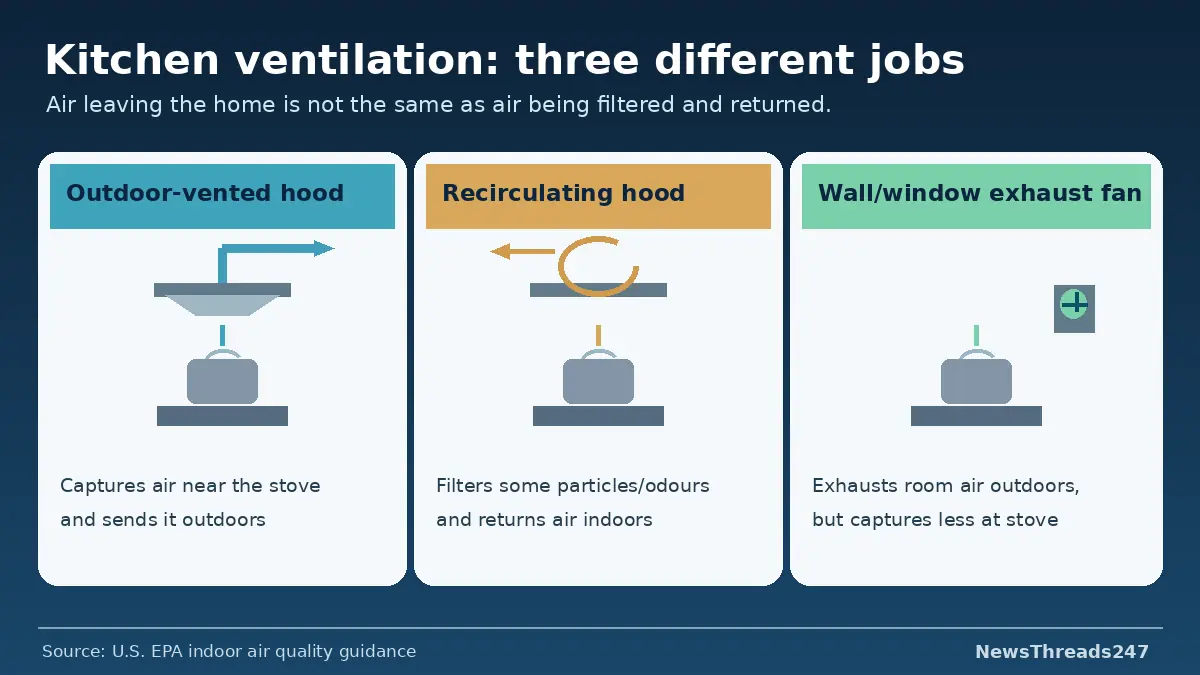
An outdoor-vented or ducted hood uses a fan to pull air from the cooking area and exhaust it outside through a duct. Properly designed and installed, this can remove cooking particles and other pollutants before they spread throughout the home. The duct must actually lead outdoors; a cabinet opening or concealed recirculation path is not equivalent.
A recirculating or ductless hood draws air through filters and returns it indoors. Grease filters can catch some airborne grease, and certain models include carbon media to reduce some odours. Filtration effectiveness varies by design and maintenance. Because the air returns to the room, this is not the same as outdoor exhaust, and it cannot be assumed to remove all cooking pollutants or moisture.
Check the hood you already own rather than relying on the marketing word ‘chimney’. Look for an external outlet and duct path, a manufacturer’s installation guide and the filter type. If there is no route outdoors and the unit blows air back into the kitchen, it is behaving as a recirculating system even if its exterior resembles a ducted chimney.
A dirty grease filter is not a sign the system has permanently failed. It may require cleaning or replacement according to the manufacturer’s instructions. Conversely, buying a more expensive hood does not compensate for an obstructed outlet, unsuitable installation or a fan that is left off because it is too noisy to tolerate.
Where a Wall Exhaust Fan or Air Purifier Fits
A wall or window exhaust fan removes air from the general room, usually without the source capture provided by a hood positioned directly over the burners. That can still be valuable when a range hood is unavailable. Its effectiveness depends on where the fan sits, what path fresh replacement air takes and whether cooking emissions travel through living areas before reaching the fan.
For the separate buying decision about filter capacity and room size, see our guide to air-purifier CADR, room size and replacement-filter costs. A portable air cleaner is another tool, not an identical substitute. A filter sized for the space can help reduce airborne particles. It does not replace direct ventilation for pollutants associated with fuel combustion, and it cannot solve a faulty or unsafe gas appliance. Avoid devices that deliberately produce ozone, which the EPA does not recommend for occupied spaces.
A ceiling fan can improve comfort, but moving air around a room is not the same as exhausting contaminated air outdoors. Strong cross-drafts can sometimes carry a cooking plume past the hood rather than into it. If your existing arrangement is confusing, watch the airflow around the hood with the manufacturer’s recommended method or ask a qualified installer to assess it—do not use an unsafe smoke or flame test.
These distinctions also explain why an air purifier buying guide answers a different question from this article. A purifier’s clean air delivery rate tells you something about filtered particles; a range hood’s job is to capture the cooking plume close to the source and remove it.
A Practical Before, During and After Cooking Routine
A useful routine begins before the kitchen looks smoky. First, clear obstructions from the exhaust path, check that the grease filter is in serviceable condition and turn on the outdoor-vented hood. The EPA recommends using the hood whenever cooking, not merely when smoke becomes visible.
During cooking, choose back burners where practical and safe. Reduce unnecessary high-heat charring; keep an eye on heating oil and clean burnt food residue from appliances. If a recipe requires high heat, ventilation becomes more important, not less. Never leave a hot pan unattended in the hope that the fan will manage a developing problem.
After switching off the stove, keep the outdoor-vented hood running for approximately 10–20 minutes, as recommended in the EPA’s cooking guidance. This helps remove lingering cooking emissions. There is no need to invent a universal fan-speed setting, because hood design and kitchen volume vary.
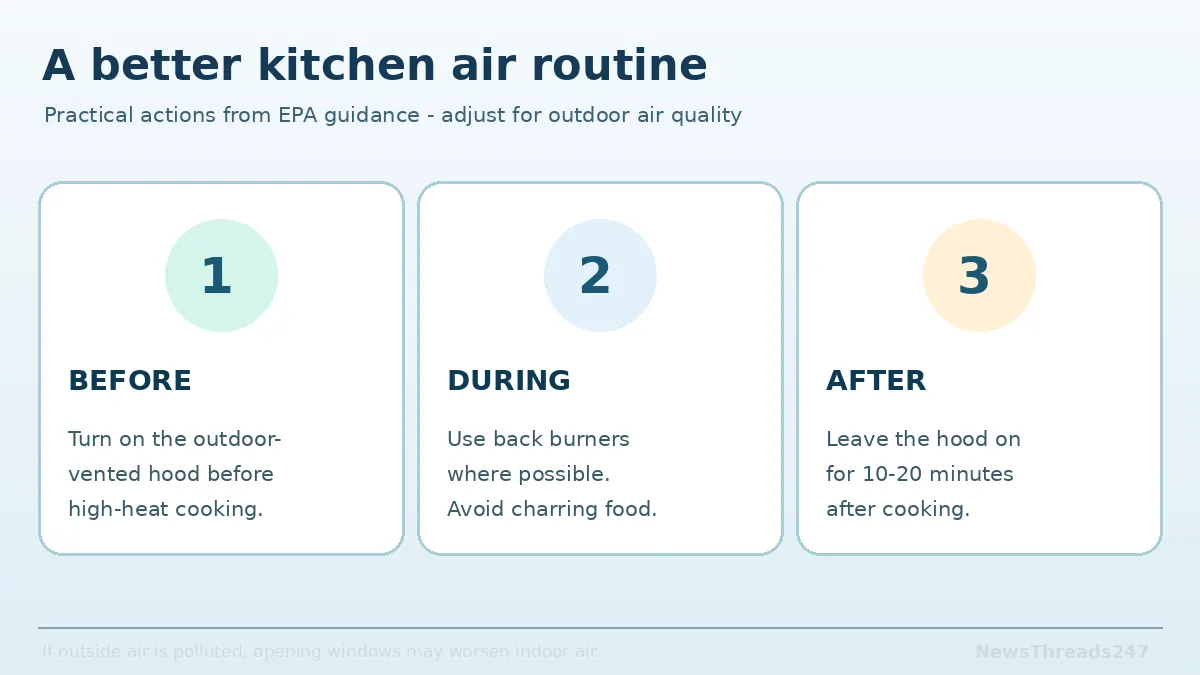
For example, someone preparing dinner in a small apartment could switch on the hood before heating a pan, place the more smoke-producing dish on a rear burner if practical, avoid unnecessarily burning spices, and leave the fan on while plating the meal. The routine takes less new equipment than replacing an entire kitchen.
Cleaning needs a routine of its own. A grease-laden filter or obstructed fan should be serviced according to instructions. Regular attention may also reduce accumulated grime around the cooker. Never dismantle electrical or gas components beyond the tasks the manufacturer explicitly permits for ordinary users.
What to Do in a Rented Flat With No Outside Duct
Many households, especially rented flats, cannot install a new exterior duct. A wall may be shared, an external modification may need permission, or the route may be too complicated to do safely. In those cases, start with the room’s actual layout rather than buying a hood before verifying installation conditions.
If an outdoor-vented hood is not available, the EPA advises using a wall or ceiling exhaust fan where possible and opening windows or doors when outdoor air quality and weather allow. The important qualification is that outdoor air is not always cleaner: on a heavily polluted day, opening a window can bring in substantial additional particles.
A sensible sequence is to reduce cooking emissions at the source, use safe existing exhaust, and consider supplemental filtration suitable for the room. Do not block existing ventilation grilles, install a fan with unsafe wiring, cut structural walls without permission, or route cooking exhaust into an enclosed roof or another room.
For an apartment resident, a landlord or housing association may need to approve external venting. Ask an installer how the exhaust will exit, what maintenance access is available and whether the unit is compatible with other fuel-burning equipment in the home. A photograph of the kitchen and the building’s ventilation instructions often makes that discussion more useful.
Gas Cooking, Outdoor Pollution and Backdrafting Risks
Gas cooking adds considerations beyond visible food smoke. Combustion appliances can produce nitrogen dioxide and carbon monoxide under certain conditions, especially if poorly installed, adjusted or ventilated. A recirculating filter should not be treated as protection against every combustion gas.
There is also a less familiar risk with powerful exhaust systems. If a large volume of air is removed without an adequate replacement air supply, a naturally vented water heater or other combustion appliance can sometimes backdraft, drawing combustion products into the home rather than safely outdoors. The EPA cautions that some high-airflow hoods may require professional assessment of this issue.
That does not mean residents should avoid ventilation; it means complex installations need competent design. If the home has a gas water heater, furnace or other fuel-burning unit, consult a qualified professional before installing an unusually powerful exhaust system. Follow local gas and building rules. If there is a suspected gas leak, stop the activity and follow the emergency instructions of the local gas supplier rather than operating electrical switches. Our India LPG-smell safety explainer covers that separate urgent situation.
Outdoor air has its own hazards. During intense outdoor pollution, wildfire smoke, dust events or heavy traffic exposure, routinely throwing open windows is not always the best choice. The EPA advises considering outdoor air conditions before using window ventilation. In India, consult trustworthy local air-quality information and the building’s ventilation provisions.
How to Compare Ventilation Without Buying the Wrong Product
Ventilation appliances are often marketed by one prominent number: airflow, motor power, filter layers or decibels. No single figure tells you the whole story. Check the duct route first, then the fit over the cooking area, usable fan settings, noise, installation and cleaning requirements.
A hood that captures the plume effectively on a setting people will actually use may be more valuable than a loud model that remains switched off. Ask whether replacement filters are available, whether grease filters can be washed, whether the quoted airflow applies to the installed duct arrangement, and how the outlet is protected from external obstruction.
Do not compare a ducted hood’s advertised airflow with an air purifier’s clean-air delivery rate as if they describe the same job. One moves air out of the building, while the other processes air within the room. Likewise, ‘odor removal’ is not a verified claim that all hazardous gases are gone.
When deciding on a purchase, get installation requirements and annual maintenance estimates in writing. For a rental, confirm who is permitted to alter external walls or ducts. For a household using gas and other fuel-burning appliances, make safety and replacement-air needs part of the installation conversation, rather than an afterthought.
Three Realistic Kitchen Scenarios
Scenario A — frequent frying in a small kitchen: The household has an external ducted hood but rarely uses it because of noise. A practical improvement may be to check the filters and duct, choose a comfortable effective setting, use back burners when appropriate and run the hood throughout cooking. Buying a second appliance before fixing the existing system could waste money.
Scenario B — a rental with no external hood: The family has a wall exhaust fan and a window facing a busy road. The best response depends on outdoor conditions. On a clear-air day, safe window ventilation and the exhaust fan may help. During heavy outdoor pollution, reducing emissions at the stove and using suitable filtration can be more appropriate than opening the road-facing window.
Scenario C — gas stove and gas water heater: The homeowner wants the largest available hood. This is a case for professional assessment of ducting, replacement air and the other combustion appliances. A stronger fan is not automatically a safer installation.
Across these situations, the method is the same: identify the pollutant source, discover where the air actually goes, improve the existing system and seek competent help for work involving gas, wiring or high-capacity exhaust.
Frequently Asked Questions
Does a kitchen chimney remove all smoke and harmful gases?
No. Performance depends on whether the hood vents outside, its capture efficiency, installation and maintenance. A recirculating hood returns air indoors and should not be assumed to remove all combustion gases.
Can an air purifier replace a kitchen exhaust fan?
A suitable portable cleaner can reduce some airborne particles, but it does not replace direct source ventilation or fix unsafe gas appliances. Use it as a supplement when appropriate.
Should I open kitchen windows during cooking?
Only when it is safe and outdoor air quality allows. Opening windows may dilute indoor pollution, but on severe outdoor-pollution days it can bring additional contaminants indoors.
How long should the range hood run after cooking?
The U.S. EPA suggests approximately 10–20 minutes after cooking has ended for an outdoor-vented hood, in addition to running it during cooking.
Is a recirculating range hood useless?
No. Filters may capture grease and reduce some odours. The limitation is that the unit returns air to the room, so it does not perform the same function as an outdoor-vented hood.
Sources, Editorial Method and Safety Notes
This editorial is based on publicly available government guidance. It is not a laboratory comparison of appliances, a home inspection, medical advice or an endorsement of specific brands. The guidance reflects U.S. EPA technical explanations; homeowners should also follow applicable local installation and gas-safety rules.
- U.S. EPA — Sources of indoor particulate matter: cooking emissions, range hoods, back burners, duration and installation cautions.
- U.S. EPA — Cooking and indoor air quality strategies: practical use of ventilation and supplemental filtration.
- U.S. EPA — The Inside Story: source control, ventilation and fuel-burning appliance risks.
- U.S. EPA — Remodeling and kitchen ventilation: range hood installation and makeup-air considerations.
Image disclosure: The featured kitchen scene is an original AI-assisted conceptual illustration, not a photograph of an inspected installation. Both embedded comparison graphics are original editorial diagrams and do not represent measured performance of any appliance.
Safety disclaimer: Use qualified professionals for gas, electrical, structural and significant ventilation modifications. If a cooking appliance is faulty or a gas leak is suspected, follow local emergency procedures. This article offers general information only; complex installations require site-specific assessment.