

Car payload capacity includes people as well as luggage. A boot that can hold every suitcase may still leave the vehicle carrying too much weight. Start with the load limit for your actual car, count everyone and everything it will carry, then check the other loading conditions in its manual. The U.S.-market labels discussed below are examples; drivers in India and other markets should use their own vehicle’s documents and manufacturer guidance.
In this article
Find the limit for your actual vehicle
Ford’s payload explanation distinguishes the weight a vehicle carries from the trailer weight it can tow. A payload figure is not the same as boot volume, and a towing figure is not an allowance for luggage inside the car. Keep those quantities separate before doing any calculation.
In its load-limit manual page, Ford identifies the U.S./Canadian Tire and Loading Information label as a place to find the combined occupant-and-cargo limit. It notes that vehicles exported elsewhere may not have that label. Use the label and manual applicable to your vehicle rather than borrowing a figure from a similar-looking car, a different trim or an online calculator’s example.
If your documents give a gross vehicle weight rating, do not read that entire number as luggage capacity. Ford’s glossary defines GVWR as a limit for the fully loaded vehicle, including the vehicle itself. Payload calculations subtract vehicle weight from that rating. Where the starting weight or the effect of fitted equipment is unclear, ask the manufacturer or a competent workshop to establish the applicable allowance.
Make a short record before packing: the car and variant, where the figure came from, its units and what it includes. An unexplained number copied into a travel checklist is easy to misuse later. Recheck the record if the vehicle or its permanently fitted equipment changes.
Subtract people and equipment before luggage
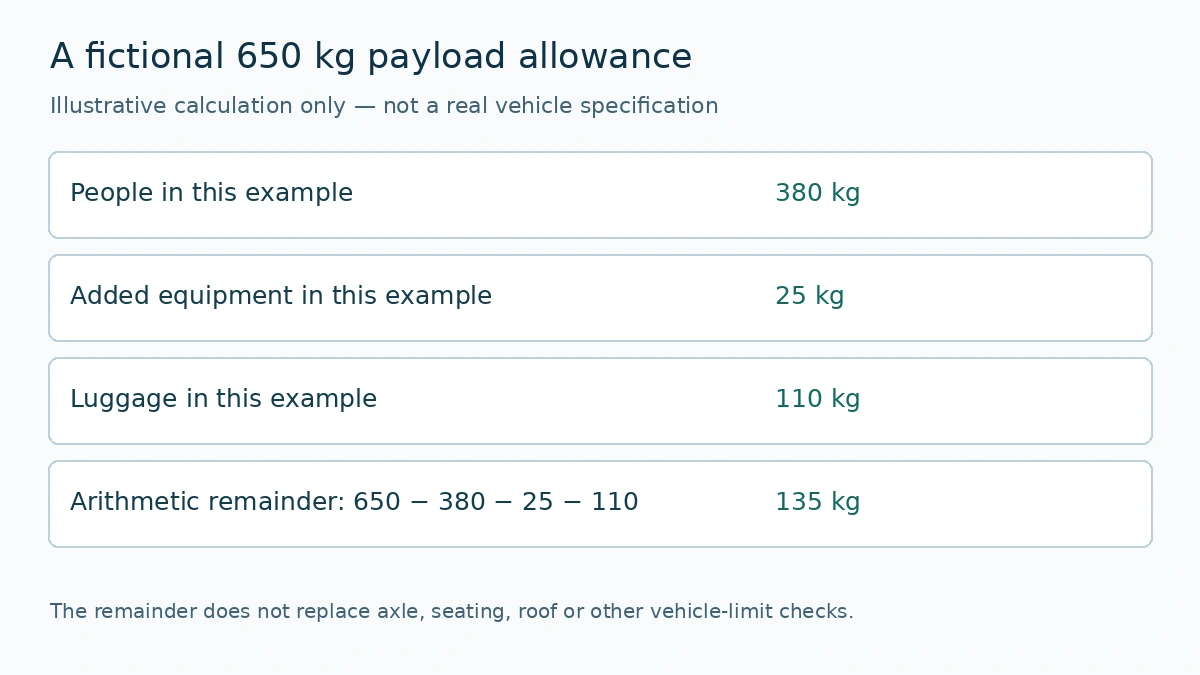
Consider an entirely fictional example with a 650 kg combined occupant-and-cargo allowance. This is not a specification for any vehicle. The people travelling together weigh 380 kg in total. Additional equipment fitted after the allowance was established weighs 25 kg. Subtract those amounts first: 650 − 380 − 25 = 245 kg available for the remaining load.
If the planned luggage weighs 110 kg, the example leaves 135 kg within that particular calculation: 245 − 110 = 135 kg. That is arithmetic headroom for this invented trip, not a recommended extra load or proof that every other limit is satisfied. The point is the order of the checks. Counting bags alone would conceal most of the weight being added.
Now imagine another adult joins the same fictional trip and weighs 80 kg. With everything else unchanged, the arithmetic headroom falls from 135 kg to 55 kg. There is no reason to assume the added passenger weighs a standard amount. Use the actual combined load rather than multiplying the number of seats by a convenient average.
Weigh a bag when its contents make guessing unreliable. Books, tools and liquids can change the weight without making the suitcase look much larger. Count items outside the boot as well: bags in the cabin still form part of what the vehicle carries. Keep kilograms throughout the calculation, or convert every entry consistently before subtracting.
Ford’s manual says that additional equipment reduces the as-built allowance and that trailer tongue or kingpin load also contributes to payload. For a towing trip, use the vehicle’s towing instructions as well; the simple non-towing example here does not establish a safe trailer combination.
A positive remainder does not settle every limit
Toyota’s vehicle-load guidance treats total load capacity, seating capacity and trailer rating as different limits. An acceptable total weight does not create another approved seating position. Equally, having an empty seat does not prove that enough weight allowance remains for another person and their luggage.
Ford’s load-limit page also requires the loaded vehicle and each axle to stay within their respective ratings. A passenger-and-bag subtraction cannot tell you the actual load on each axle. If you are close to a limit, carrying an unusual concentrated load, or unsure about modifications, obtain suitable vehicle-specific advice and an appropriate weight check. Do not treat a rough estimate as a measurement.
Roof carrying needs another check. Moving a suitcase from the boot into a roof box does not remove it from the vehicle’s total load. The box and carrying equipment also matter. Read our roof-load guide for the separate vehicle, rack and box limits; a large total-load allowance cannot override a lower roof rating.
Keep the packing decision distinct from the capacity decision. The fact that a bag fits upright, or that the hatch closes, tells you about space. Secure and position cargo according to the manual after confirming that the load is permitted. Rearranging an overweight load is not the same as reducing it.
Finish the check before the trip changes
Use a simple trip record with four entries: applicable allowance, people, added equipment and other cargo. Write “not yet known” beside a missing weight instead of quietly treating it as zero. This makes the unresolved work visible before departure. Include each item once, with a note explaining whether fitted equipment was already included in the starting figure.
When the plan changes, update the record. An extra passenger, camping gear collected on the way or a roof box added after the first calculation can change the result. A number checked for last month’s trip is not a reusable permission to carry the same visible pile of bags with different occupants.
If the planned load exceeds the applicable allowance, remove weight or change the transport plan. Do not search for a higher advertised maximum to justify the same load. If you cannot identify the correct limit, resolve that with the vehicle manufacturer or an appropriate service professional before relying on the calculation.
The useful outcome is a traceable decision: this vehicle, this limit, these occupants and this cargo, with the other ratings checked separately. This guide explains a method using manufacturer sources; it does not certify a particular vehicle or load. Reverify it when manufacturer loading guidance changes, and use your own manual whenever its instructions differ from these examples.
Cover image: original AI-generated editorial illustration. People, vehicle and scene are fictional. No real measurement, exact vehicle model or first-hand test is represented. This guide explains linked manufacturer documents; use the instructions and ratings for your own vehicle.