
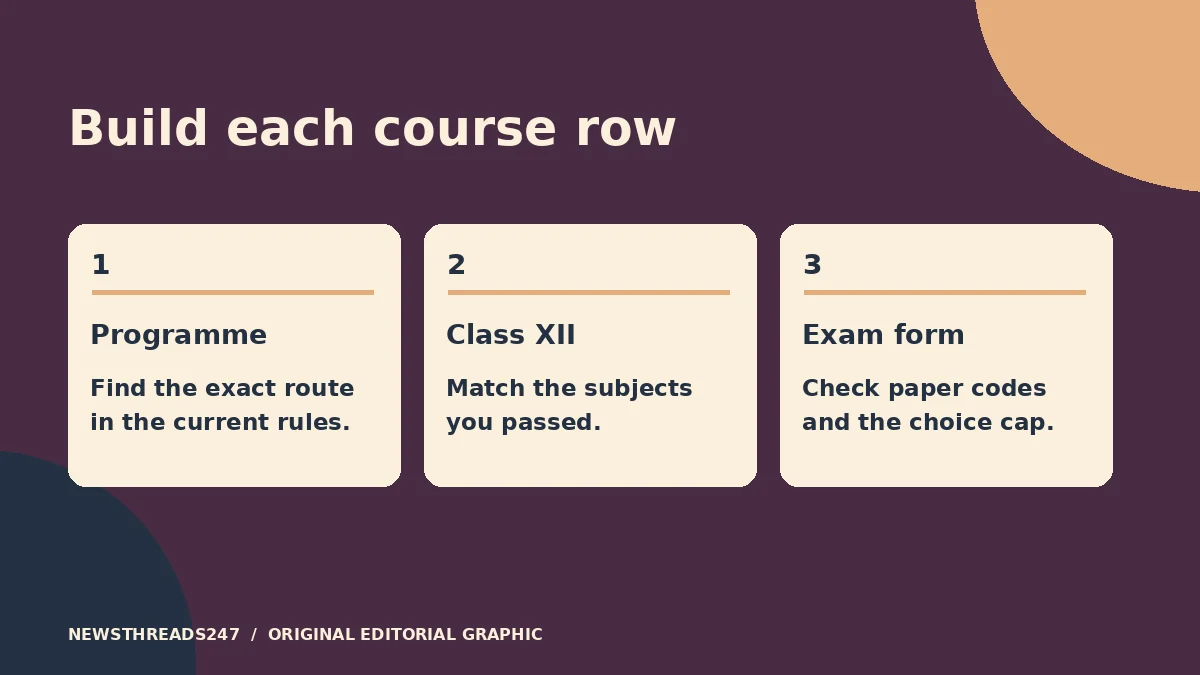
Choose CUET UG subjects by working backwards from the course you want. Start with the university’s current programme rules, match them to the subjects you passed in Class XII, and only then choose the papers in the exam form. The exam form tells you what you can sit; the university decides which scores it can use for admission.
In this article
Separate the exam menu from the admission rules
There are two documents to read. The National Testing Agency (NTA) bulletin tells you which papers exist and how many you can select. The university’s admission bulletin tells you which combinations count for a particular degree, and whether your school subjects also have to match. A paper can be available to sit without being useful for a specific application.
For example, the NTA’s 2026 CUET UG information bulletin let candidates choose up to five subjects, including languages and the General Aptitude Test, irrespective of their Class XII subjects. But the University of Delhi’s 2026–27 admissions FAQ said candidates had to appear in CUET papers corresponding to subjects they had passed in Class XII for Delhi University admissions. Those rules answered different questions. Neither is a prediction about the next cycle. Read the current versions before you pay or submit.
Use the NTA paper list and syllabuses to match the official paper name and code once you know which paper you need. Do not reverse this process by picking papers that look familiar on the exam site and then trying to fit a degree around them.
Make one row for each real application
Write the university, campus if relevant, exact degree name and intake at the top of each row. Copy the programme rule into plain English. Use “and” for requirements that go together and “or” between allowed alternatives. A university may offer more than one way to qualify, but a candidate normally has to satisfy one entire route; the pieces of two routes do not automatically form a third.
Next add three columns: Class XII subjects that support this route, CUET papers needed, and a link to the university rule. Mark any uncertain mapping with a question mark. If the school transcript uses an unfamiliar title or combines two subjects, ask admissions how it treats that exact transcript entry. A private coaching site’s subject-equivalence list is not a determination from the university.
Now mark each programme essential or optional. First reserve exam choices for the complete routes to the essential programmes. Then see which remaining paper would unlock an optional programme. An extra paper that earns a high score but unlocks no route may cost time you need to prepare for a required one. If two essential choices cannot fit within the current exam cap, resolve that trade-off explicitly.
Try the worksheet on a concrete case
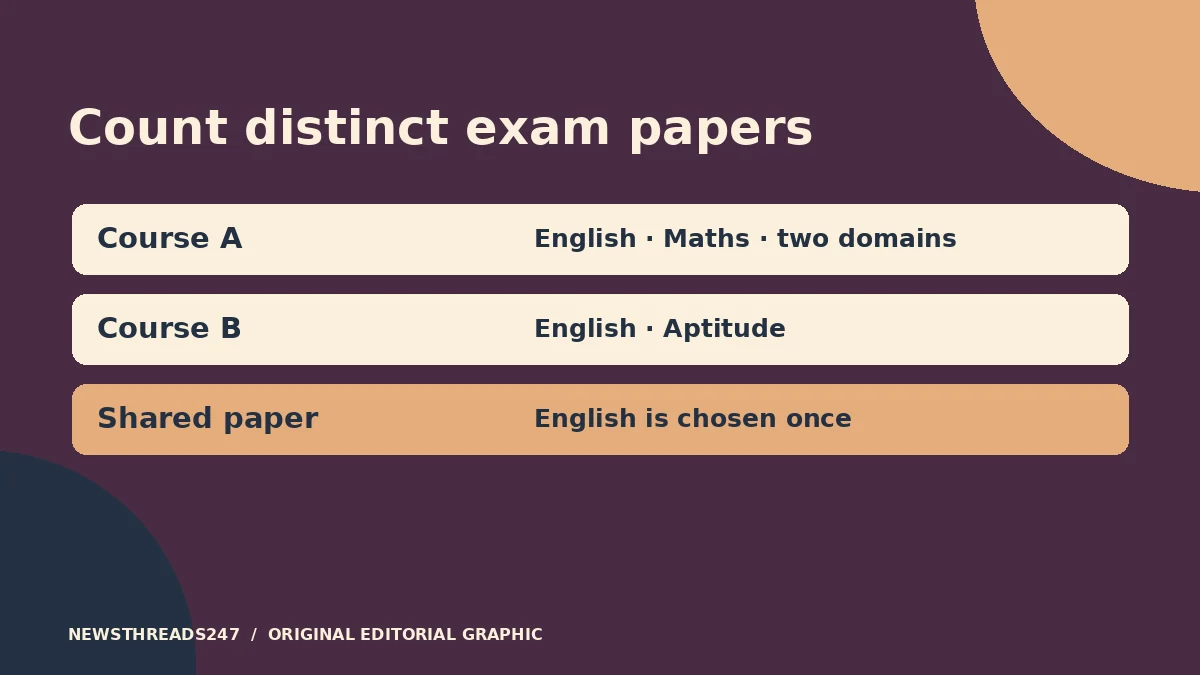
Suppose a student passed English, Mathematics, Economics and History and is comparing two programmes. In an invented example, Programme A requires a language, Mathematics and two listed domains; Programme B requires a language and a General Aptitude Test. The student can write down English, Mathematics, Economics and History as the possible complete A route, and English plus the aptitude paper as the possible B route, assuming the rules confirm those papers. There are five distinct papers across the two routes. English appears in both rows but takes only one exam choice. This is a worksheet example, not a published rule for either institution.
Now imagine a different student with the same school subjects except Mathematics. An exam portal might let that student tick Mathematics. The tick doesn’t settle eligibility where the course requires both school Mathematics and the CUET paper. In the University of Delhi’s 2026–27 bulletin, B.A. (Hons.) Economics listed Mathematics or Applied Mathematics as part of its routes, and the university’s FAQ explains the school subject rule for compulsory subjects. A high mark in another domain cannot substitute unless the actual programme rules provide that alternative.
The aptitude paper deserves its own check. It may be crucial for one of your courses and irrelevant for another. Do not add or drop it because of the course’s stream label. Go to the course row and read the route that you intend to use.
Verify what the form and the university each require
Compare the codes in the registration form with your worksheet before paying. Keep the application confirmation and your rule links together so you can spot a mismatch while any official correction option still exists. If you are relying on a correction window, check the notice for your cycle and verify which fields it allows candidates to change. Do not assume a later window exists or that it allows new papers.
Also verify whether the university requires its own application and preference submission. For example, Delhi University described a separate seat allocation process in its 2026–27 admissions bulletin. Treat the NTA registration and the university process as different tasks, each with its own official instructions. Our guide to checking institutional recognition and accreditation can help with a separate question: whether a programme is worth keeping on your shortlist.
Reopen the rules when the next cycle starts
Save the worksheet as a planning document and replace the bulletin links when new notices appear. Confirm the current paper cap, programme combinations, subject mapping, and separate university steps. If you can’t substantiate a route from the current bulletin or a written response, leave it marked unresolved. The useful milestone is a complete eligible route for each course you intend to pursue, before you submit the exam form.