
IELTS One Skill Retake can make sense when one score is holding up an application and your exact destination accepts a retake. Check acceptance first, then confirm you are eligible and have time for the result to reach the recipient. A seat at a test centre only settles whether you can take the exam; it doesn’t settle whether a programme, licensing body or immigration authority will use the score.
In this article
Ask the people who will use the score
Start with the actual application. Write down the course or route, the intake, the required test type, the overall minimum and the minimum for each skill. Then look for wording that expressly covers IELTS One Skill Retake. A page that simply says it accepts IELTS Academic does not answer the retake question. IELTS advises applicants to check directly with the receiving organisation before booking.
If the published policy is unclear, ask for a written answer about your exact case. Try: “For this programme and intake, will you accept the Test Report Form from IELTS Academic One Skill Retake for Writing? Do the same overall and component minima apply, and by when must the score be received?” Replace Academic and Writing with the test and section you actually took.
If the score must serve two purposes, keep two rows in your notes. A university’s answer covers the university; it does not speak for a visa authority. An employer’s answer cannot stand in for a professional regulator’s either. When a second destination is essential and won’t confirm acceptance, compare a full test before paying for a retake that might serve only half your plan.
Run the test clock and the application clock
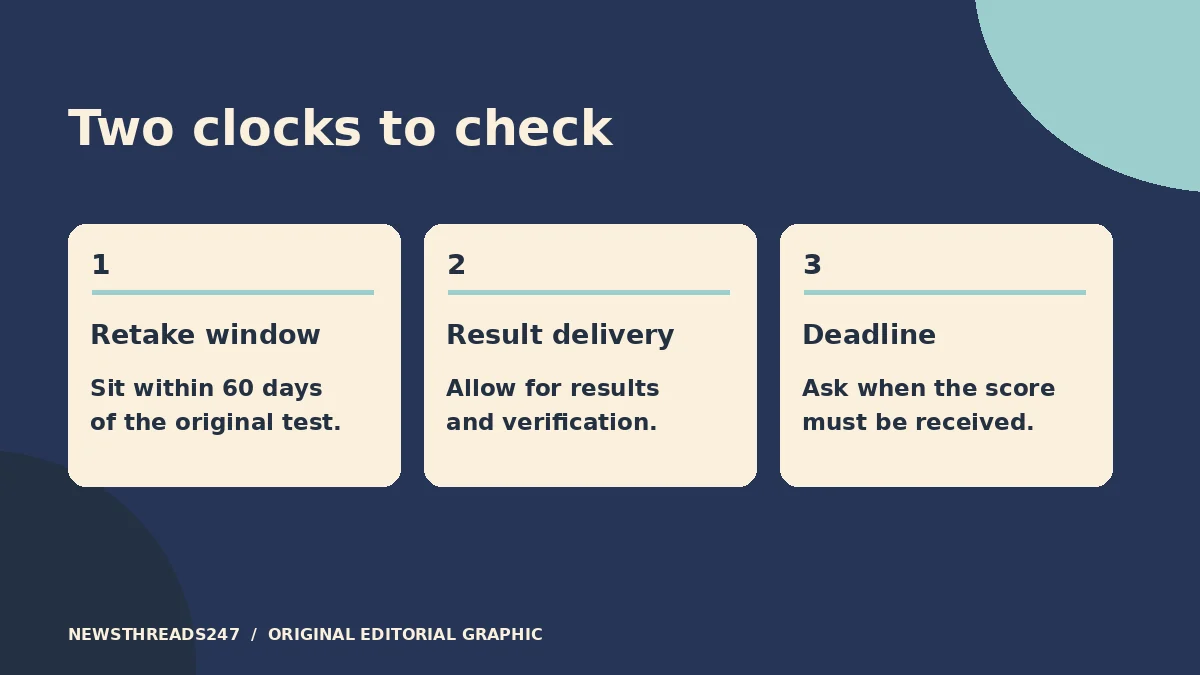
The official IELTS retake rules require a full IELTS on computer test at a centre that offers One Skill Retake. You can retake just one skill, once per original full test, and you must sit the retake within 60 days of that original test. This applies to eligible Academic and General Training tests. Being able to book before the window ends is insufficient if the actual sitting would be too late. If the retake is not offered in your booking account, ask the centre that ran your original sitting to confirm eligibility and availability.
Run a second clock from the receiving organisation’s deadline. The British Council says a retake result normally arrives within three to five days. Allow time for the result to be sent or verified by the recipient. If the deadline is the 20th and the available sitting is on the 17th, even the normal window runs right up to or beyond the deadline before any delivery or processing. Ask whether the file can be completed later; do not assume a booking receipt counts as a score.
A test centre can tell you what it has available and what it charges. The recipient can tell you what it accepts and when it needs it. Make the two calls separately. For competing options, compare the earliest feasible result delivery dates, including for a full retake, instead of just comparing the next dates you can sit.
Work the numbers before choosing a section
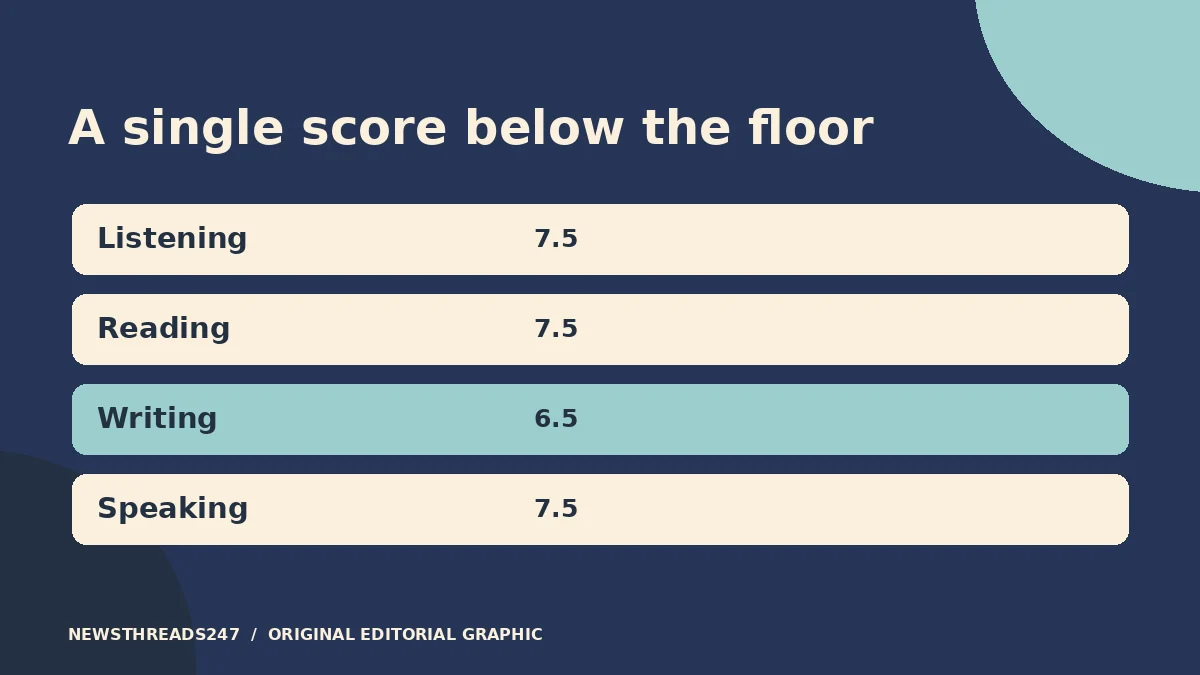
Consider an illustrative applicant with Listening 7.5, Reading 7.5, Writing 6.5 and Speaking 7.5. Assume the programme requires at least 7.0 in every skill and an overall 7.0. The Writing score is the one gap; an accepted Writing retake that reaches 7.0 would meet both requirements. That arithmetic identifies a route worth checking. It doesn’t predict a future Writing score.
Now suppose Speaking is 6.5 as well. A Writing retake can leave the programme’s Speaking minimum unmet even if Writing improves. A third situation is subtler: every component clears its floor, but the overall score is still short. Use the IELTS overall band and rounding rules and calculate what change in one component would actually move the overall score far enough. If the target needs an implausibly large jump in that one skill, compare the full test rather than assuming the shorter exam offers the best chance.
Once you identify the bottleneck, look at what practice tells you. For instance, a timed practice session can help distinguish unfinished Writing tasks from a response that addresses the prompt poorly. Those problems call for different work. If your practice does not suggest a path to the required score in the time available, it is reasonable to wait for better evidence or ask the programme about its later test deadline.
Send the right report as a whole
After the retake, IELTS issues a new Test Report Form with the retaken skill and the other three scores from the original sitting. You can choose to use the original or the new form. Treat each as a complete result. Do not paste the better numbers from different reports into an application as if the combination appeared on an official form.
The British Council describes both forms as valid for two years from the original test date. The retake doesn’t restart that clock. A recipient may use its own score recency rule, so check which date it uses to judge your score. Keep a record of which form you sent to each organisation and use the delivery or verification method it specifies.
If you have previously sent results from other tests, don’t carry over rules from one testing programme to another. Our guide to SAT Score Choice and superscoring explains a separate set of rules; it does not describe how IELTS reports are combined.
Make the decision before you pay
A single-skill retake is a reasonable choice when the recipient confirms acceptance, one component can close the gap, your original sitting qualifies and a result can reach the recipient in time. If two components miss required floors, compare a full retest or other tests the recipient explicitly accepts. If one organisation needs another kind of evidence, plan for that requirement rather than treating the retake as a universal substitute.
For a later intake, reopen the organisation’s policy and the test centre’s booking rules. A saved email can document what applied to your original application, but it cannot confirm a future intake’s rules.