
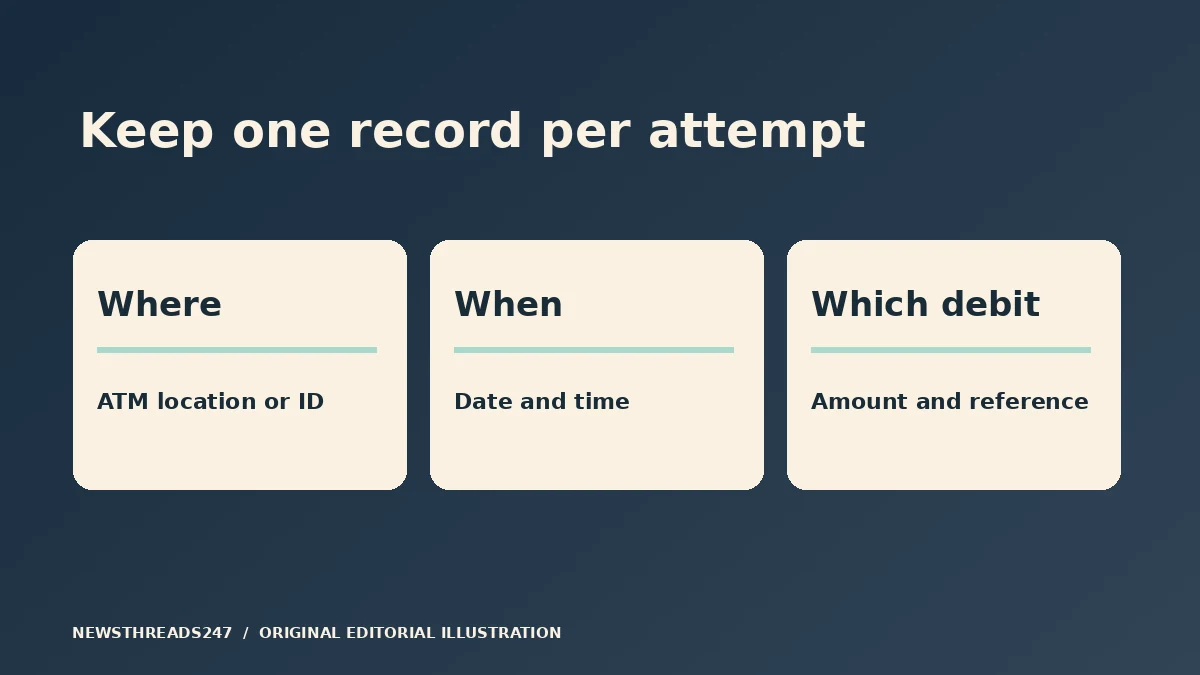
If an ATM in India debits your bank account but gives you no cash, save the transaction details and report it to your card issuer through an official channel. The Reserve Bank of India says a failed ATM withdrawal of this kind must be reversed within five calendar days after the transaction date. The complaint helps you follow the money; it does not start a fresh five-day clock.
In this article
Record the failed withdrawal while the details are fresh
Check the bank app or statement for the debit and keep the alert. Note the amount, date and approximate time, ATM location, and terminal ID if you can find it. Keep the receipt if there is one, but do not wait to complain just because the ATM did not print one. If you tried twice, write down each attempt separately. Two equal amounts can look identical in a short SMS, but each transaction can have a different reference and outcome.
Use your own bank’s official app, website, phone line or branch to raise the complaint. The Reserve Bank of India’s ATM FAQ says you can complain promptly even though banks are meant to reverse these transactions on their own. If you used another bank’s machine, tell your card issuer which machine it was. Ask for a complaint number you can use if the case moves to another team.
Share only the information the bank needs through its official channel. Do not disclose an ATM PIN, password or one-time code to anyone who says they can release your refund. If the cash withdrawal is one you did not make at all, report it to the bank as an unauthorised transaction immediately; the failed withdrawal example in this article does not describe that situation.
Count calendar days from the ATM attempt
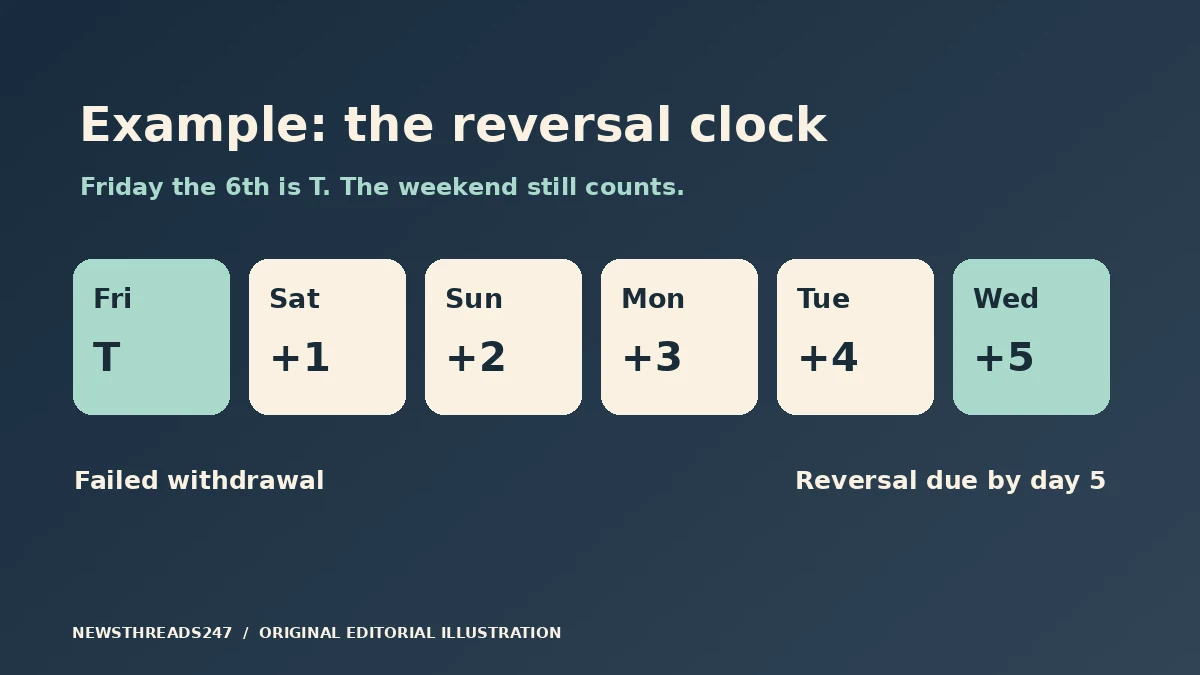
In the RBI framework for failed payments, T means the calendar date of the transaction. In the row for an account debit with no cash dispensed, reversal is due by T+5. Calendar days include weekends and holidays. A late-night transaction near midnight is a reason to check the date on the bank record rather than estimate from memory.
For example, suppose a ₹4,000 withdrawal fails on Friday the 6th and the account is debited. Friday is T; Saturday is day one, Sunday day two, Monday day three, Tuesday day four and Wednesday the 11th day five. A complaint lodged on Monday does not move that Wednesday deadline. The RBI prescribes ₹100 for each day of delay beyond T+5, to be credited automatically. If the eligible debit in this example is reversed on Friday the 13th, the two days of delay illustrate ₹200 in compensation, separate from the ₹4,000 reversal.
Check that both entries make sense
Compare the transaction history with the complaint status. The reversal returns the money debited for the unsuccessful withdrawal. Compensation, when due, is a separate amount for the delay. The app may use a different label for each credit; the useful check is the amount, date and transaction it belongs to. A case marked resolved does not by itself show that the money is available again.
If a second withdrawal succeeded, do not expect both debits to disappear. Match the credit to the unsuccessful attempt and ask the bank for a breakdown if the figures do not reconcile. If the machine gave some cash rather than none, state the exact amount received and the amount debited. Ask the bank how it classifies that discrepancy rather than assuming every short-dispense claim follows the example above.
UPI debits can also go through a reversal, but the clock depends on the type of UPI transaction. Our guide to failed UPI payments explains that separate set of checks. When speaking to the bank, identify the original transaction as an ATM cash withdrawal so the two processes are not confused.
Follow up with a message the bank can act on
A short complaint can include the attempted amount, terminal or location, transaction date and time, and reference if you have it. State plainly that no cash was dispensed. For a follow-up, quote the original complaint number, attach a redacted record if the bank asks, and specify whether the debit itself, delayed compensation, or both still need review.
If the bank says the cash was dispensed and you disagree, request a written explanation linked to the exact transaction. The details you wrote down matter more than a general description such as “the ATM failed last week.” Keep the bank’s written response and note when you received it. That record can also help establish what has already been considered if you escalate the complaint.
Keep the reversal and escalation clocks separate
The five-day reversal rule is not the waiting period for every Ombudsman complaint. Raise the issue with the bank first. If its reply does not resolve the complaint, or no reply arrives within the applicable waiting period, check the RBI’s current Ombudsman FAQ for the Complaint Management System filing instructions. The scheme in force from 1 July 2026 uses 30 days for no reply unless an applicable RBI, NPCI or card-network timeframe is longer. An unsatisfactory reply is a separate route. Check the scheme’s scope and filing limits before relying on it.
Keep the withdrawal date, first complaint date and any response date in three separate fields. That simple record helps you decide which rule to check next. This guide concerns domestic Indian ATM debits where no cash is dispensed; cross-border withdrawals, disputed partial cash and unauthorised withdrawals can involve different procedures.