
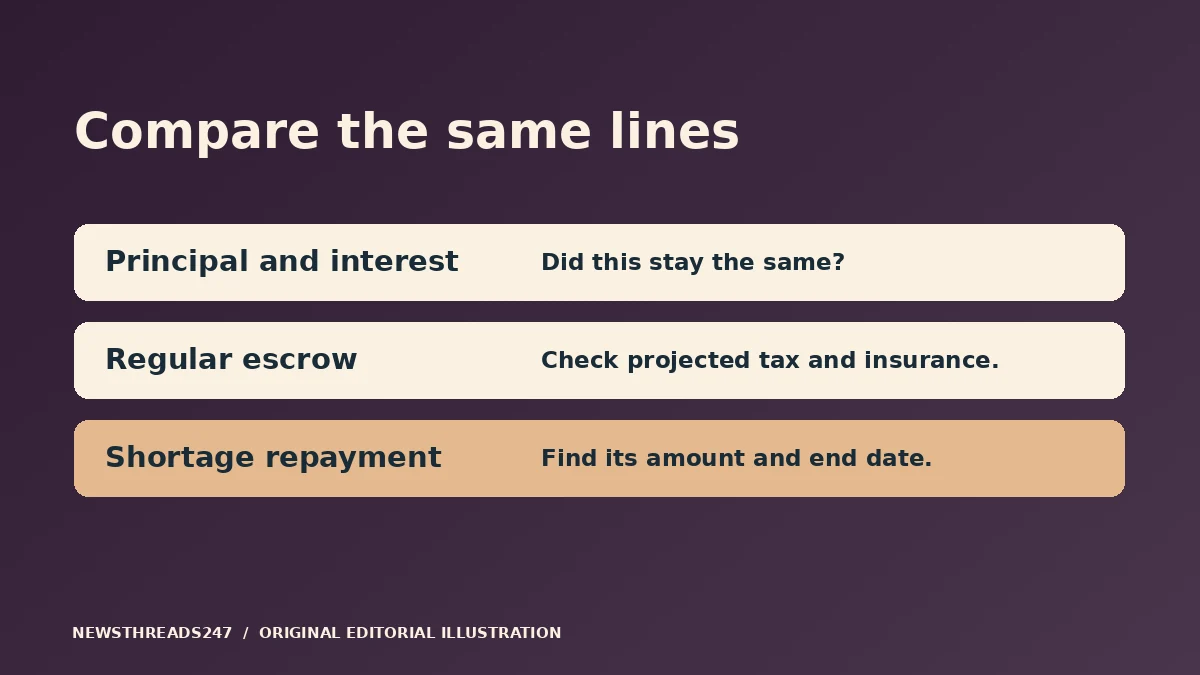
A US mortgage payment can rise even when the principal-and-interest line has stayed the same. An annual escrow analysis can change the amount collected for upcoming property taxes and insurance, and it can add a separate payment to cover an escrow shortage. Read those two figures separately before deciding whether paying the shortage would lower your bill.
In this article
Find the three lines that explain the payment
Start with the last regular statement and the new escrow analysis. Write down your previous principal-and-interest payment, your previous regular escrow contribution, and any separate shortage payment. Do the same for the new figures. Compare the totals for the same kind of payment period and check the date when the new payment takes effect.
The Consumer Financial Protection Bureau’s explanation of mortgage payment changes also lists reasons outside escrow, including changes to the principal-and-interest payment on some loans. This guide covers the case where escrow is the reason. If the principal-and-interest line has changed too, ask the servicer to explain that change separately instead of trying to account for the whole increase through tax and insurance.
Compare what was paid with what the servicer expects next
Escrow is a reserve that the servicer uses to pay certain bills for your home, commonly property tax and homeowners insurance. In its current Regulation X escrow rule, the CFPB distinguishes the account’s actual balance from the balance that the analysis targets. A shortage means the actual balance is below its target when analysed; a deficiency means the actual balance is negative. A shortage can therefore appear even when the statement shows money in the account.
Look for three pieces of evidence: the amounts actually paid from escrow, the next projected disbursements and the projected low point in the balance. The timing matters. For instance, an insurance premium due before several monthly deposits arrive can affect the projected low point even if the annual total looks reasonable. A cushion can also affect the target; where the federal rule applies, it generally caps that cushion at one-sixth of estimated annual escrow disbursements, with a lower limit if applicable under state law or mortgage documents.
If the new tax or insurance amount surprises you, compare it against the actual bill or renewal notice. Check that it belongs to the same property, tax year or insurance policy period. If your insurance changed midyear, check whether the analysis shows the old policy, the new policy, a refund, or more than one of those entries.
Work one example before weighing a lump sum
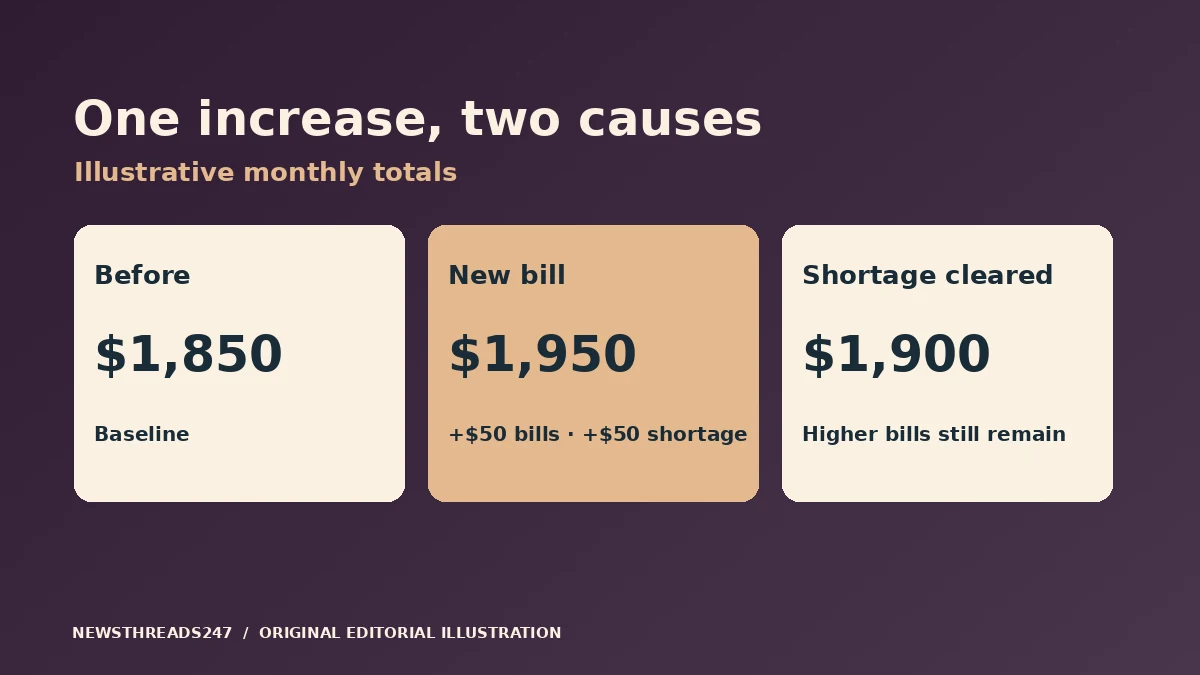
Suppose an illustrative monthly payment is $1,500 for principal and interest plus $350 for regular escrow. The servicer now projects $4,800 in annual tax and insurance payments, making the new regular escrow contribution $400 a month. Assume the escrow analysis also reports a $600 shortage and spreads repayment over 12 months, adding $50 a month.
The monthly amount in that example rises from $1,850 to $1,950: $50 for higher projected bills and $50 for repaying the shortage. If the servicer accepts a voluntary $600 payment, applies it to the shortage and confirms that it will remove the monthly shortage instalment, the illustrative total falls to $1,900. It does not go back to $1,850 because the forecast for the next year is still higher. These figures isolate the two changes; actual statements can include other payment components.
Read the repayment rule and your actual notice
For a shortage at least as large as one month’s escrow payment, Regulation X’s shortage provision allows a covered servicer to leave it in place or require equal monthly payments over at least 12 months. For a smaller shortage, the rule also allows the servicer to require repayment within 30 days. These options apply to shortages under the rule, not every negative escrow balance or every loan.
The CFPB’s servicing FAQ distinguishes what the notice can offer from whether a servicer may accept an unsolicited payment. Before sending anything extra, ask how it would be applied, when a new payment amount would take effect and whether the regular escrow contribution would still rise. Use the payment instructions from the servicer. Sending extra money without identifying where it should go can defeat the purpose of trying to clear the shortage.
Ask for an explanation or document an error
If the numbers still do not fit, ask about one identifiable entry first: “My renewal shows $1,320. Your projection lists $1,620 for that same policy period. Which bill supports your figure?” Keep the bill and both escrow analyses. If the servicer does not resolve a suspected error, the CFPB’s mortgage dispute guide explains written notices of error and requests for information, including use of the servicer’s designated address if it has one. Keep proof of sending and check your payment obligations while the issue is being reviewed.
If you are only trying to verify a debit from your bank account, our guide to recurring US bank debits explains that separate process. Changing a payment instruction does not settle the mortgage bill. For an escrow issue, the practical next step is to identify the expected ongoing contribution, the amount and end date of any shortage instalment, and the evidence behind each projected bill. This article explains US consumer mortgage statements and does not determine the amount due on any particular loan.