
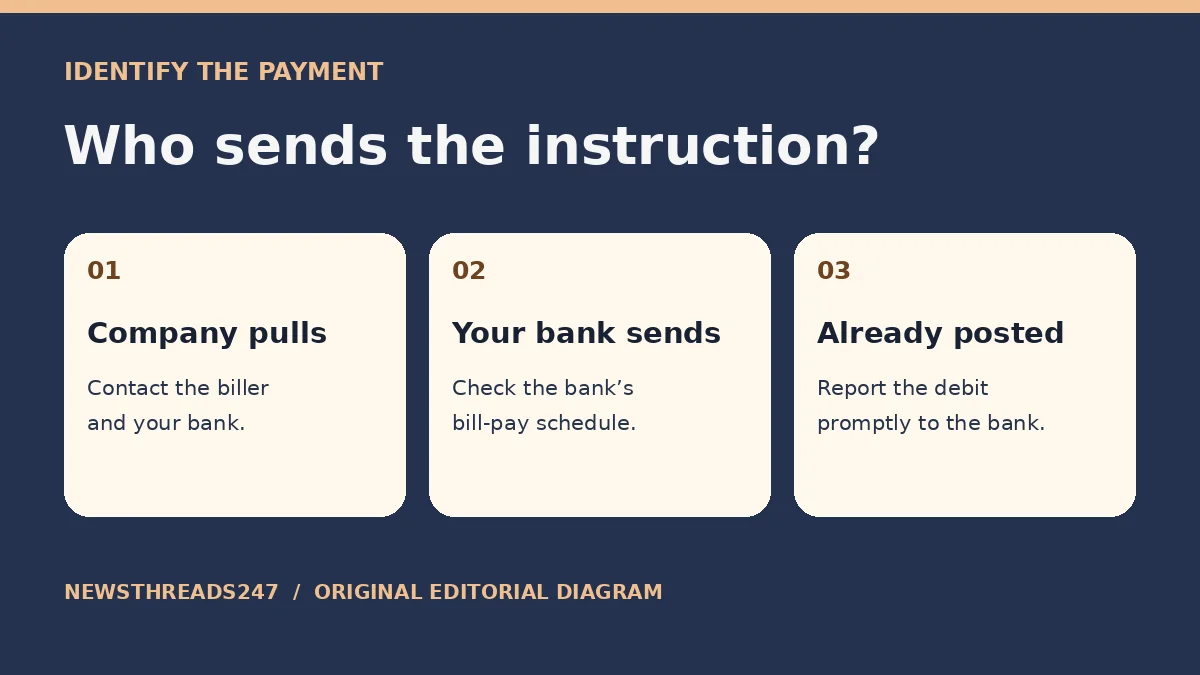
To stop a company pulling a recurring payment from a US checking account, tell the company that you revoke its permission and tell your bank or credit union. If the next withdrawal is close, ask the bank about a stop-payment order. If the payment already posted, report it promptly as a transaction to review. You may still owe the bill or need to cancel the contract separately.
In this article
Identify who starts the payment
First, find out who sends the payment instruction. A gym may pull dues using the account details you gave it. Your bank may send a payment every month because you set up bill pay in the bank’s own app. Or the charge may be on a credit card statement, where the bank-account rules in this guide do not apply in the same way. A recurring debit card transaction can require a different blocking process from an ACH debit; tell the institution which payment method you used instead of assuming replacing the card solves it.
Look at both the transaction descriptor and the original authorization or scheduled payment. The Consumer Financial Protection Bureau’s explanation of automatic payments distinguishes a company pulling money from a bank sending it. That distinction tells you where to start. Our guide to reading a US bank’s check deposit hold notice covers a different question: when money going into the account becomes available.
Revoke the company’s permission and keep proof
Use the verified contact method in the authorization or the company’s account portal. Say which recurring debit you want to stop and keep a dated record. “I revoke my authorization for recurring electronic debits for account reference [reference], effective today” is enough to describe the request. Use a reference the company already knows. Do not put your full account number or sign-in details into ordinary email.
Tell the bank or credit union that you revoked authorization, identifying the payee and the next expected date and amount if known. The CFPB’s consumer guide covers both notifications. The official interpretation of Regulation E § 1005.10 explains that the institution cannot simply wait for the payee to stop debiting once the institution is notified the authorization is no longer valid; it may ask for confirmation. Ask what proof it needs and use its secure channel.
For bank-initiated bill pay, check the bank’s scheduled payments instead. The Office of the Comptroller of the Currency distinguishes instructions you gave your bank from permission you gave the merchant. Some banks cannot edit a bill-pay transfer once it starts processing; Capital One’s Simply Checking disclosure is one example. Check your own bank’s terms and pending status.
Ask about stop payment before the next debit
For a covered preauthorized electronic fund transfer, Regulation E § 1005.10(c) gives you the right to notify the financial institution orally or in writing at least three business days before the scheduled transfer. Call promptly even if you may have missed that window; ask what can still be done. The bank may require written confirmation within 14 days of an oral order and must tell you of the requirement and where to send it. If it requires confirmation and does not get it, the oral order ceases to bind the bank after 14 days.
Suppose your gym is due to pull $45 next Friday and you contact the bank on Monday, with Tuesday through Thursday all business days. That gives the bank three intervening business days. The same calendar dates may not work in a holiday week. Ask how the bank counts its business days and how to verify the order is in place. Get the case number, any fee and written confirmation instructions. If the bank asks whether you want to stop a single withdrawal or report a revoked recurring authorization, answer that distinction explicitly.
Meanwhile, check when the underlying bill is due and whether you have arranged a different payment method. Stopping the transfer does not cancel a membership, settle a disputed invoice or discharge a loan. If the company says a separate cancellation notice is required, read the contract and keep that record alongside the bank’s confirmation.
If a debit posts, switch from prevention to reporting
Use the number on your bank card or the bank’s secure message center. Provide the posted amount, transaction date and descriptor, and state whether you never authorized the debit or you revoked authorization on a specific date. Share the bank’s earlier case number if you have it. Do not assume a conversation with the merchant starts the bank’s review.
Regulation E § 1005.11 generally requires a qualifying notice of error within 60 days after the institution sends the first periodic statement showing the error. That is not a reason to wait. Reporting immediately helps identify subsequent debits and lets the bank tell you how to document your report. The timing and rules can depend on the account and what happened; a refund is not automatic just because you called.
Review the next statement as well. If the biller tries again, the institution can match your earlier report and see the new entry. This guide covers recurring electronic debits from US consumer bank accounts; use your own institution’s instructions for its channels and recheck the current CFPB rule if its procedures or the regulations change.
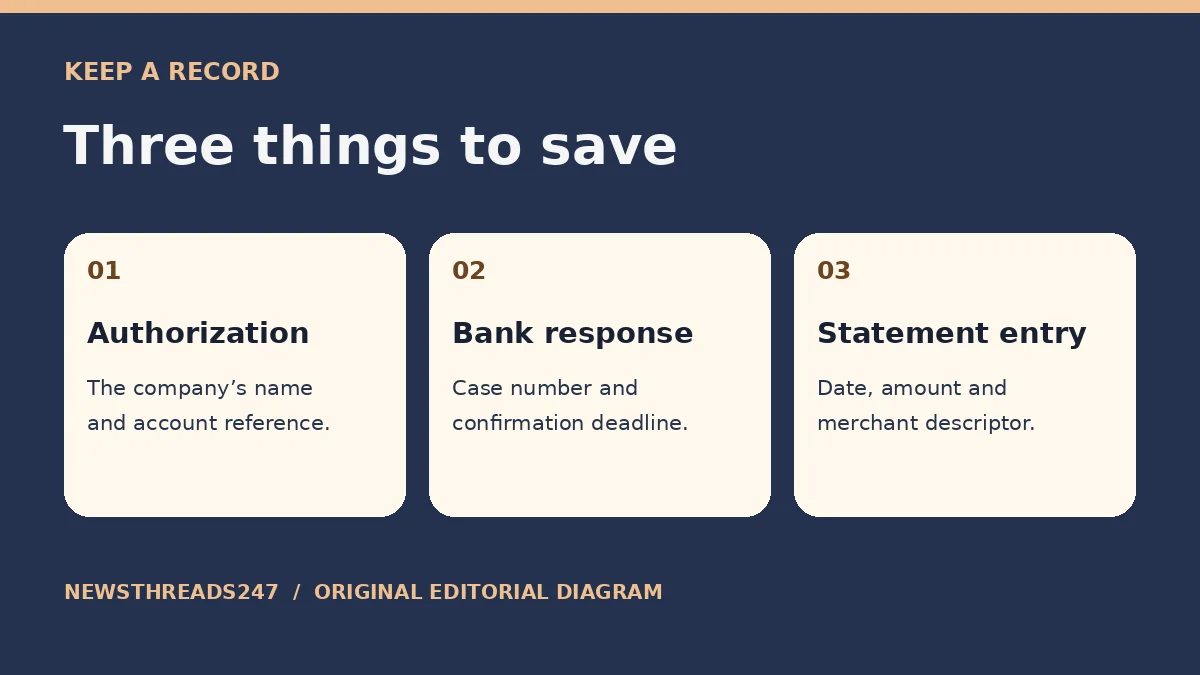
Choose the request based on timing
Several days before the next debit: revoke permission with the biller and tell your bank. Decide whether a separate stop-payment order is needed and note any confirmation deadline. The debit is pending: contact the bank and merchant quickly and ask which actions are still possible. The debit posted: tell the bank that it is a posted transaction you want it to review. These are different requests, even if they all start with the same complaint.
If you changed checking accounts, verify that you removed the old authorization rather than assuming a new card or account will make recurring instructions disappear. Check that your replacement payment actually posted; scheduling it is not proof that the biller received it. If the bill was paid twice, ask the company how it will allocate the duplicate and keep the bank report separate when the old debit was unauthorized.
Keep one record for each biller. A short note listing the date you revoked authorization, the bank’s case number and the date of the replacement payment is more useful than a pile of screenshots without context. If you are moving several payments, work from the most recent statements and look for bills that recur quarterly or annually as well as monthly.