
A fixed deposit can mature without money appearing in your savings account. If you gave the bank an instruction to renew, it may have opened a new deposit. If you chose payout, the bank should follow the destination on record. Start by finding the maturity instruction and the destination account on the receipt or in the deposit details. The maturity date alone tells you when the old term ends; it does not tell you where the money goes next.
In this article
Find the maturity instruction before choosing a rate
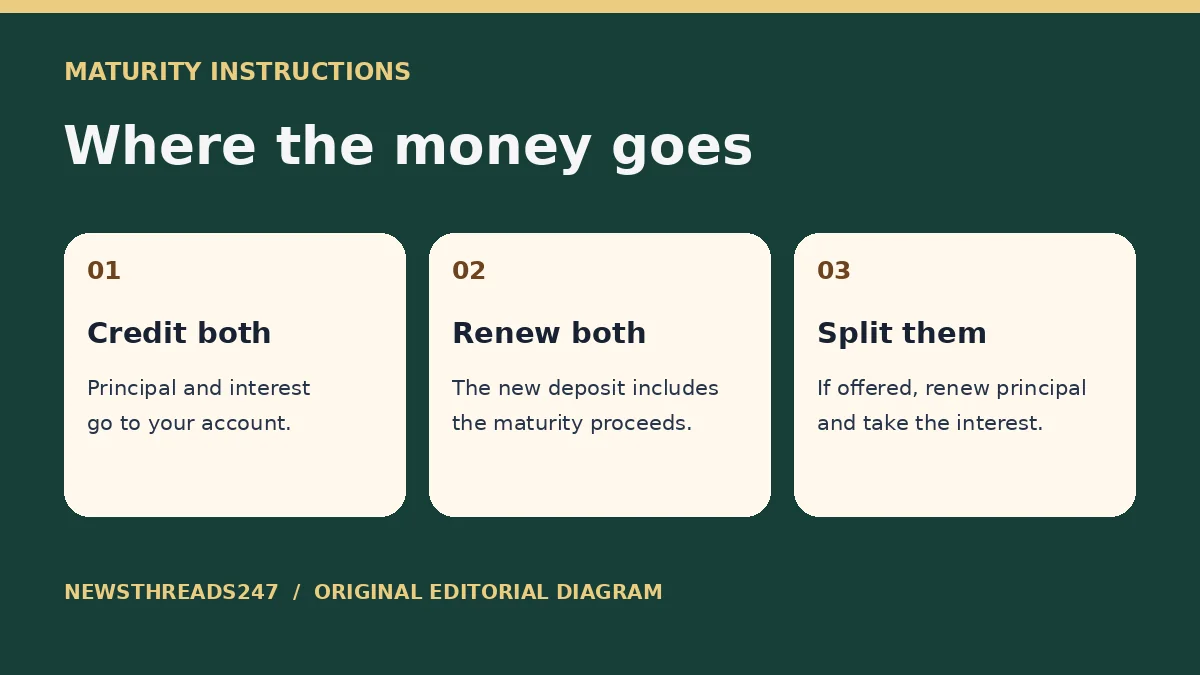
For ordinary domestic rupee deposits at Indian commercial banks, distinguish three possible instructions. You may be able to have both principal and interest paid out, renew the entire maturity amount, or renew principal and collect the interest separately. The third option depends on the product and bank. A payout deposit may already have paid interest during the term, so check what is actually due at the end. ICICI Bank’s FD FAQs describe linked-account payout and renewal for the same tenure. Axis Bank’s terms are another example of why the specific maturity instruction matters.
Look for four details on the bank’s record: the maturity date, the destination account, whether the principal and interest go to the same place, and the deadline and channel to change the instruction. A reminder SMS can help you find the record, but it is not a substitute for seeing the instruction itself. If a branch changes it, ask for an acknowledgement or a revised receipt.
Treat renewal as a new decision
The interest rate on the old deposit is for its old term. If you renew, compare the actual renewal rate, term and withdrawal conditions the bank offers, rather than carrying the old rate into your plan. ICICI, for example, says its automatic renewal uses the rate prevailing on the renewal date. The bank’s current rate card and the fresh receipt answer different questions: the card shows the published rates for qualifying deposits; the receipt shows what was actually booked for yours.
Suppose a receipt shows ₹1,08,000 payable when a ₹1,00,000 deposit matures. If the product lets you renew only principal, the next deposit starts with ₹1,00,000 and the remaining ₹8,000 goes to the nominated payout account. If you renew all proceeds, the new deposit starts at ₹1,08,000. If you take the payout, all ₹1,08,000 is available in the linked account once credited. Those are illustrations of where the money goes, assuming the stated amount is payable after any applicable deductions. They are not forecasts of interest or tax.
Match the term to when you may need the money. If part is earmarked for a bill in three months, renewing everything for another year can turn an avoidable cash shortage into an early withdrawal. Compare any penalty and the applicable interest calculation before renewing. If a deposit is already pledged, check its lien and what the bank will release. Our guide to comparing a loan against an FD with breaking the deposit covers that separate cost decision.
A matured deposit left unpaid has its own rule
Under the Reserve Bank of India’s Commercial Banks (Interest Rate on Deposits) Directions, when a domestic term deposit matures and the proceeds are unpaid and left unclaimed with the bank, the rate is the lower of the applicable savings-account rate and the contracted rate on the matured deposit. This is the rule for unpaid, unclaimed proceeds; it is not the rate on a new fixed deposit. The RBI deals separately with renewal of overdue term deposits, subject to the conditions in its directions.
For a simple rate comparison, if the matured deposit carried 7% and the applicable savings rate were 3%, the lower rate would be 3%. If the old contracted rate were 2.5% and the applicable savings rate were 3%, the lower rate would be 2.5%. These are hypothetical rates. For a rupee calculation, ask the bank for the amount on which it calculated interest, the dates it used and the rate it applied. If a rate changed during the gap, ask the bank how it split the periods.
There is a different rule for a deposit maturing for payment on a non-business day and paid the next working day. The same RBI directions specify interest at the old contracted rate on the original principal for the intervening non-business day or days. If you are checking a weekend payout, ask whether the bank applied that provision or recorded an overdue balance.
Some banks explain their handling of overdue renewal separately; see HDFC Bank’s deposit policy for one example. Do not assume a bank can or will renew from the original maturity date on the terms you expected. Ask for the actual booking date, any overdue interest and the new renewal rate in writing. This guide does not cover NRE or foreign currency deposits, corporate FDs or nonbank products.
Reconcile the receipt with what actually happened
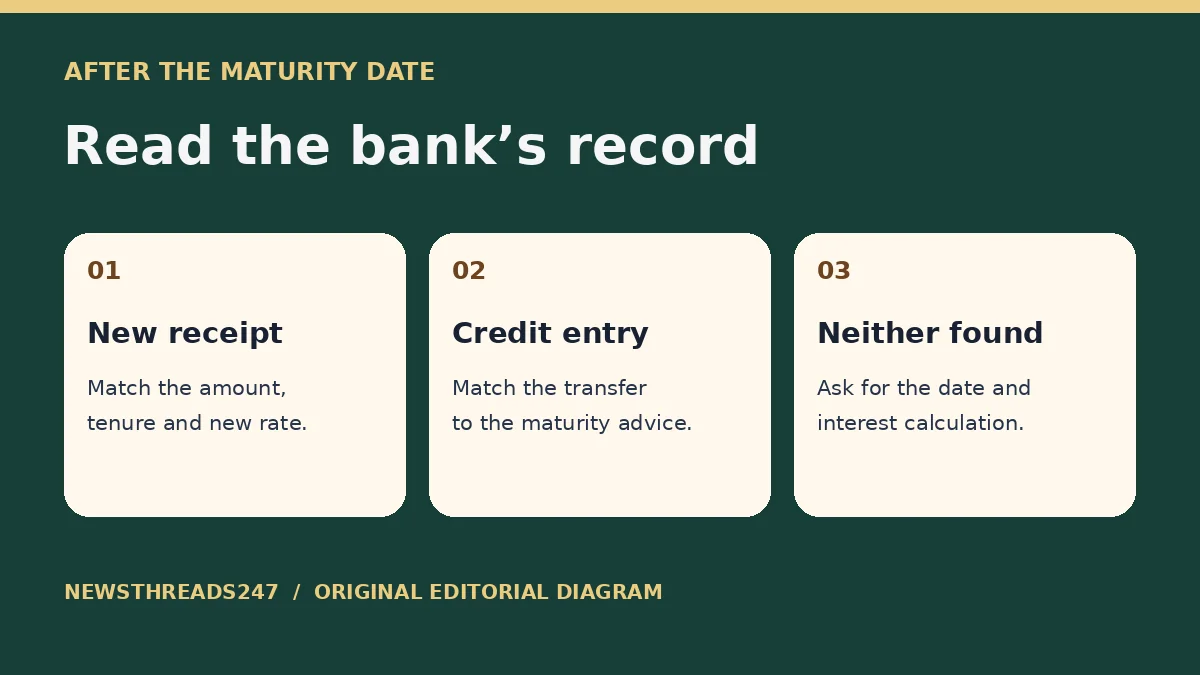
After maturity, compare the old deposit record with the linked account and the bank’s list of active deposits. If you see a new deposit, check its principal, start date, rate and new maturity date. If you see a credit, match the amount to the maturity advice and check that it went to the intended account. A credit for interest alone is not evidence that the principal was paid out.
If you see neither, contact the bank through a verified channel. A useful request is: “Please confirm the instruction you applied, the destination or new deposit reference, and any interest from maturity to payment.” Keep the request reference and the bank’s explanation. If the bank confirms the funds are still unpaid, ask what it needs to release or renew them. A recent missed payout is a different problem from the older unclaimed balances discussed in our UDGAM guide.
Before the next deposit matures, set a reminder early enough to act. Make the instruction fit the date you will need the cash, then confirm what the bank actually booked. Recheck the current RBI directions and the bank’s terms if you change products or if the bank updates its deposit policy.
Choose the instruction that fits the next use
If you know you will need the full amount soon, check whether a payout to an active linked account fits your timing. If you need only the interest, ask whether you can renew principal alone. If you want to keep the whole amount in a term deposit, review the new rate and end date rather than leaving auto-renewal on by habit.
Where the product permits it, another option is to take the payout and create separate deposits for different cash needs. That gives each portion its own maturity date, but the rate may differ by tenure and amount. Check the minimum for each new deposit and whether any preferential rate actually applies. Keep enough accessible cash for near-term spending before choosing longer terms.
Joint or restricted deposits can make a routine change less straightforward. Ask the bank who may give the instruction, whether all holders need to sign, and how payment works if the linked account is closed or restricted. Use only the bank’s own app, website or branch to update payout details; a maturity reminder is not a reason to enter banking details through an unsolicited link.