
A check deposit can appear in your US bank account before you can spend the money. Find the banking day the bank used, then check the amount released and the date given for any held balance. Even funds marked available do not prove that the check was paid.
In this article
Received, available and paid are separate milestones
A deposit receipt shows the bank got the item or your submission. A posted balance may reflect the transaction even while a hold limits withdrawals. The available balance is the bank’s view of what you can currently use, subject to other account activity. A check can still be returned after money became available, and the bank can reverse the credit. Chase’s ATM information makes this distinction explicitly for its customers.
Look for the hold at the transaction level instead of guessing from the overall balance. If you began with $400 and can now use $675 after depositing a check, the $275 difference may be an initial release, but pending purchases or other deposits can also change that figure. The deposit detail or hold notice is the place to confirm how much of that check is available.
| What you see | What to verify |
|---|---|
| Deposit accepted | The effective banking day |
| Some money available | The amount and release date for the rest |
| Hold notice | Reason, channel, and next action |
| Sender wants money back | Contact the bank before sending anything |
Find the banking day before you count
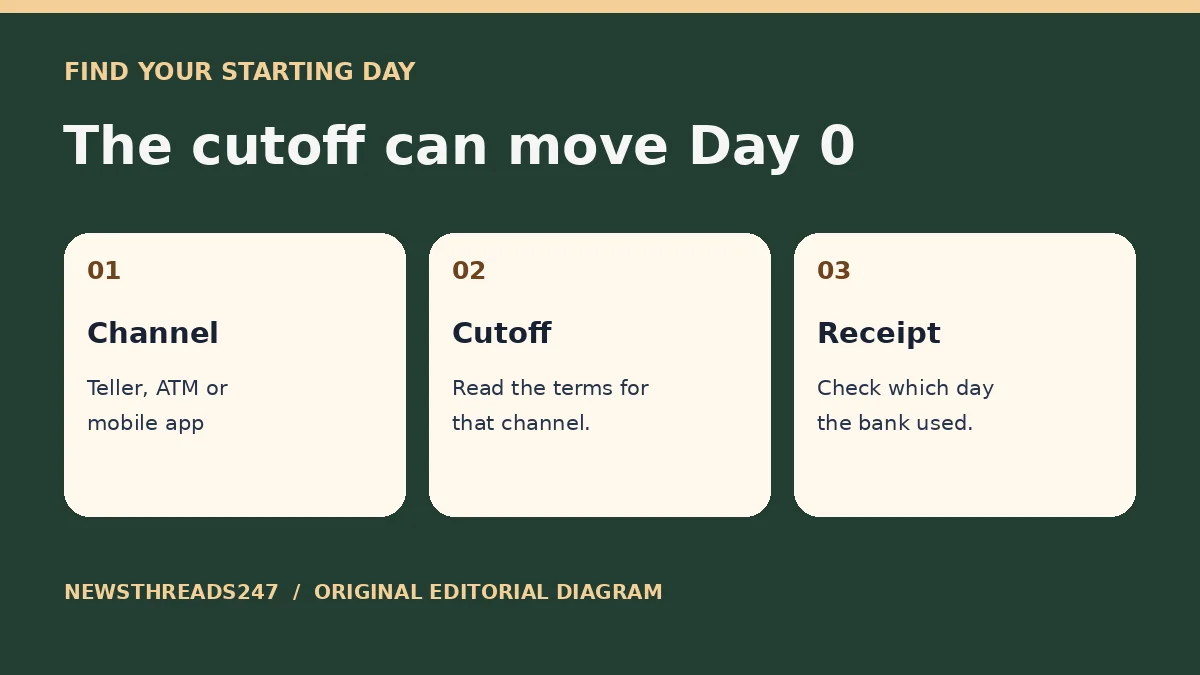
Check the cutoff for the channel you used: a teller, an ATM and a mobile app may follow different schedules. For example, suppose you submit a check late on Friday, and your bank says an after-cutoff submission is credited as received on the next banking day. With no holiday and Monday treated as the next banking day, Monday is your starting day for that deposit; Tuesday is the following business day. If Monday is a holiday or the bank gives you a different effective date under its terms, use the receipt and notice.
The point of the example is to find the day the bank actually used, not to assign a universal Friday cutoff. Chase’s deposit FAQ is one example of a bank publishing separate mobile deposit guidance. If you use a phone, open your own bank’s mobile deposit terms rather than borrowing the availability schedule for a branch deposit.
Where the $275 figure fits
The Federal Reserve and Consumer Financial Protection Bureau adjusted several Regulation CC dollar thresholds effective July 1, 2025. The US Office of the Comptroller of the Currency explains the general next-business-day availability rule for the first $275 of covered check deposits. The schedule can vary by check type, method and circumstances. The number does not tell you when the rest of your deposit is available.
The regulation and official commentary explain the schedules and exceptions. The current large-deposit threshold is $6,725 for the relevant exception; that figure is not a promise that every deposit below it will be free of holds. New accounts, redeposited checks, certain repeated overdrafts, reasonable cause to doubt collectibility and emergencies can affect availability. Ask which provision or policy applies to your account and channel.
Read the hold notice before scheduling a payment
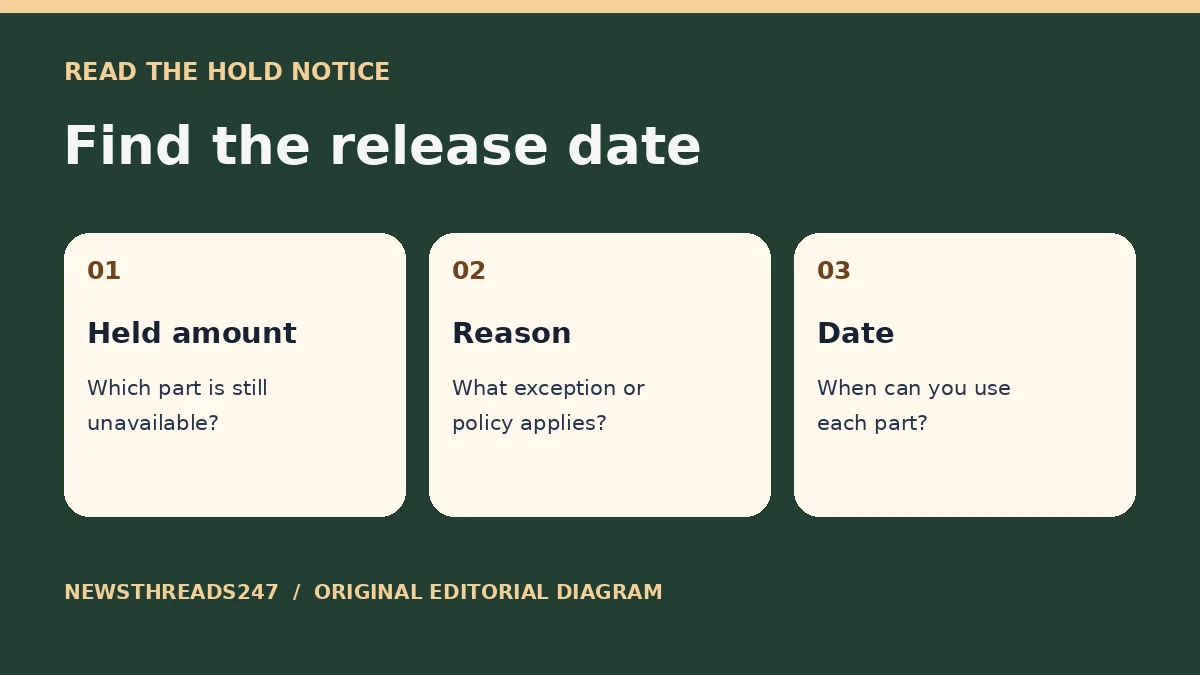
The Federal Reserve’s consumer help explains that an exception hold notice identifies the reason for the delay and when funds will be available. Keep the original deposit receipt and any notice. Write down the deposit date the bank used, the held amount, each release date shown and the bank’s explanation. If the date is unclear, ask whether the bank is referring to the full deposit or only a portion.
Suppose a $900 check appears in your transaction history, the bank releases $275, and it states that the remaining $625 is held until a named date. If you have a $500 bill due earlier, the displayed $900 deposit is not a reason to schedule the bill against it. Check the available balance after other pending items or find a different payment arrangement. The dollar amounts are hypothetical and the stated hold notice, not this example, determines availability in a real case.
Do not return money just because a check shows as available
The Federal Trade Commission’s fake-check guidance explains a common pattern: someone sends too much and asks you to return part of it or pay another person. If the check is fake and later reverses, the money you sent may be gone. If a stranger asks you to buy gift cards, wire funds or forward an overpayment, stop and contact your bank through its verified contact details.
For a routine delay, start by asking for the bank’s deposit availability policy and the release date for the specific item. If the date passes without release, use the bank’s complaint channel and retain your correspondence. Our deposit insurance guide explains the separate question of account protection. This article gives general US consumer information, not advice for a specific account. Recheck it when the federal thresholds or the named bank disclosures change. The original diagrams are illustrations, not screenshots.