
Paying the credit card minimum due by the due date generally keeps the bill from being overdue for that cycle. It usually leaves part of the debt unpaid, and the interest-free period can be lost. To understand the next bill, check the balance left after your payment, the dates on which credits posted, and the finance charges your issuer applies.
In this article
Three amounts that answer different questions
The total amount due is the amount billed on the statement. The minimum amount due is the issuer’s required minimum for that statement. The current balance in the app may include spending or credits posted after the statement closed. If those numbers differ, check the statement period before using any one of them to plan your payment.
India’s RBI commercial-bank credit card directions, updated as of 1 October 2026, define the minimum amount due in relation to overdue status. They separately describe interest-free credit and the consequences of partial payment. The rules cited here apply to the commercial banks covered by that direction; if your card is issued by a different class of entity, check the issuer’s terms and applicable RBI directions.
A worked statement, before interest
Suppose your statement shows ₹20,000 total due and a ₹1,500 minimum. You pay ₹1,500 on time. In this simplified example, with only retail purchase principal and no new activity, ₹18,500 of that billed balance remains after the payment. A payment of ₹5,000 would leave ₹15,000 on the same assumptions. Paying the full ₹20,000 would clear the billed amount in this example. None of those subtractions, on its own, calculates the next statement.
The example deliberately leaves out interest, fees and tax. In a real statement your payment may be allocated across these items before reducing principal. For example, the published SBI Card terms describe a payment order that includes tax, instalments, fees and finance charges ahead of some principal categories. That is an issuer example. Use your own Most Important Terms and Conditions (MITC) for the formula, the order of allocation and the treatment of refunds.
| Payment | Billed principal left in the simplified example |
|---|---|
| ₹1,500 minimum | ₹18,500 |
| ₹5,000 partial payment | ₹15,000 |
| ₹20,000 full payment | ₹0 |
Why interest can appear after an on-time payment
The RBI direction says that partial payment or failure to clear the total due by the due date can remove interest-free credit. It allows interest on the outstanding amount from the transaction date, with payments, refunds and reversals taken into account as credited. The billed total and the balance to which an interest charge relates are therefore not interchangeable.
Look at the dates as well as the rupee amounts. For example, if a purchase posted earlier in the cycle and you paid part of the balance on the due date, the reduced balance did not exist throughout the whole period. Ask your issuer for the balances, rates and dates behind the finance charge rather than trying to reproduce it by multiplying the remaining amount by a monthly rate.
A late charge is a different item from a finance charge. Paying the minimum and avoiding a late charge does not prove you kept interest-free credit. Our guide to the three-day rule covers the distinction between payment timing and late-charge rules.
How to check the next statement
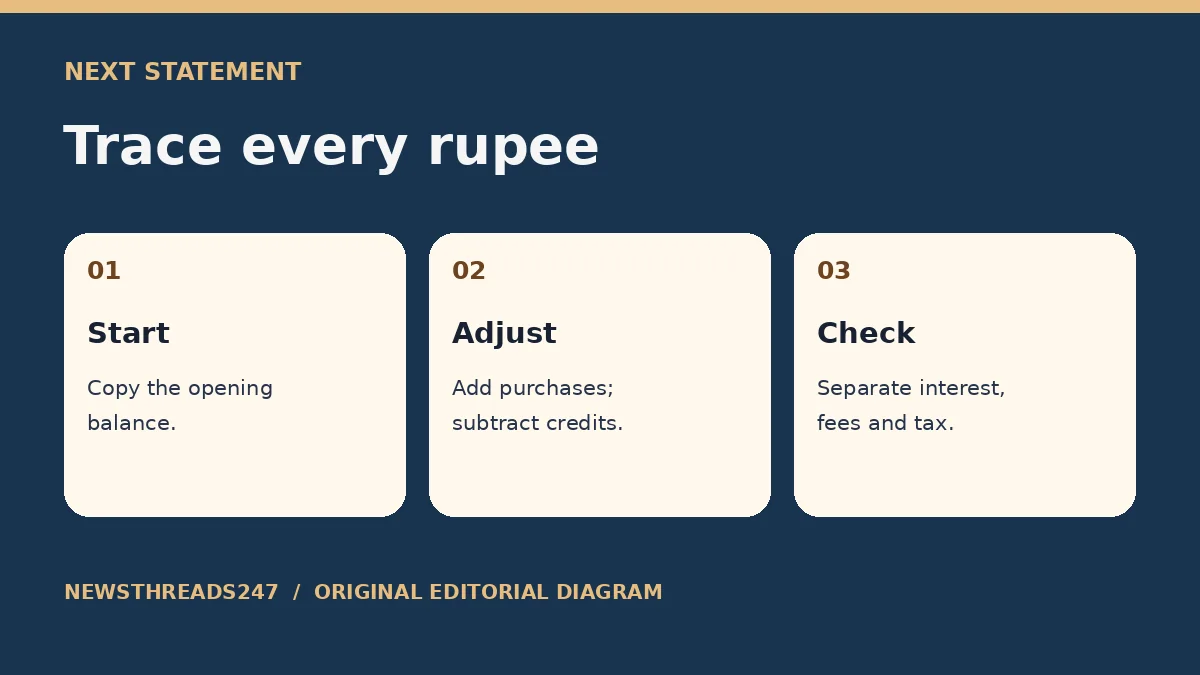
Put the old and new statements next to each other. Mark the previous billed balance, the payment actually credited, subsequent purchases and refunds, and then the finance charges, fees and tax. Use the posting dates shown on the account, and mark any transaction that was authorized before the statement but posted afterward. This helps explain why a refund or payment visible today did not appear on an older PDF.
If you are trying to stop carrying a balance, ask the issuer what amount would settle it on the date you expect to pay. A prior statement may not capture charges that accrued after it was generated. If the amounts do not reconcile, ask for the calculation and preserve the statements and payment references. Keep account numbers and card details out of public messages.
Use the minimum as a floor in your repayment plan
If you can pay the full billed amount, compare that figure with any recent payment already credited before sending more. If you cannot pay it all, work out the largest payment you can realistically make without missing essential bills. The minimum is a near-term obligation to keep track of; it is not a plan for getting out of debt. Adding fresh spending while carrying a balance can make progress harder to see.
If you expect to miss the minimum or cannot see a path to reducing the balance, contact the issuer through its published channels before the due date. Ask what options are available, what the total cost would be, and whether an instalment conversion has a processing fee or other terms. Compare the total outlay and length, not just a smaller monthly amount. This is general consumer information; use your statement and current issuer terms for the actual charges. Recheck this guide when RBI directions or issuer disclosures change. The figures and graphics are explanatory, not a real statement.