

A three-credit course rarely means that the course takes just three hours of your week. Class meetings, reading, problem sets, laboratory work and preparation all compete for time. Before adding another class, estimate the complete academic workload and place it beside the rest of your commitments.
Start with the credit definition used by your own university, then check the length and format of the course. This guide uses named US university policies as examples. Their units, contact-hour conventions and term calendars are not interchangeable with every US college or with an Indian institution’s credit system. The method is a planning tool, not a universal conversion or a prediction of your performance.
In this article
What the credit number can tell you
Stanford Academic Advising describes a unit as roughly three hours of work each week, commonly split between one hour of class and two hours outside it. It also warns that actual work varies between students and classes. That is a starting assumption for planning, not a promise that every assignment will finish within a set time.
A contact hour needs its own definition. Rice’s registrar, for example, defines it as a 50-minute instructional period. A course catalogue’s academic “hours” therefore need not equal the same number of 60-minute blocks on your personal calendar. Keep the institution’s convention visible when you compare a policy with a timetable.
Locate four items before calculating: the number of credits, the dates over which teaching takes place, compulsory meetings beyond the main lecture, and the expected independent work. A laboratory attached to a lecture, a separate discussion section or a required placement can change where the work happens. Avoid counting a meeting twice simply because it appears in two descriptions.
Credits describe an academic expectation. They do not measure how familiar you are with the material, how quickly you read a technical chapter, or how much revision an unfamiliar kind of essay needs. Treat a first estimate as a budget to test, rather than a personal speed target you must meet.
Why a shorter course can fill more of the week
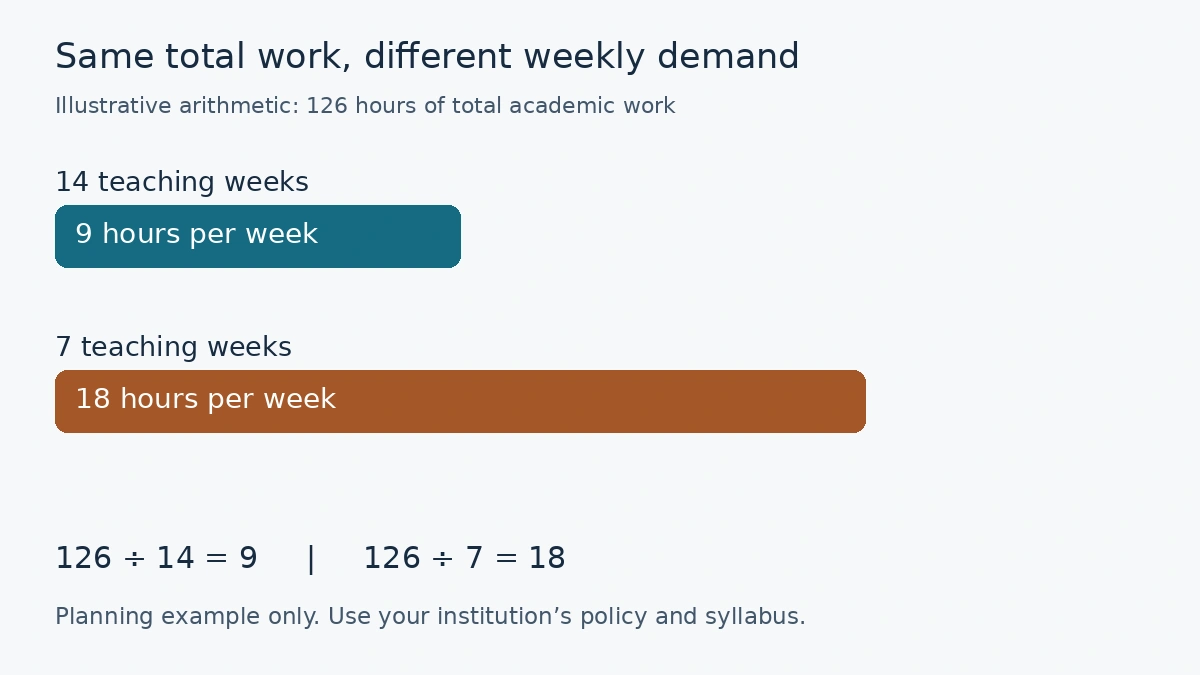
UConn’s published workload guidance lists a minimum of 42 academic-work hours per credit over a term and shows how weekly expectations rise in shorter sessions. Its three-credit example totals 126 hours. Those figures describe UConn’s framework; check the equivalent at your college before borrowing them.
For a transparent planning illustration, divide 126 total hours by 14 teaching weeks: that is nine hours a week. Divide the same total by seven weeks and the average becomes 18. Neither calculation says that the course has become academically harder. The same assumed work has less calendar space.
The averages also hide peaks. Two courses can have similar total work and still collide when both require a presentation in the same week. Put major assessments onto the calendar before judging the load manageable. Check reading weeks and exam periods separately, because the timetable may show fewer meetings while preparation continues.
Online study does not remove those hours. Distinguish scheduled video meetings from recorded lessons, discussion contributions, exercises and independent preparation. A flexible meeting pattern can help with timing, but flexibility alone does not establish a lighter workload.
Build a week that includes the work between classes
Consider a fictional student, Alex, whose university uses an estimated three hours of total work per credit each week. Twelve credits imply a starting academic budget of 36 hours. Alex’s timetable contains 12 meeting hours, so the planning remainder is 24 hours outside those meetings. This is an illustrative application of an assumption, not a recommendation that all students take 12 credits.
Alex also works ten hours, spends five travelling and has regular family commitments. Those obligations belong on the same calendar. A free afternoon on the class timetable may already be occupied. Protect time for meals, sleep and ordinary tasks before allocating every remaining gap to coursework.
Give the independent work a task: reading before Tuesday’s seminar, attempting a problem set while help is still available, or drafting an essay early enough to revise it. “Study sometime” is difficult to defend against other demands. A specific task also makes it easier to notice when the original estimate is wrong.
Allow a margin rather than scheduling every minute. A delayed commute, a difficult assignment or a group meeting that must move can otherwise force one course’s work into another’s allocated time. If the plan only works when nothing goes wrong, revise it before adding a further course.
Test the estimate before you commit to more
During the first ordinary teaching week, record time in broad categories: required meetings, preparation, assignments and review. Repeat during a week with an assessment. The aim is to discover the shape of the work, not to turn every pause into a performance score.
Compare the record with the syllabus. If reading is repeatedly taking much longer than expected, identify the obstacle: unfamiliar vocabulary, missing prerequisite knowledge, an unrealistic reading method or an unusually heavy week. Ask a focused question during college office hours rather than assuming that slower work proves you cannot succeed.
Before dropping or adding a course, ask your adviser about the academic and administrative consequences. Workload arithmetic does not establish full-time status, financial-aid eligibility or permission to change enrolment. Those decisions require the rules for your programme and circumstances.
Finish with a workable decision: keep the current load with protected study periods, move an optional commitment, or discuss a different course combination. Recheck the plan when a syllabus changes, a short session begins or employment hours increase. A useful credit estimate should help you choose where time goes; it should not disguise work that the timetable leaves out.
Sources checked 18 November 2026. Reverify institutional credit definitions, term dates and syllabuses before a new registration period. Original examples and planning analysis by NewsThreads247 Editorial; no student interviews or time-use study are claimed.