

Before switching a college course to pass/fail, check three separate questions: what result earns credit, whether that credit satisfies the requirement you need, and whether the change can be reversed. A button in the registration system answers only whether an option is offered—not whether it is the right choice for your degree.
Pass/Fail, Credit/No Credit and Credit/D/Fail are not interchangeable labels. This guide explains a decision method through specific US university examples. It does not prescribe a grading choice for every college, predict a professional school’s admissions decision, or replace the rules for your programme and entry year.
In this article
Read the grading scale behind the label
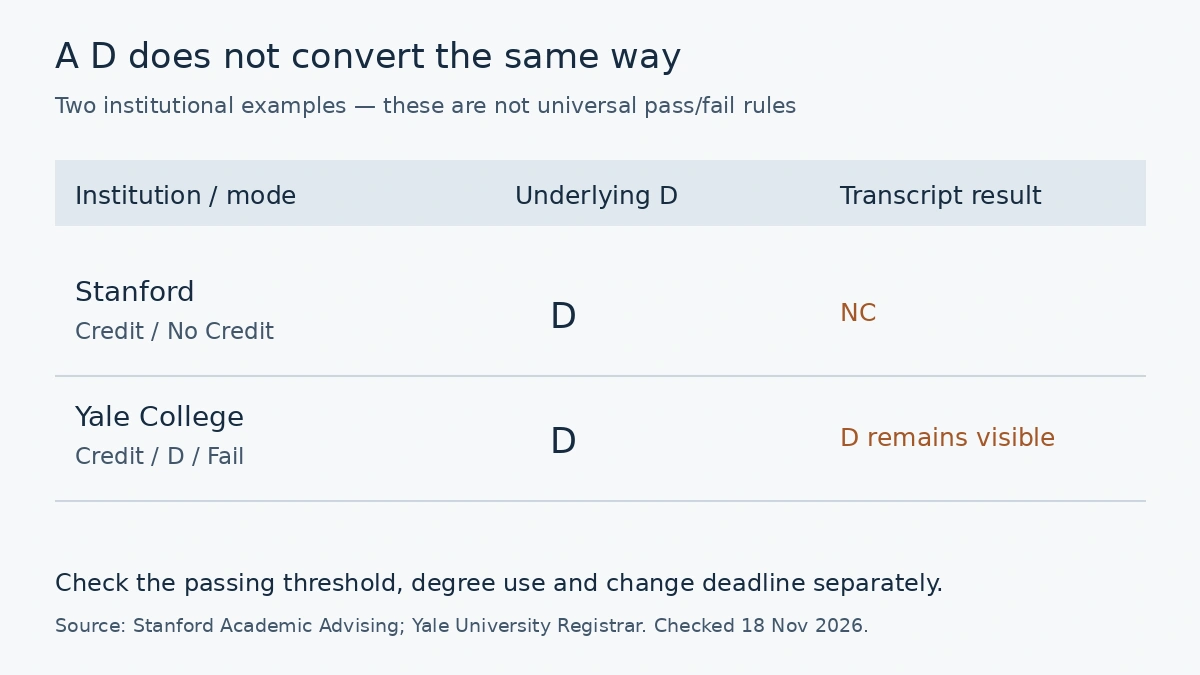
Begin with the registrar’s definition, including the treatment of a low result. Stanford’s advising guide says Credit/No Credit requires the equivalent of C− or better to earn CR. An underlying D becomes NC, although a D would normally pass under its letter-grade system. Its CR/NC and S/NC outcomes do not affect GPA.
That is materially different from Yale College’s Credit/D/Fail system. Yale converts grades from A through C− to CR, while grades in the D range and F remain on the transcript as reported. The word “Credit” therefore does not mean that every lower grade disappears.
Make a small note with the exact mode, passing threshold and transcript notation. Ask what happens both if you do well and if you fall short. A choice based only on the best outcome overlooks the result that may matter most when you are struggling.
Also distinguish an elective grading choice from a course offered only on a pass/fail basis. The availability of an alternative is itself part of the academic record. Do not describe a compulsory grading format as a student’s attempt to avoid a letter grade.
Check the requirement you expect the course to satisfy
A course can earn units without satisfying the particular box in your degree audit. Identify the intended use: major, minor, general education, elective or preparation for a later programme. Then find the grading rule for that use. A general policy that permits pass/fail does not automatically override a department’s requirement.
Yale’s registrar explicitly directs students to major-specific limits for Credit/D/Fail courses and identifies restrictions on applying CR towards certain distributional requirements. Stanford’s advising guide likewise warns that most university and major requirements need a letter grade. These are institutional examples, not a shared national rule.
Consider a fictional student, Nora, who wants to explore a sculpture course while majoring in economics. If it fills only an unrestricted elective and the applicable rules permit the chosen mode, pass/fail may fit the educational purpose. If Nora later decides to add an art minor, the same course may need a new review. Its usefulness depends on the requirement, not on whether the subject seems unrelated today.
Ask about subsequent use before you decide: a transfer institution, professional programme or certification body may apply its own conditions. Request a written answer from the relevant office when the course matters to a specific plan. Do not assume that a current adviser can bind another institution’s future evaluation.
Treat the deadline and reversal rule as separate checks
Find the calendar for your actual term and student group. A deadline mentioned in a general help page is not a substitute for a dated academic calendar, especially in a short session. Write down the last permitted change time and the office responsible for resolving an error.
The examples again differ. Stanford’s guide describes switching grading basis within its grading-basis deadline when the course offers both options. Yale College says a Credit/D/Fail election cannot be reversed once selected. Importing one institution’s rule into another can turn a supposedly temporary choice into a lasting one.
Do not wait for an imagined “last chance” after a final grade. If you are unsure, arrange an advising conversation with enough time to act through the official process. An email asking a question may not itself submit a grading election or preserve a deadline.
After an approved change, reopen the course record and verify the actual grading mode. Keep the confirmation. If the system still shows the old mode, contact the appropriate office promptly with the course, section, term and confirmation details. Avoid assuming that pressing Save completed the change.
Make the choice with the course’s purpose in view
Write a short decision statement: “I want this course for this requirement; this mode is allowed; these outcomes earn usable credit; this is the change deadline.” If one part is unknown, that identifies the next question. It is more useful than asking whether pass/fail is generally “good” or “bad.”
For a course with a worried grade forecast, use the actual assessment rules first. Our guide to calculating weighted course grades explains why averaging percentages without their weights can mislead. A prediction is still uncertain; do not treat a rough estimate as a guaranteed final mark.
Next compare the educational trade-off. Would the grading choice let you attempt a challenging elective while continuing to complete its work? Or would losing a required letter grade create a later repeat or delay? Pass/fail changes the record of assessment; it does not supply missing prerequisite knowledge or remove the course’s assignments.
When a course is already going badly, discuss support as well as grading. Ask about feedback, study approaches and the official alternatives available in your circumstances. Avoid assuming that a non-letter mode will erase an unsuccessful result, protect every form of eligibility or satisfy a future admissions requirement.
The practical endpoint is a verified course-level decision, not a universal verdict on pass/fail. Keep the relevant policy link and written clarification with your plan, and revisit them if you change majors, transfer plans or professional goals. Rules should be checked again before another term; a choice that fit one elective may not fit the next.
Institutional examples checked 18 November 2026. Reverify the current catalogue, department rules and term calendar before electing a grading mode. Original decision examples by NewsThreads247 Editorial; no admissions outcome or personalised academic advice is promised.