

A film can credit one person for story and another for screenplay because those labels recognise different writing contributions. “Written by” can combine the two. Even the difference between an ampersand and the word “and” can tell a viewer something about how a writing credit is organised.
The clearest way to read them is to start with the credit actually shown, then apply the rules relevant to that production. This guide uses the Writers Guild of America’s rules for covered theatrical films. It does not claim that every Indian film, independent production or television programme follows the same contractual system.
In this article
Read the role before comparing the names
The WGA Screen Credits Manual distinguishes story contributions such as the basic narrative and character development from screenplay contributions involving scenes and dialogue. Under its rules, Written by is used when the credited writer or writers are entitled to both Story by and Screenplay by.
That makes “story” more specific than a casual claim to have suggested an idea over lunch, and “screenplay” broader than typing dialogue after someone else supplied everything important. Read them as credit categories rather than a ranking in which one kind of writer automatically matters more.
Imagine a fictional film about two siblings deciding whether to sell their family shop. A story discussion might concern the central conflict and how the siblings change. A screenplay discussion might concern the scenes through which that conflict unfolds, their sequence and the spoken exchanges. This is an explanatory distinction, not a claim that a real project must divide its work between two people.
A credited name identifies an attributed role under the applicable system. It does not let a viewer calculate the hours worked, decide whose draft was best, or award every memorable line to one person. Those claims require evidence beyond the short credit.
Notice “&” and “and” without inventing a production story
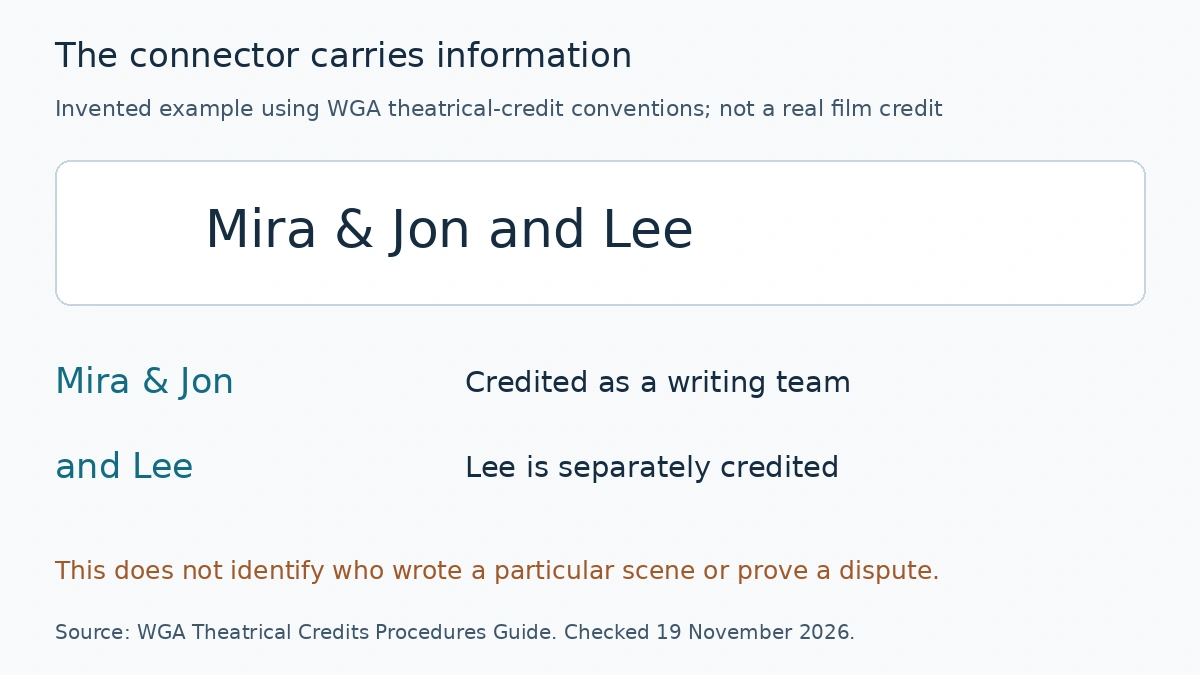
The WGA Theatrical Credits Procedures Guide says an ampersand joins writers who worked as a team, while the word “and” joins writers who did not work as a team. Preserve that punctuation when you transcribe a credit; replacing both with a comma loses information.
For example, the invented credit “Mira & Jon and Lee” presents Mira and Jon as a team, with Lee separately credited. It does not identify a real film or writer. Nor does it prove who wrote a specific scene, the order of every draft or whether the writers disagreed.
That limit matters when reading publicity or social discussion. A list of three names may be flattened into “three co-writers,” while the actual credited grouping communicates something more precise. Return to the complete credit before repeating a claim about collaboration.
Do not turn the connector into gossip. The fact that people were not credited as a team does not establish conflict, dismissal or personal dislike. It also does not supply a percentage breakdown of their contributions.
Keep an adaptation’s source credit separate
A film based on a novel or another work can acknowledge that source as well as crediting its screenwriting. The manual’s source-material categories include previously published or exploited material on which the screenplay is based. A source acknowledgement and a screenplay credit answer different authorship questions.
Suppose the fictional family-shop film adapts an invented novel. A “based on” acknowledgement would direct the viewer to the underlying work; the screenplay line would identify the screenwriting credit. One should not be silently substituted for the other when describing who wrote the film.
Read the complete wording. A review that says only “written by the novelist” may hide the adaptation step if the screen credit names someone else for it. Conversely, naming only the screenwriter can leave out the source work a reader wants to find.
Our guide to remakes, adaptations and sequels addresses the relationship between stories. A writing-credit check asks a different question: which contribution does this particular production attribute to each credited person?
Use final credits before a shortcut cast listing
Start with the film’s final on-screen credits or the production’s official credit information for the edition you watched. Record the full role, spelling, grouping and source acknowledgement. A short promotional listing may omit a category or shorten a name list.
Under the WGA credits system, the credit process concerns covered work and has procedures for determining the final attribution. Do not treat a tentative announcement, a draft’s cover page and the released film’s credit as interchangeable evidence.
A missing primary writing credit also does not, by itself, prove someone contributed nothing. The Guild identifies a separate Additional Literary Material credit for qualifying participating writers who do not receive the specified principal writing credits. Avoid turning an incomplete listing into a claim about the entire production history.
If two reliable records differ, identify what each actually is: an early announcement, a released-film credit or a later correction. Leave an unresolved attribution uncertain. A public database can help locate information, but it does not replace the relevant primary record when the exact wording is disputed.
Know where the explanation stops
A viewer’s careful reading is different from deciding a writer’s contractual entitlement. That decision can depend on the applicable agreement and submitted material. This article does not offer a formula for assigning credit from a synopsis, counting scenes or comparing online drafts.
For a television episode, check the television-specific guidance rather than importing every theatrical rule. For a film outside WGA coverage, establish the relevant production and contractual context. The English words can look familiar while the governing rules differ.
Before sharing a credit claim, make a brief check: the exact film and edition, the complete writing line, its connectors, any separate source credit, and the primary source supporting the statement. Then make only the claim that evidence permits.
The reward for noticing credits is a clearer understanding of the work, not a verdict on writers’ private relationships. Preserve what the film and applicable rules actually establish, and distinguish your interpretation of the finished story from a factual account of how it was written.
WGA theatrical-credit sources checked 19 November 2026. Reverify the applicable current manual and the specific film’s final credits before making an attribution. All names and the family-shop example are fictional. Original reader method by NewsThreads247 Editorial; no filmmaker interview, Guild membership, production access or legal expertise is claimed. Images are disclosed original AI editorial illustrations.