

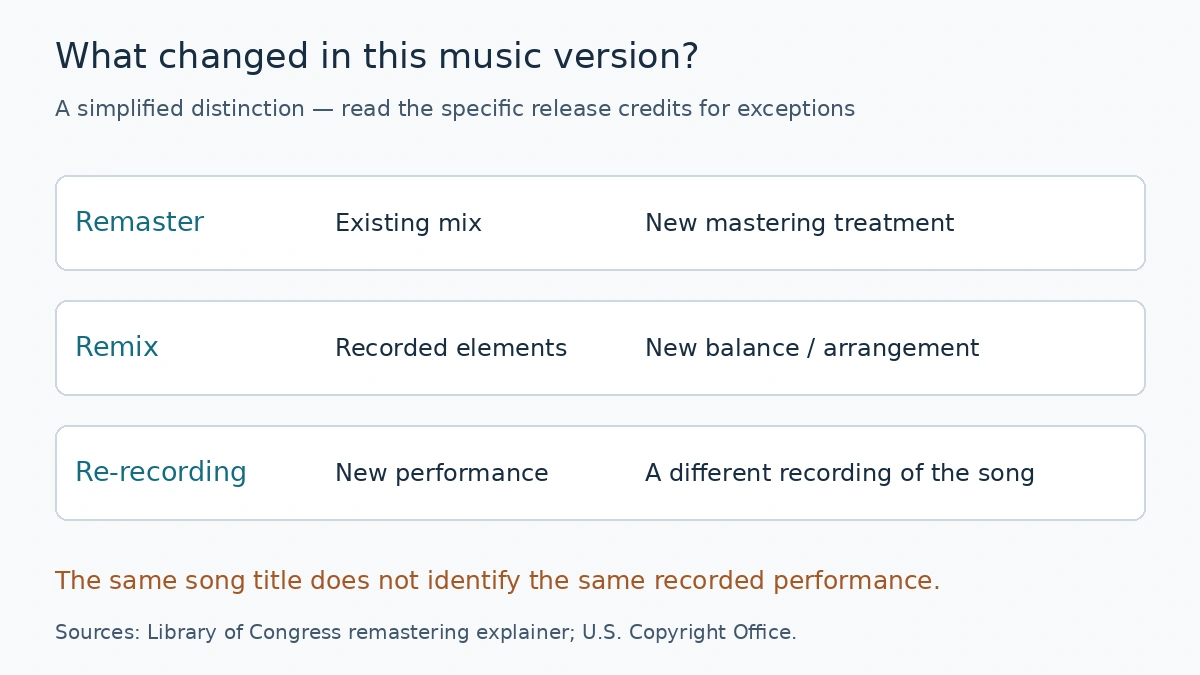
A remaster usually revisits the mastering of an existing mix. A remix changes how recorded elements are combined. A re-recording captures a new performance of the song. Those distinctions explain why two releases with the same song title can offer very different listening experiences.
Before buying a reissue or saving an album to your library, identify what has actually changed. “New version” is not a sound-quality verdict. This guide combines production explanations with a practical way to read credits; it does not claim a listening test of any particular album.
In this article
Separate the song from the recorded performance
Start with two questions: is this the same song, and is it the same performance? A song can be performed and recorded more than once. The US Copyright Office’s sound-recording guide distinguishes the underlying music and lyrics from the recording of a performance. Its legal explanation concerns US copyright, but the distinction is also useful when reading a release list.
A re-recording is a new recording of the song rather than simply another treatment of the old finished audio. The singer may be the same person, yet the phrasing, instruments, arrangement or performance can differ. The title alone cannot tell you whether you are hearing the performance you remember.
Do not infer the business reason from the sound label. A new recording may have a documented artistic or commercial explanation, but that explanation needs evidence for the specific release. Nor does “original” settle every question: it can refer to an earlier performance, a mix or an edition. Ask what the description is identifying.
For a listener seeking a familiar recording, the first useful evidence is the performer and recording information, followed by the version credits. For someone exploring a new interpretation, a different performance may be the attraction. Neither preference requires declaring one version universally superior.
Locate the change: the finished mix or its ingredients
A Library of Congress explainer by Cary O’Dell and Alex Emrich draws a practical distinction. Remixing returns to recorded elements and recombines them; remastering generally treats the finished mix as a whole. A remix can change the balance, effects or arrangement. Remastering can adjust the overall presentation for release and playback.
Think of a vocal that seems more prominent. That observation alone does not establish the process used. Read the credited description rather than diagnosing an engineering workflow from a short comparison. Releases and promotional labels can describe complex projects more loosely than a simple definition does.
Abbey Road’s mastering and remastering explanation describes remastering as repeating the mastering process and says that an earlier master need not have been flawed. Where possible, engineers may return to unmastered sources. That does not mean every remaster uses the same source quality or makes the same choices.
An anniversary package can include several kinds of work: a remastered original mix, a new mix and separate live or alternate performances. Read track-level information as well as the box’s large headline. A single marketing phrase may not identify every disc or track in the package.
Read the edition details before comparing prices
Use the label or artist’s official release description, the physical booklet where available and the listing for the exact edition. Look for the mix being supplied, mastering or remix credits, source descriptions and included material. Keep the format and edition aligned when comparing offers.
A release date and a recording date answer different questions. An old performance can appear in a newly issued remaster. A recent release date therefore does not by itself prove that the artist returned to the studio. Likewise, a year in a track title is a clue to investigate, not a full account of the production.
The same caution applies to broad labels such as deluxe, expanded or anniversary edition. They may identify extra tracks or packaging without specifying a new mix. Establish which recordings and versions are included before deciding whether the additional material matters to you.
A fictional example makes the check concrete. Suppose a shop offers a “remastered original mix” and a “new stereo mix,” both of the same album. If your aim is to retain the familiar mix, investigate the first. If you want to hear an alternative balance of the recorded elements, investigate the second. The example does not describe a real album or promise that either will sound better.
Now add a third listing explicitly described as a new recording. It belongs in a different comparison because the performance itself has changed. Check the credited performers and recording details rather than treating its price as the price of another mastering option.
If a description is vague, ask the seller for the exact catalogue or edition information and the source of its version claim. A clear answer can be more useful than a prominent “remastered” sticker. When the information remains unavailable, treat the version as unconfirmed rather than inventing a provenance.
Compare for your purpose without turning preference into proof
Begin by stating what you want: the recording you grew up with, an alternative mix, additional performances or a particular physical edition. That narrows the decision more effectively than asking which version is “best” for everyone.
When you can legally preview both versions, compare the same passage at a comfortable, broadly similar listening level. Keep the playback device and settings consistent. A louder presentation can attract attention; it is not by itself proof of more detail or a better source. This is a suggested comparison method, not a result from tests conducted for this article.
Listen for the aspects that matter to your purpose, such as a changed vocal placement, a different ending or a newly performed passage. Describe what you hear with appropriate limits. Hearing a difference does not establish the tape lineage, mastering equipment or commercial motive behind it.
Also separate the version from the way it is delivered. A file-format label, streaming tier or physical format does not identify whether the music is the original mix, a remix or a new performance. Our guide to finding film music by its credits applies the same useful habit: identify the work and recording before choosing a release.
Keep a small record of the exact edition you prefer, including the credited version and the source of that information. If a service changes the available album or a seller substitutes a different edition, compare again. A useful choice is one you can explain in terms of the music and material you wanted, with uncertain claims left uncertain.
Sources checked 19 November 2026. Simplified production distinctions should be verified against each release’s actual credits. Original comparison method and fictional edition example by NewsThreads247 Editorial; no first-hand studio reporting, album testing or artist interview is claimed. Feature and contextual images are disclosed AI illustrations, not photographs of an actual release or session.