
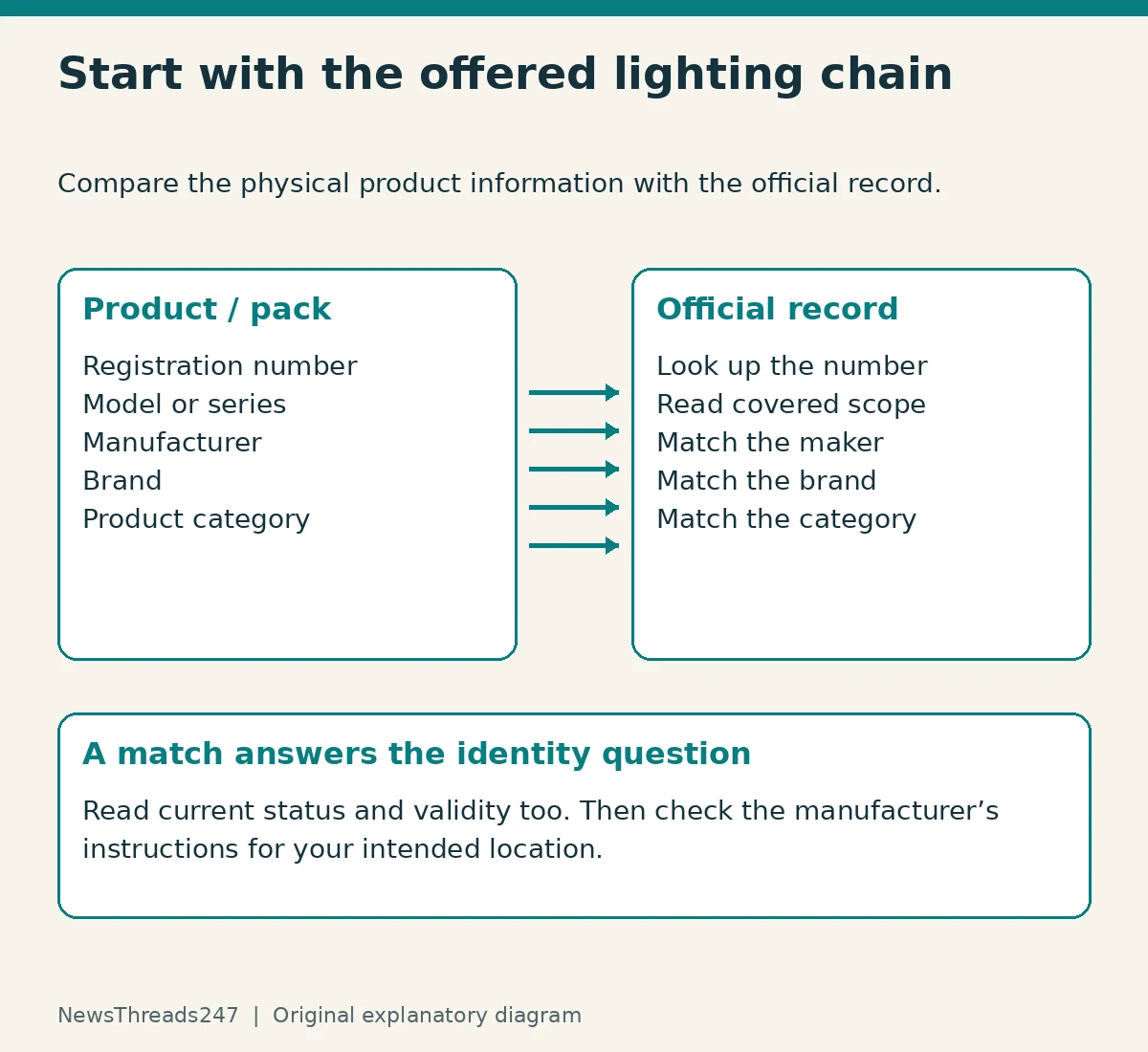
For shoppers in India, the useful check on a box of Diwali LED lights is whether its BIS registration belongs to that product. A printed number, a seller’s certificate photograph or the words ‘BIS approved’ should be the beginning of the enquiry. Match the actual lighting chain to the official registration details, then decide whether its instructions suit the place where you want to use it.
There is a reason to check the current record rather than memorise one standard year. On October 29, 2026, the BIS Compulsory Registration Scheme standards list includes LED Lighting Chains against both IS 10322 (Part 5/Sec 7):2017 / IEC 60598-2-20:2014 and a 2026 edition. That listing alone does not establish a withdrawal deadline for every older-labelled pack. This guide does not declare stock invalid simply because its printed year is 2017.
Identify the product before checking the number
Start with the box you will receive, not a general photograph of a similar string. Record the product description, model or series code, brand, manufacturer and registration number. For an online purchase, ask for a readable photograph of those details on the actual offered model. A listing showing several lengths or power options deserves more attention: confirm which code belongs to your selected option.
The distinction matters because decorative lighting is not one undifferentiated product. BIS lists lighting chains, rope lights, fixed luminaires and self-ballasted LED lamps in separate entries. A registration result for a bulb is not evidence about a string of lights merely because both carry the same retail brand. Compare the named category as well as the number.
Keep the seller’s identity separate from the manufacturer’s. A shop or marketplace seller may sell goods made by another business. The practical question is whether the product and brand being offered fit the registration record, not whether every name on an invoice is identical. If the seller cannot explain a mismatch, pause the purchase rather than filling the gap with an assumption.
Use the CRS verification route
BIS describes ‘Verify R-Number under CRS’ in BIS Care as the route for checking electronic-product registration. Enter the number shown on the product information and read the result. Do not use the jewellery HUID search for an electrical product: these are different identifiers and verification services.
BIS’s official app listing explains that verification can provide manufacturer details, registration validity, covered varieties, brands and current status. Those fields make a better comparison than a green tick in a seller’s message. Save a dated record of what you checked alongside the pack photographs and invoice, so a later question concerns an identifiable item.
Read the result as a whole. Ask whether the product category is right, whether the maker and brand are consistent, and whether the model or covered scope includes the offered item. Check the displayed status and validity rather than relying on an old certificate’s issue date. A real registration number for another item would not resolve your purchase question.
A worked comparison without a real registration number
Imagine two fictional listings for a warm-white lighting chain. Listing A gives a readable model code and registration number. Its current official record identifies the same manufacturer and brand, the lighting-chain category and a scope covering that model. That resolves the identity comparison; it is still necessary to read the product’s use instructions.
Listing B shows a certificate photograph, but the visible record describes a different lighting product and the seller will not provide the offered model’s code. You have not established that the proposed purchase is covered. The sensible next step is a request for matching details or a different product, not an accusation that the entire brand is counterfeit. These examples illustrate a checking method; neither represents a tested product or a real licence lookup.
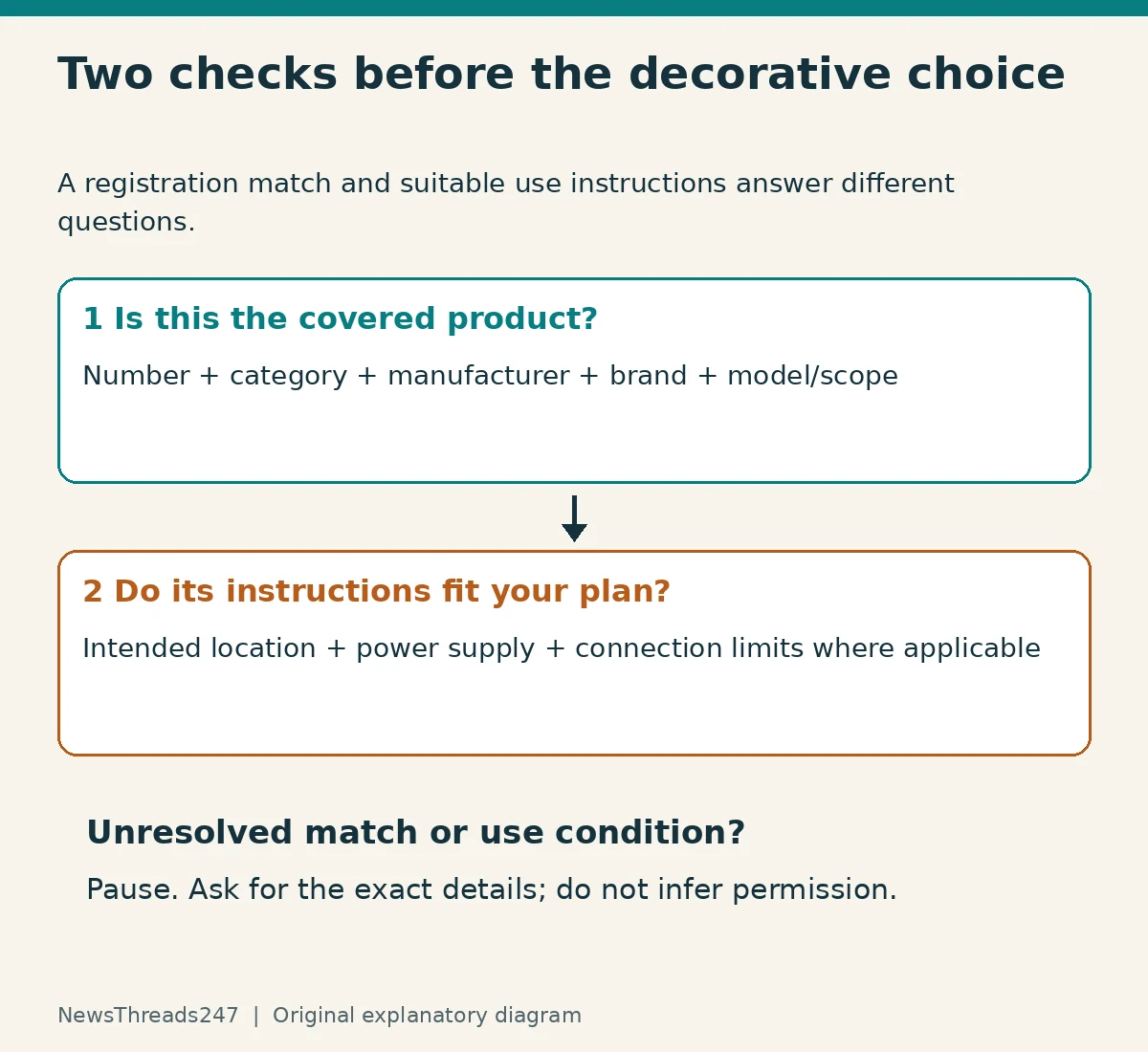
Registration and your intended location answer different questions
BIS explains that manufacturers apply for CRS registration after testing through recognised laboratories and may then use the notified Standard Mark for conforming articles. That is the scheme’s conformity process. It is not a personalised assessment of your balcony, extension arrangement or weather exposure.
Before paying, write down your intended location and compare it with the supplied instructions: indoor room, sheltered area or an exposed outdoor position are different requests. Ask for the manufacturer’s stated conditions, power-supply requirements and connection limits where applicable. Do not translate an unsupported ‘waterproof’ sales description into permission to use the set anywhere. If the instructions leave your use unresolved, choose an alternative with clear information or seek qualified installation advice.
Treat that as a separate decision from decorative preferences. Colour, pattern, length and price can narrow a shortlist, but they cannot explain a registration mismatch or a missing instruction. Checking suitability before ordering also avoids discovering, after the lights arrive, that the planned position is outside the product’s stated use.
If a record is missing or the answer is unclear
A failed search is an unresolved check, not by itself proof of forgery. Recheck the digits and identifier type, then ask the seller or manufacturer for the exact product details. A temporary service problem should not become an excuse to accept an unrelated certificate. Keep the item uncommitted while the question remains open.
Where a standard transition is the unresolved issue, ask BIS or the manufacturer for the applicable current notice and the registration’s position. Do not rely on a blog’s standard year to invent an effective date. The official list observed for this guide shows both editions; a product-specific conclusion needs more than that list.
BIS Care also provides a complaints route for suspected misuse of its marks or problems with marked products. Preserve the packaging details, purchase record and the mismatch you observed. Describe the evidence precisely: for example, the number returned another category, or the model could not be matched. Avoid claiming that you conducted electrical testing when you only checked records.
The purchase decision can now be specific: proceed only when the product identity and intended use are sufficiently clear, or leave the unresolved item behind. If you are also comparing festive jewellery purchases, our gold hallmark and HUID guide covers that separate BIS check. A jewellery identifier must not be substituted for an electrical-product registration.
Sources and visual credits
Official sources were checked on October 29, 2026. This is a consumer record-checking explainer, not a product test, BIS endorsement or installation assessment. Featured art is an AI-generated conceptual illustration of generic lighting, not a photograph of a certified model. The two explanatory graphics are original NewsThreads247 diagrams; no real registration number or BIS interface is reproduced.