
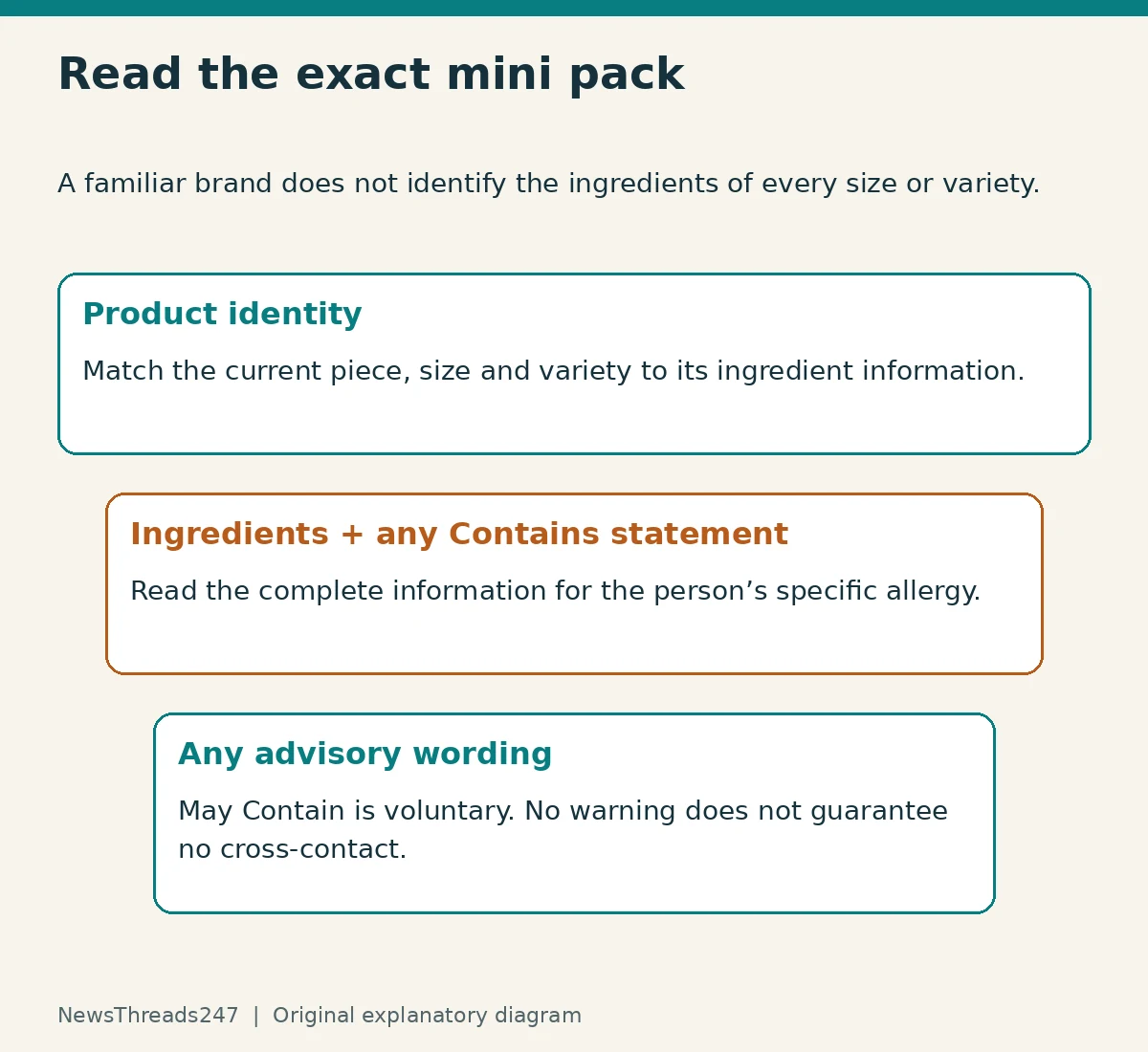
For US families managing food allergies, check Halloween candy labels on the exact product and size before the treat is eaten. A familiar brand or a full-size bar that worked before is not enough information about a mini version. If the piece has no usable ingredient information, set it aside and choose an appropriate alternative rather than guessing from its wrapper colour.
With October 31 approaching, the immediate problem is often a mixed bag of individually wrapped sweets, not a supermarket shelf with every outer pack available. This guide turns current FDA, Food Allergy Research & Education (FARE) and American Academy of Pediatrics advice into a sorting plan. It is not a list of candies guaranteed safe for every allergy.
Keep the product identity with the ingredient information
FARE’s Candy Facts guidance notes that mini candies can have different ingredients from larger versions, and that a previous year’s favourite needs another label check. The American Academy of Pediatrics also warns that smaller versions may use different ingredients or equipment. That is a reason to verify the exact piece, not a claim that every miniature recipe has changed.
When buying treats yourself, keep the outer package until the individually wrapped pieces have been assessed. Note the variety and size you actually bought. A mixed bag containing several products should not acquire one reassuring label in your mind: each type needs to remain identifiable. A photograph can help retain information, but it is useful only if it belongs to the specific pack in front of you.
For treats collected from other households, a detached wrapper may leave more questions. Do not borrow the ingredient list from a similar-looking item in the bowl or from an old shopping order. If you cannot establish what the piece is and read the relevant information, place it in the unresolved pile. That is an information decision, not a judgement about the neighbour who offered it.
Read ingredients even when you see no Contains box
The FDA explains that major-allergen information on most packaged foods it regulates may appear in the ingredient information or in an adjacent Contains statement. A separate Contains box is not required on every allergen-containing product. Read the full ingredient list rather than searching only for that one heading.
Contains and May Contain do different jobs. A Contains statement identifies major allergens used as ingredients. May Contain or a shared-facility advisory concerns possible unintended presence and is voluntary. Its absence therefore is not a guarantee that cross-contact cannot occur. Do not rank two products as safer merely because one uses a shorter advisory phrase; follow the person’s clinician-provided allergy guidance and resolve relevant uncertainty with the manufacturer.
A useful question is more precise than ‘Is this brand allergy-friendly?’ Identify the product, flavour and size, state the allergen you need information about, and ask about the unclear ingredient or manufacturing point. Keep the answer tied to that product. If the response is generic or does not settle the concern, it has not supplied a reason to serve the treat.
Three sorting decisions for a mixed Halloween bag
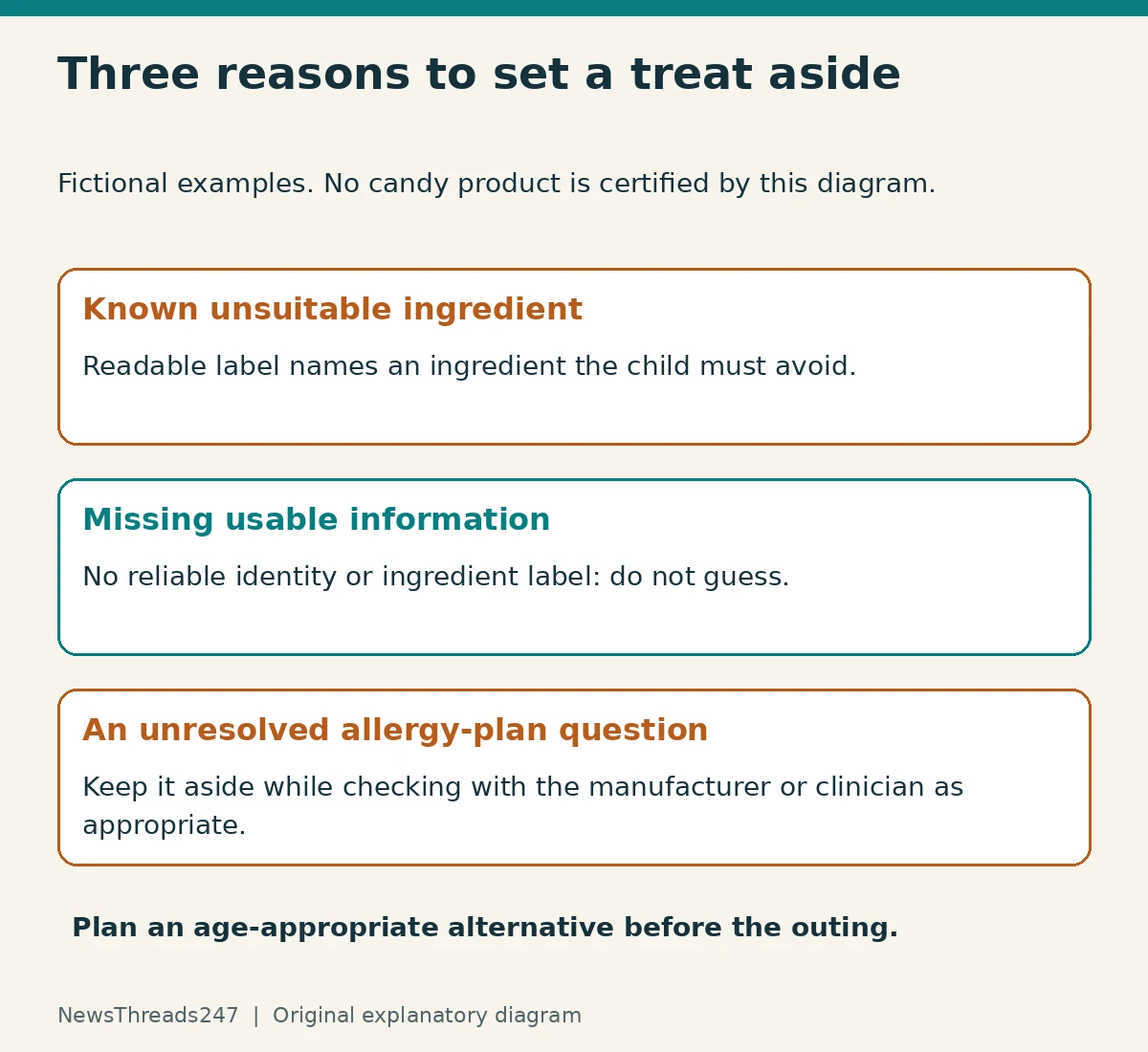
Use a fictional example of a family reviewing three pieces. The first has a readable current label naming an ingredient the child must avoid: it belongs outside the child’s eating pile. The second is familiar but its label is missing: familiarity does not close that information gap. The third is identifiable and has readable information, but an advisory statement raises a question under the child’s allergy plan: keep it aside while that question is resolved.
The point of this comparison is to avoid making the same kind of assumption three times. A known unsuitable ingredient, missing identity and unresolved advisory are different reasons to stop. None should be converted into ‘probably fine’ because the wrapper is small or because another child ate one. The diagram separates those decisions without certifying any product as allergen-free.
Decide in advance who will do the checking. A parent, caregiver or responsible accompanying adult can keep the process consistent with the family’s plan. A short note about the unresolved product can be more useful than repeatedly re-reading a growing heap. Keep the wrapper with that note so a manufacturer enquiry does not begin with a guess about which candy it was.
A wrapper check comes before an allergy check
The FDA’s Halloween advice recommends waiting until an adult has inspected collected treats, choosing commercially wrapped items and discarding suspicious ones. It identifies damaged wrappers, tiny holes and unusual appearance among things to notice. An intact wrapper still does not answer the separate question of ingredients for a child with an allergy.
The same FDA guidance advises that a child with a food allergy should not eat home-baked goods received while trick-or-treating. Do not try to turn an unlabeled brownie into a labelled product by comparing it with a shop-bought one. Also consider age-appropriate choking hazards when sorting: small toys are not automatically suitable simply because they are not food.
Make the alternative part of the evening
A planned swap gives the child something to look forward to when a treat cannot be used. FARE’s trick-or-treating guidance suggests non-food alternatives and preparation with neighbours. A small activity, sticker sheet or other age-appropriate option can replace the unresolved item without requiring an immediate verdict on its ingredients.
For hosts, offer non-food options in a way that lets families choose. Describe what you have rather than promising that everything in the bowl is ‘allergy-free’. Keep any relevant packaging available for questions. A welcoming choice is more useful than a broad assurance that cannot describe every visitor’s needs.
The American Academy of Pediatrics’ Halloween advice also stresses informing accompanying adults about the allergy and emergency response. Keep prescribed medication and the clinician-provided emergency plan available as directed. A label-sorting system supports preparation; it does not replace that plan or medical care.
If costumes are part of the evening, deal with other product decisions ahead of the outing too. Our US guide to decorative contact lenses explains why the purchase needs a prescription and proper fitting. Making those choices early leaves the food check as a deliberate step, rather than another rushed decision at the door.
Sources and visual credits
Official and specialist sources were checked on October 29, 2026. This is general US consumer information, not an individual medical assessment or a product safety guarantee. Featured art is an AI-generated conceptual illustration with fictional generic packaging; its blurred label must not be used as ingredient information. The two original NewsThreads247 diagrams explain a checking process and do not reproduce real candy labels.