
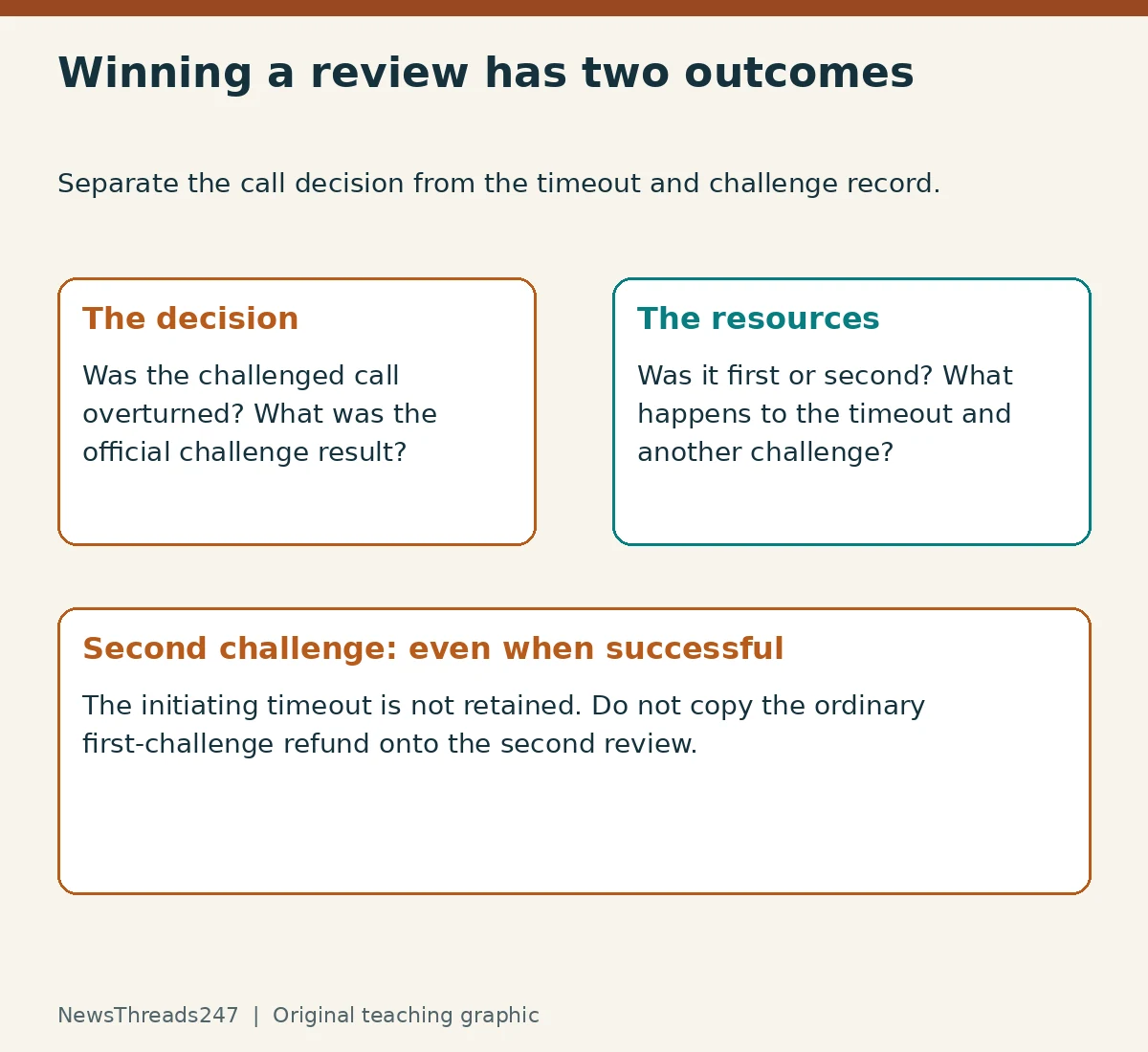
A successful second NBA coach’s challenge still costs the team the timeout used to initiate it. Winning the decision does not refund that stoppage. The easier way to follow the review is to keep two separate records: what happened to the challenged call, and what happened to the team’s remaining challenges and timeouts.
For US viewers following the 2026–27 NBA season, this is an established rule worth distinguishing from a new announcement. The league expanded the challenge system for 2023–24. Its July 11, 2023 official release explains the second-challenge entitlement and its timeout cost. This guide was checked against the current online Rule 14 on October 29, 2026; it does not apply to every basketball competition or special-event format.
Record the entitlement before interpreting the celebration
Each team starts with one challenge and earns a second if the first is successful. The 2023 NBA announcement also makes the prerequisite clear: an available timeout is needed to use either challenge. A team that has earned another review therefore still needs the means to initiate it. A remaining challenge and a remaining timeout are related resources, not interchangeable ones.
Think of the broadcast as displaying two separate counters. One answers ‘Can this team challenge again?’ The other answers ‘How many timeouts remain?’ After a decision, update both. A coach may be pleased with an overturned call while also having fewer stoppages left for the rest of the game. The reaction from the bench cannot tell you which counter changed.
A fictional two-review ledger
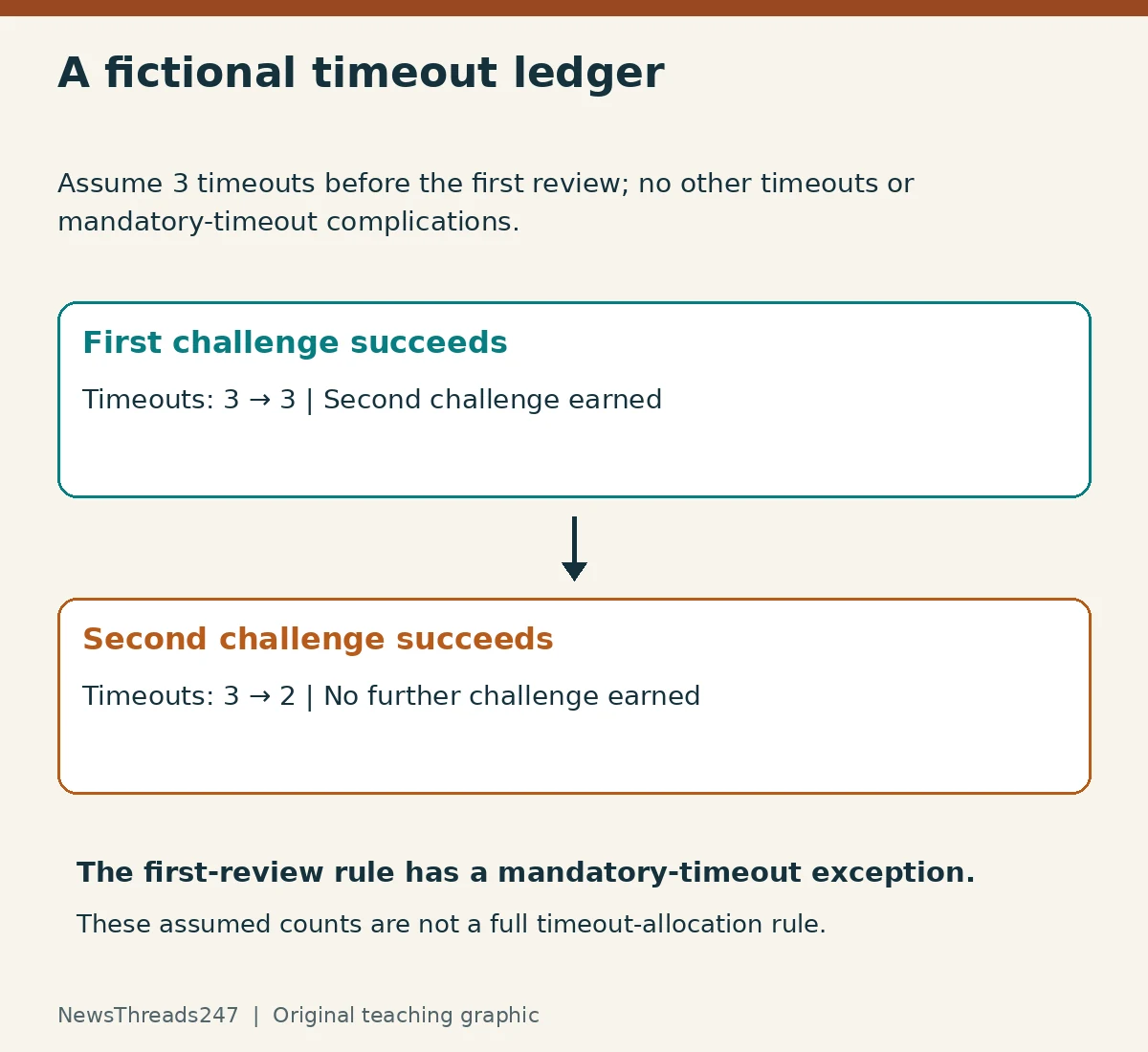
Suppose a team has three available timeouts before a valid first challenge. Assume no other timeout is called, no mandatory-timeout complication applies and the first challenge succeeds. It has earned the second challenge and retains the timeout used for that first review. The illustrative timeout count remains three.
Later, assume the same team uses its second challenge and again wins the decision. That review still consumes its initiating timeout: the illustrative count falls from three to two. The example is bookkeeping, not a report about an actual game, and the starting number is an assumption rather than a claim about the league’s full timeout allocation.
Now change only one fact: the first challenge fails. The team has used that challenge and its initiating timeout, rather than earning the extra review. This comparison explains why the sequence matters. A successful review late in the game cannot be understood from the word ‘successful’ alone; establish whether it was the first or second challenge.
The mandatory-timeout exception changes the first-review shortcut
The phrase ‘win the first challenge, keep the timeout’ needs a qualification. Rule 14, Section V says the team retains the initiating timeout on a successful first challenge unless that timeout initiated a mandatory timeout. The rule also sets out allocation when a challenge coincides with the opponent’s timeout. Do not use a simple refund slogan to override those circumstances.
When a televised sequence looks inconsistent, reconstruct the order instead of assuming a scoring error. Identify whose timeout was underway, whether it was mandatory, and which challenge the team used. Those are better questions than whether the replay decision appeared favourable. The ordinary example above deliberately removes those complications so that its arithmetic is readable.
A changed detail does not always make a foul challenge successful
For a challenged foul, Rule 14 distinguishes overturning the foul from changing another reviewable detail. If it remains assigned to the player originally called for it, the challenge is unsuccessful even when another change helps the team. The rule expressly includes a shooting foul changed to a non-shooting foul on the same player.
Consider the viewing mistake that can follow: the announcement improves the team’s immediate position, so a fan writes ‘won’ in the challenge column. That conclusion skips the actual test. Listen for the disposition of the foul charged to the original player, then check the official challenge outcome. A beneficial adjustment and a successful challenge are different descriptions.
Out-of-bounds reviews can involve more than last touch
A separate historical change explains another source of surprise. In its September 10, 2024 release, the NBA expanded out-of-bounds challenge reviews to consider a nearby uncalled foul, starting in 2024–25. It identified the players involved, distance and elapsed time as factors in determining proximity.
That means a close-up showing the final fingertip need not tell the whole story of a review. Follow the officials’ explanation of the review’s permitted scope instead of treating one camera angle as a complete verdict. This is a reason to watch the sequence of events, not permission for a challenge to reopen any unrelated possession earlier in the game.
Nor should the existence of that review scope be mistaken for a general right to challenge every missed whistle. Identify the event that triggered the review before interpreting what officials may examine within it. The initiating call and the matters reviewed are separate questions; confusing them makes a limited replay rule sound unlimited.
A useful note while watching
Keep a short line for each review: first or second; call upheld or overturned; official success result; timeout consequence. Add ‘mandatory?’ when that is part of the announcement. This is a viewing aid, not a substitute for the official scorer or the rulebook, but it makes later discussion about the coach’s remaining options more precise.
The broader habit also helps when changing sports: read the named competition’s rules rather than borrowing another league’s counter or clock. Our NFL regular-season overtime explainer, for example, separates possession opportunities from the remaining period. In this NBA decision, the useful separation is the result of the review from the price of initiating it.
Sources and visual credits
Sources were checked on October 29, 2026. The examples use fictional teams and assumed timeout counts, not match reporting or a strategic recommendation. Featured art is an AI-generated conceptual basketball still life, not a photograph of an NBA game. Two original NewsThreads247 diagrams explain review bookkeeping and are not official scoreboards or league graphics.