
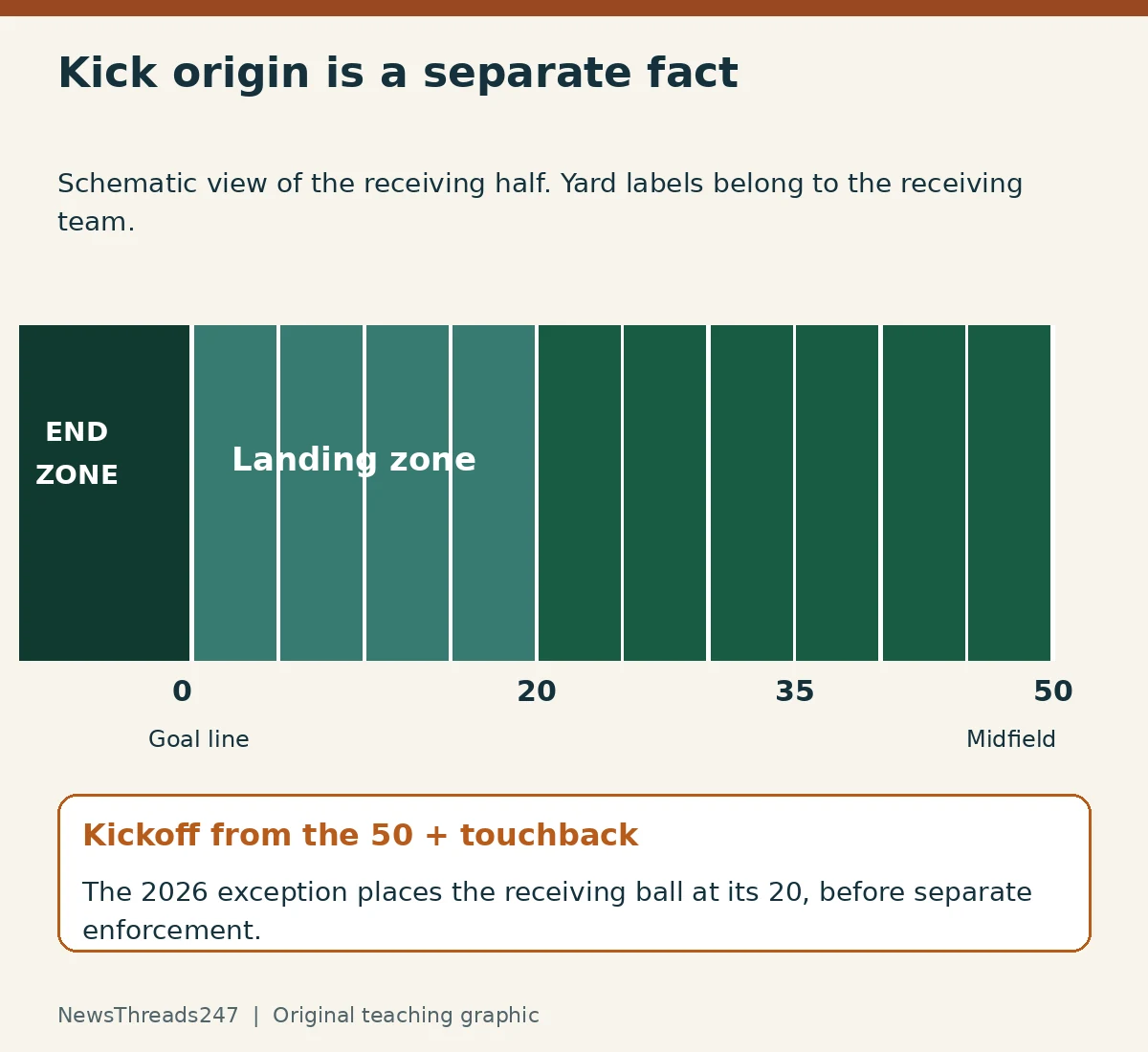
For NFL viewers in the United States, a kickoff taken from the 50-yard line that results in a touchback puts the receiving team at its own 20 in 2026. The familiar 35-yard touchback description does not cover that special case. Check where the kick began before applying the ordinary landing-zone distinction.
The confirmed 2026 change is recorded in the NFL’s 2026 rulebook page: Rule 6-1-5 modifies the touchback spot for kickoffs from the 50. Its linked final playing rules contain the operative exception. This explainer concerns NFL kickoffs; other touchback situations and other competitions have their own rules.
Find the kick’s origin before following its flight
In a normal broadcast, the camera’s attention quickly moves toward the returner. For this decision, note the kickoff location first. A ball kicked from midfield is a different starting fact from a kickoff at the usual location. Rewinding only the last few yards of its flight may omit the fact that selects the exception.
The final 2026 NFL playing rules, Rule 6, Section 1, Article 5, place a touchback at the 20 when a kickoff from the 50 ends that way. Do not turn that into ‘every midfield kickoff is automatically dead’: the condition is that the play results in a touchback. A return is a different outcome.
The new location is especially easy to overlook after a scoring sequence and an enforced penalty. The official Minnesota Vikings March 31 account of the approved rules uses a penalty moving the kickoff from the team’s 35 to the 50 as its illustration. Treat that as an example of how the kick can be moved, not as a claim that every penalty has the same enforcement.
What changed, and why the older shorthand can mislead
The NFL’s approved-rules summary described the purpose as removing an incentive to kick intentionally out of bounds when kicking from the 50. The change addresses an unusual kickoff location. For the final spot, use the season’s operative rule rather than a general description of the dynamic kickoff.
There is also a chronology trap. The league’s featured-rules page explains the 2025 move to a 35-yard spot for specified end-zone touchbacks. That remains useful background, but a 2025 summary cannot settle the later midfield exception by itself. A page’s availability today does not make every paragraph on it a description of the latest change.
A comparison that changes only the starting spot
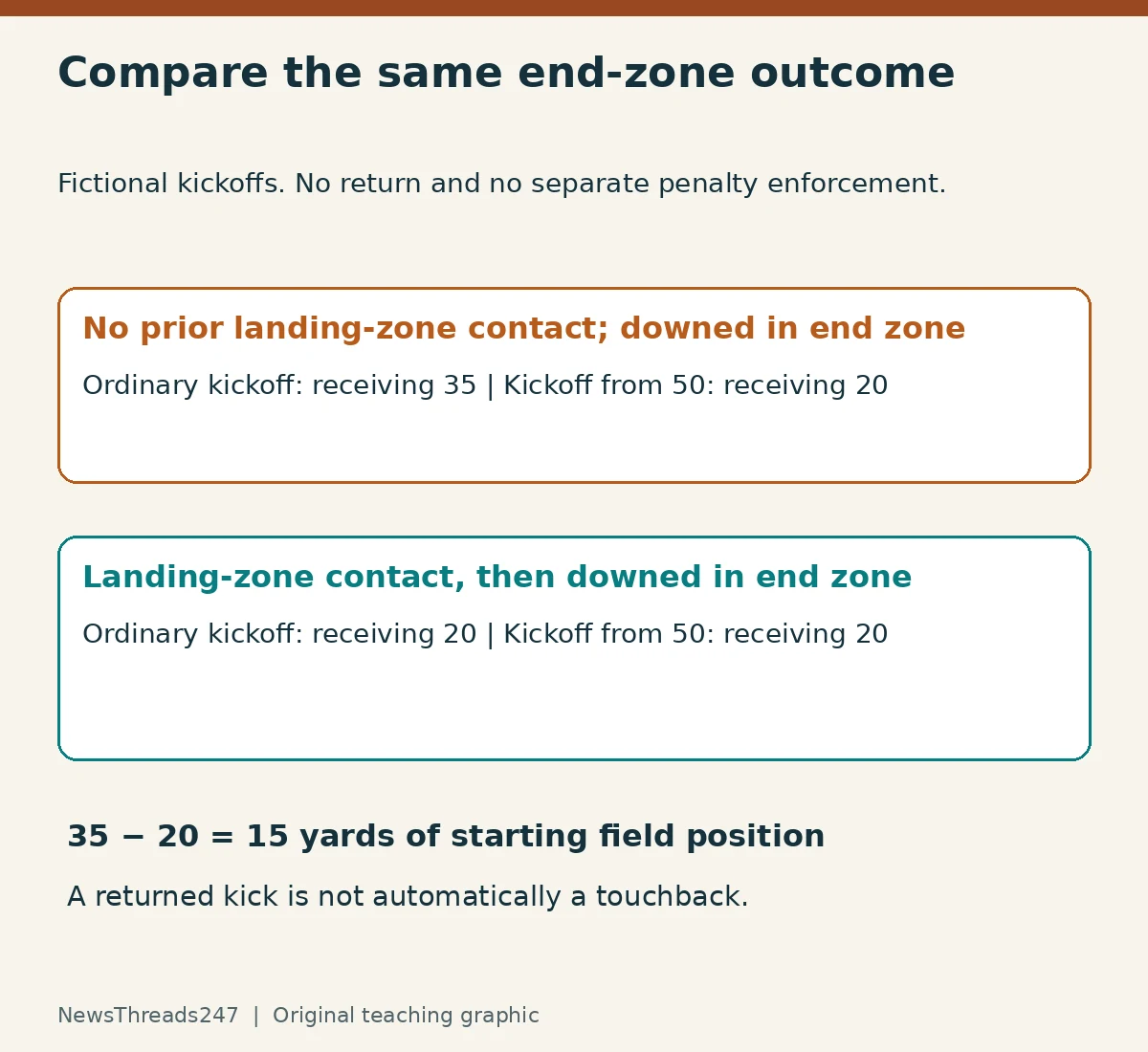
Consider two fictional, penalty-free plays whose kicks reach the end zone without first touching the ground or a player in the landing zone and are downed there. In the ordinary case, the Article 5 spot is the receiving team’s 35. Change the kick’s origin to the 50-yard line and the midfield exception makes that touchback spot the receiving team’s 20.
The difference in those starting positions is 15 yards: 35 minus 20. That is field-position arithmetic, not an estimate of points, win probability or the best kicking strategy. Isolating the origin in this example makes it clear why two end-zone images that look alike can lead to different starting spots.
Next, consider the landing-zone path. The rules define that zone from the receiving team’s 20 to its goal line. A kick touching the ground or a player there and then being downed in the end zone, or going out behind the goal line, falls under the ordinary 20-yard touchback branch. A midfield kickoff touchback also goes to the 20. In that comparison, changing the origin does not create another 15-yard adjustment.
These examples assume no return, no foul altering the final spot and no disputed sequence after possession. Add those facts and the official ruling may involve more than the touchback provision alone. Use the complete play announcement when comparing the final spot with these simplified examples.
Do not confuse the landing zone with the eventual spot
The landing zone describes part of the receiving end of the field. The dead-ball spot describes where a particular outcome leaves the ball. They are different pieces of information. Seeing a player wait deep does not establish which touchback branch applied, and hearing ‘touchback’ does not tell you the kick’s origin.
For the narrow midfield question, make a three-part note: kick from the 50; official result touchback; receiving ball at the 20 before any separate enforcement. For an ordinary kick, note any landing-zone contact as well. That note preserves the facts needed to explain the spot without reconstructing an entire drive from a highlight clip.
If the announced spot seems unexpected, check for a return, an out-of-bounds ruling between the goal lines, a foul or another enforcement detail. Those are reasons to examine the complete play announcement. The midfield-touchback shortcut cannot decide an event that was not ruled a touchback in the first place.
Use the correct rule year when revisiting a clip
A video from 2024 or 2025 can be an excellent illustration of the older game, yet a poor answer to a 2026 enforcement question. Keep the season, kick location and official result together when sharing an explanation. The change here was adopted before the 2026 season; the October source check is verification, not a new announcement of the rule.
For another NFL situation where two correct statements need to be read together, our 2026 regular-season overtime guide separates the possession opportunity from the 10-minute limit. On a kickoff, the comparable discipline is to establish the starting location before assuming a touchback spot.
Sources and visual credits
The final 2026 rulebook and official explanatory sources were checked on October 29, 2026. All play examples are fictional and omit separate penalty enforcement. Featured art is an AI-generated conceptual football still life, not event photography. The two original NewsThreads247 graphics are schematic teaching aids, not official NFL field or broadcast images.