
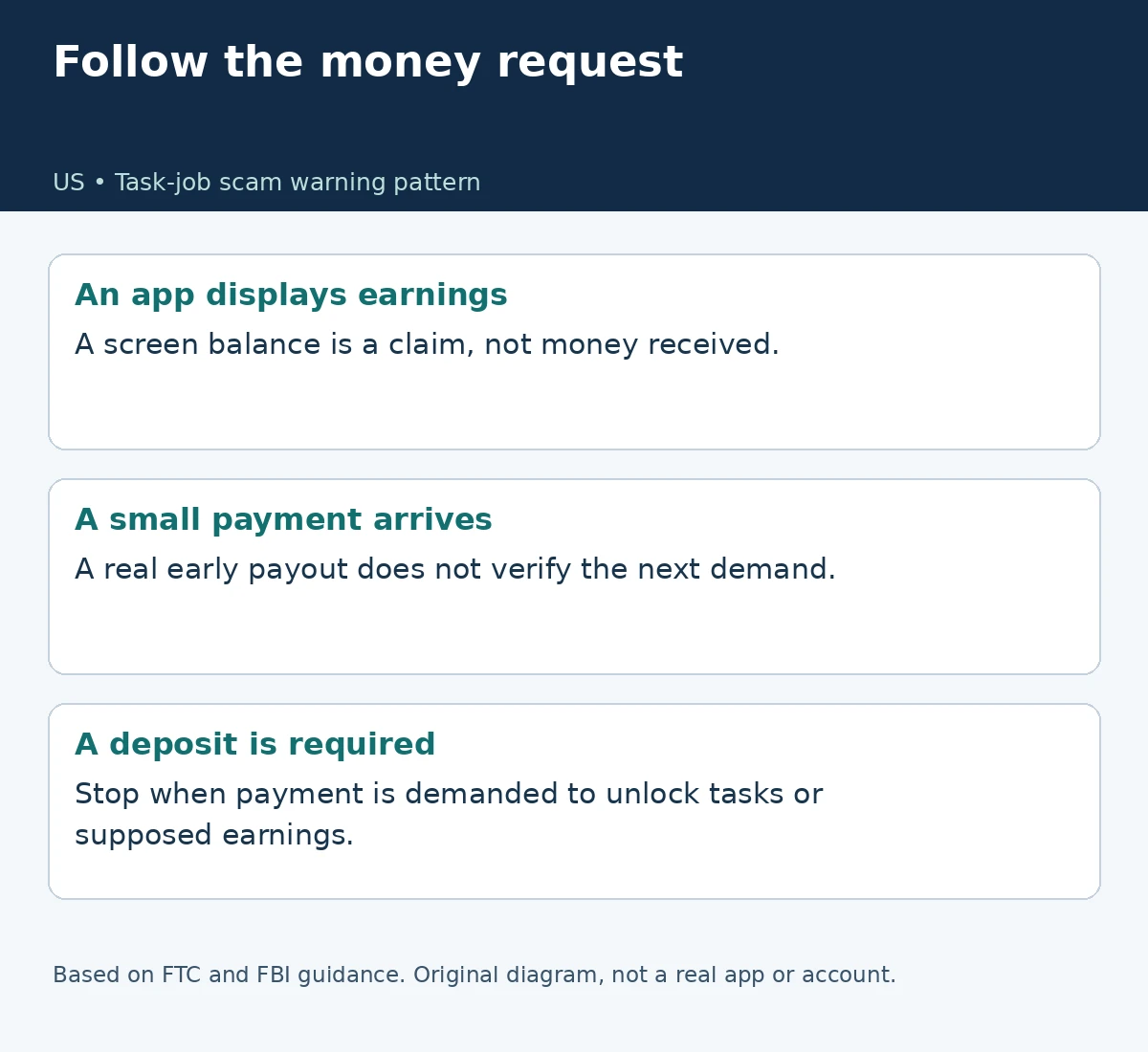
A task job scam can send you a small real payment before asking for a much larger deposit. For US job seekers, the useful test is what the supposed employer asks you to do with your own money next. If you must pay to unlock tasks or withdraw claimed earnings, stop. The earlier payout does not establish that the next request is legitimate.
The FTC’s April 2026 job-offer-text warning includes online tasks followed by deposit demands. Its task-scam guidance explains that apparent app commissions can be fake even when the operator has paid a little at the start. This is continuing consumer guidance, not a newly discovered October incident.
A balance on a screen is not a wage payment
The offer may describe ordinary-sounding work: rating, boosting or optimising products and content. An account then shows a growing balance. Keep that displayed figure separate from money that actually reached an account you control. An impressive dashboard is a statement made by the platform, not independent evidence that you can withdraw what it claims you earned.
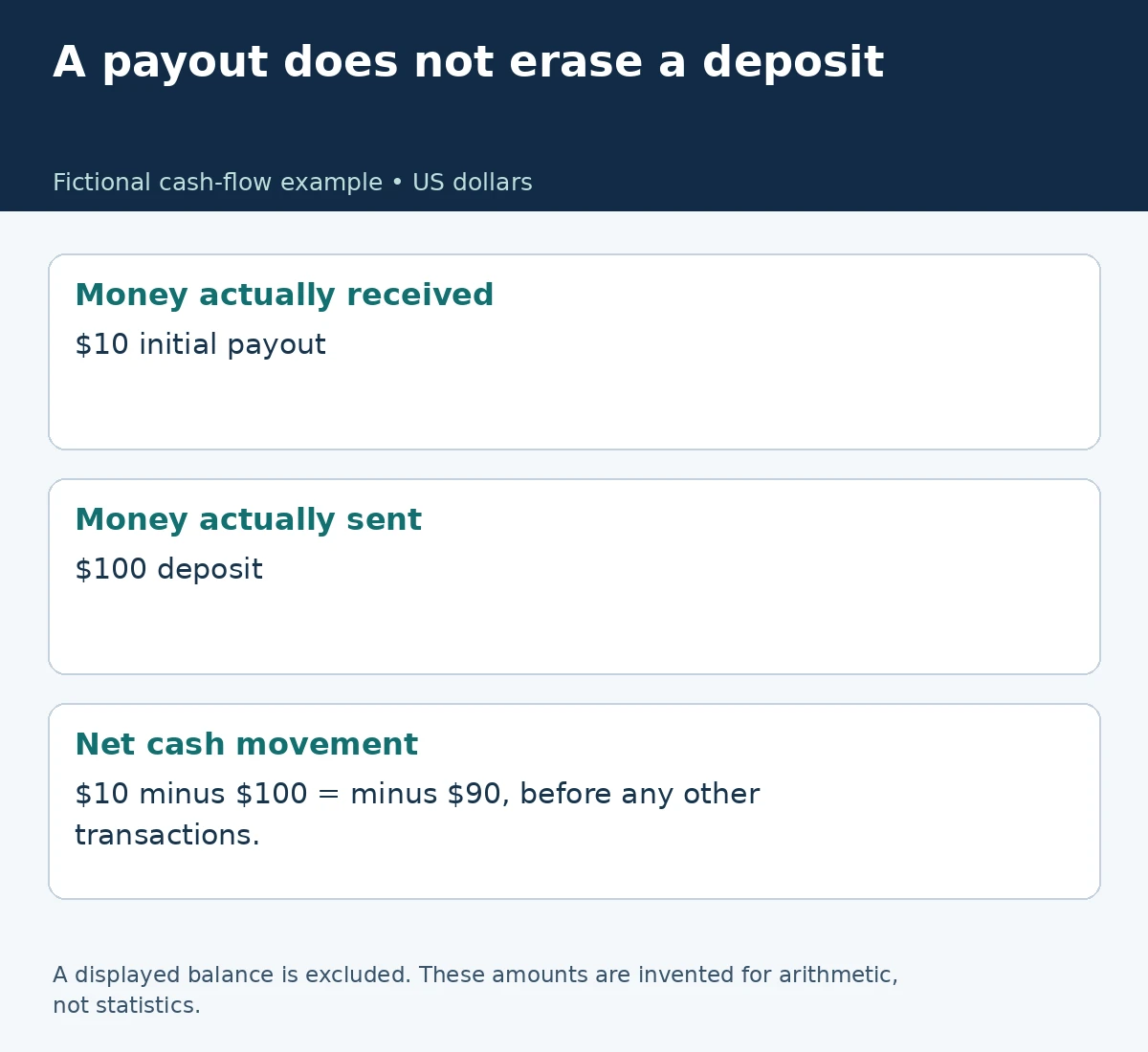
A useful check has three lines: money actually received, money actually sent, and money merely displayed. Do not add the third line to the first. This simple record makes the next decision clearer when a recruiter tries to combine a real early transfer with a much larger claim on a website. The record is an editorial decision aid, not a way to authenticate the platform.
Consider a fictional case in US dollars. Someone receives $10, then sends a $100 deposit while an app claims a $500 balance. Their cash movement is $10 minus $100, or minus $90, before any other transactions. The $500 display is not included as received money. These invented amounts demonstrate arithmetic; they are not a typical loss, an estimate or an example from a reported victim.
Listen to the condition attached to withdrawal
The critical phrase is the condition: send more money before you can obtain money supposedly already earned. The operator may call it a top-up, a new task set or a negative balance. Renaming the demand does not change its direction. The job seeker is being asked to fund the operation instead of simply being paid for completed work.
The FBI’s cryptocurrency job-scam guidance describes escalating deposits and frozen accounts, including schemes that initially permit withdrawals. It advises suspected victims to stop sending money and report. A previously successful withdrawal therefore cannot settle the safety of a new deposit demand. Do not borrow or use another person’s funds to satisfy it.
Pressure makes this harder to see. A recruiter may frame stopping as losing all the work already completed. Pause the decision and write the actual next transaction in plain language: “I would send my money to obtain a claimed balance.” Assess that transaction on its own evidence. Hours spent clicking do not make a deposit safer or create money that has not been received.
Verify the employer outside the conversation
Find the organisation’s real recruitment channel independently. Check whether the specific vacancy exists and whether the person contacting you can be verified through that channel. A company name, copied logo or profile photo in a chat is not the company’s confirmation. Keep the job title, vacancy reference and contact route together rather than relying on a generic claim that the employer is well known.
The FTC’s remote-job warning recommends verifying openings and warns about upfront payments and fake checks. Treat an unexpected generic recruitment message as a reason to verify, not an invitation to follow every link it supplies. This guide does not label every genuine recruiter contact or every remote role a scam; it addresses the specific pay-to-unlock pattern.
If money has already left your account
Stop further transfers and contact the bank, payment provider or cryptocurrency service you actually used through its verified support channel. Describe the transaction accurately and ask what reporting or recovery options are available. Do not describe the payment as something else because a recruiter says doing so will avoid questions. No refund or reversal is promised here.
Preserve a compact evidence set before losing access to the conversation: the offer, messages requesting deposits, website or app address, payment receipts, dates and relevant transaction identifiers. Separate the amounts actually sent from the balance displayed. Keep original records where possible and a short chronology so a reviewer can follow the sequence without reconstructing it from scattered images.
For US reporting, the FTC guidance links to ReportFraud.ftc.gov. The FBI directs suspected cryptocurrency job-scam victims to IC3 and says a report can still be made when transaction information is incomplete. Use the official route and provide what you have. A report is not confirmation that money will be recovered.
Do not turn a recovery offer into another loss
Be cautious if a new contact promises to release the balance or recover losses for another payment. The FBI specifically warns that recovery offers can be another scam. Verify any claimed official contact independently; do not accept a logo, case number or request for secrecy as proof of authority. Avoid public posts containing account details or identity documents.
The next useful outcome is an evidence-backed report and a stop to further payments, rather than winning an argument in the recruitment chat. You do not need the operator to admit that the balance is fake before refusing another deposit. Preserve the records, use verified channels and keep the financial decision separate from the pressure to finish one more task.
Our US background-check error guide addresses a different stage of genuine recruitment. It is relevant once an employer and its process have been independently established; it does not authenticate an unsolicited offer or a platform that demands deposits.
Sources and scope
US consumer explainer checked October 29, 2026 against FTC warnings from 2023, 2025 and April 2026 and current FBI guidance. No recruiter was contacted and no app, payment or recovery service was tested. No private victim account or new loss statistics are reported. The cash-flow example is fictional. Follow the official reporting instructions relevant to the actual transaction.
Visual credits: NewsThreads247. Featured art is an AI-generated conceptual illustration, not a real platform. The two original diagrams distinguish displayed claims, actual transfers and a fictional calculation. They are not screenshots or evidence of a particular employer’s conduct.