
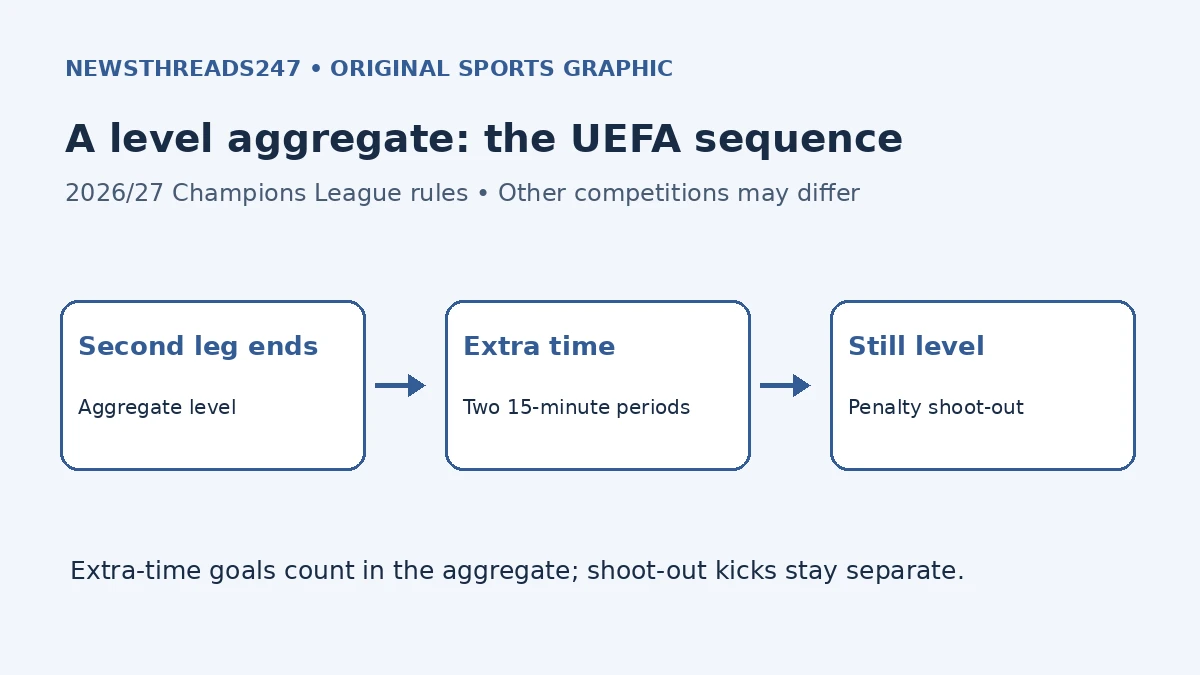
An aggregate score adds the goals from two matches that together form one knockout tie. The first-leg result remains a match result; the second-leg result remains another match result; the combined total decides who advances under the competition’s rules. A club can therefore lose the second leg and still win the tie, or win the second leg and still be eliminated.
The confusion usually starts when broadcasts compress several layers into one line: the current match score, the two-leg aggregate, an “after extra time” marker and a penalty-shoot-out score. This guide separates those layers using current UEFA Champions League 2026/27 regulations and the IFAB framework referenced by UEFA. Other competitions can choose different procedures, so the competition rulebook must remain the final check.
In this article — jump to a section
What aggregate score means
A two-legged tie gives each club one match at home in the usual format. UEFA’s current knockout regulation says that, except for the final, clubs normally play each opponent twice, home and away. The club with the greater combined number of goals across those matches advances. “Aggregate” is simply that combined total.
Suppose Blue wins the first leg 2–0. Gold wins the second leg 1–0. Gold won that evening’s match, but Blue advances 2–1 on aggregate because the two results are added. The match winner and tie winner answer different questions, so a headline or score graphic should name both when they differ.
Keep four result layers separate
| Layer | What it records | Example |
|---|---|---|
| Second-leg score | Goals in that match | Gold 1–0 Blue |
| Aggregate score | Goals across both legs | Blue 2–1 Gold |
| After extra time | Second leg continued beyond 90 minutes | 2–2 aet |
| Penalty shoot-out | Tie-breaking kicks, not match goals | Blue win 4–3 on penalties |
Penalty kicks in a shoot-out determine which team progresses, but they are not added as ordinary match goals or aggregate goals. A clean scoreline therefore preserves the level aggregate and states the shoot-out separately. This also avoids inflating player goal totals with shoot-out kicks.
Worked two-leg example
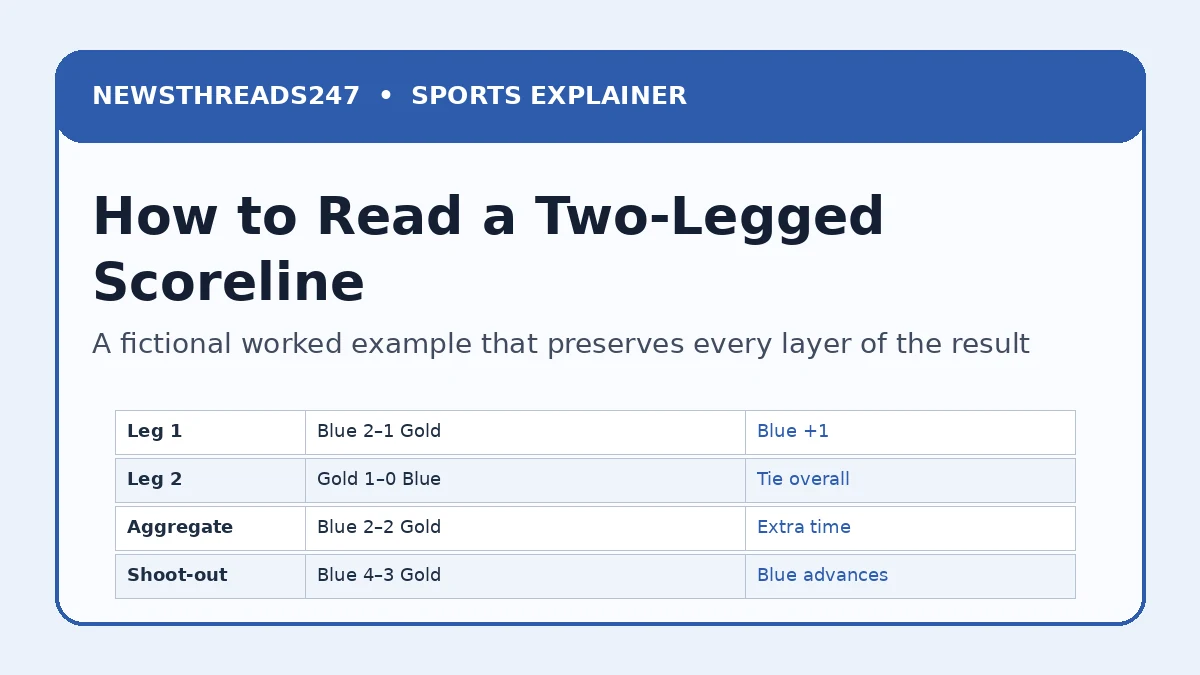
Consider a fictional tie between Blue and Gold. Blue wins the first leg at home 2–1. In the return match, Gold leads 1–0 after 90 minutes. The second-leg match score is Gold 1–0 Blue, while the aggregate is 2–2. Under the current UEFA procedure, that level aggregate leads to two 15-minute periods of extra time at the end of the second leg.
If neither team scores in extra time, the aggregate remains 2–2 and a penalty shoot-out follows. If Blue wins the shoot-out 4–3, a precise summary is: Gold 1–0 Blue after extra time; 2–2 on aggregate; Blue win 4–3 on penalties. The exact display order can vary, but the meanings should not be collapsed.
Now change one fact: Blue scores once in extra time. The second leg becomes 1–1 after extra time and the aggregate becomes Blue 3–2 Gold. Blue advances without a shoot-out. Extra-time goals are match goals and therefore affect the aggregate; shoot-out kicks do not.
What happens when the total is level
Article 21 of the UEFA Champions League 2026/27 regulations states that a level aggregate after the two legs is followed by two periods of 15 minutes. If the teams remain level after extra time, a penalty shoot-out determines who qualifies. UEFA also specifies a five-minute break before extra time, with players remaining on the field at the referee’s discretion.
That sequence is not a universal law for every football competition. The IFAB Laws allow competition rules to use away goals, two equal periods of extra time of no more than 15 minutes each, penalties, or an approved combination. Some domestic rounds go directly to penalties; some finals are one match; some playoff systems use league position or another criterion. Readers should never transfer one tournament’s procedure to another without checking.
Do away goals still decide it?
For UEFA club competitions, away goals no longer carry extra tie-breaking weight. UEFA removed that rule from the 2021/22 season onward, and the current 2026/27 Champions League text simply sends a level two-leg total to Article 21. Two goals scored away and two scored at home are therefore worth the same in the aggregate.
The broader IFAB framework still permits a competition to choose an away-goals rule. So “away goals are abolished everywhere” is too broad. The accurate statement is competition-specific: they do not decide current UEFA club ties, but another organiser may adopt a different approved method.
How to read a scoreboard correctly
- Start with the current match score and identify whether it is at 90 minutes or after extra time.
- Look for “agg” or “aggregate” and add the first-leg and second-leg goals independently.
- Treat “pens” as a separate shoot-out result, not an addition to the match score.
- Check whether the graphic is showing the score from the perspective of the home team or the named first team.
- If the procedure seems surprising, open the competition regulations rather than relying on a general football explainer.
The same discipline helps with single-match knockout results. “1–1, Blue win 5–4 on penalties” means the football match finished level and the shoot-out selected the qualifier. Stoppage time belongs to the half in which it is played; extra time is a separate added period. Our football handball explainer shows why the incident that created a goal or penalty also needs rule-specific context.
A second common error is to reverse the aggregate when the home team changes between legs. Write each club’s two scores in its own column before adding. For example, if Blue wins the first leg 3–1 and Gold wins the return 2–0, each club has three goals overall. The order of names on the second-leg scoreboard does not change who owns the first-leg goals.
Another trap is treating a two-legged tie like a league table. Aggregate goals decide that tie under the cited UEFA rule; goal difference, points from the two matches and possession statistics do not create separate tie-breakers. A team does not receive three points for winning a leg and then add those points to decide advancement. The competition groups both fixtures as one knockout contest.
| Question | Correct layer to inspect | Do not substitute |
|---|---|---|
| Who won tonight? | Second-leg match score | The aggregate winner |
| Who advances? | Aggregate plus the stated tie-break procedure | Possession, shots or league points |
| Was the match a draw? | Score after normal or extra time as labelled | The shoot-out score |
These distinctions matter beyond trivia. Search snippets, notifications and social cards often omit the small “agg” or “pens” label. When space is tight, state the qualifier in words: “Blue advance 4–3 on penalties after a 2–2 aggregate draw.” That sentence preserves the decision without pretending the shoot-out changed the football score.
Competition rules and maintenance
This article uses UEFA’s 2026/27 Champions League as a current, concrete example. It should be reverified when UEFA issues a new edition, if Article 20 or 21 changes, or before applying the sequence to another competition. The durable concept is addition across the legs; the tie-breaking procedure belongs to the organiser.
Sources: UEFA Champions League 2026/27 Article 20, Article 21, the IFAB Law 10 text published by The FA, and UEFA’s away-goals explainer. Rules checked 6 November 2026; examples are original and fictional.