

The ball touching a player’s hand or arm is not automatically a handball offence, and a contact inside the penalty area is not automatically a penalty. IFAB Law 12 asks whether the player deliberately moved the hand or arm towards the ball, or whether the arm position made the body unnaturally bigger without being justified by that movement. It also has a separate rule for a scorer’s own hand or arm immediately before a goal.
That framework explains why two clips with visible contact can receive different decisions. Distance, speed and surprise may help the referee understand the movement, but the law is not a simple “close range means no offence” formula. The official judges the entire action.
The three core handball tests in Law 12
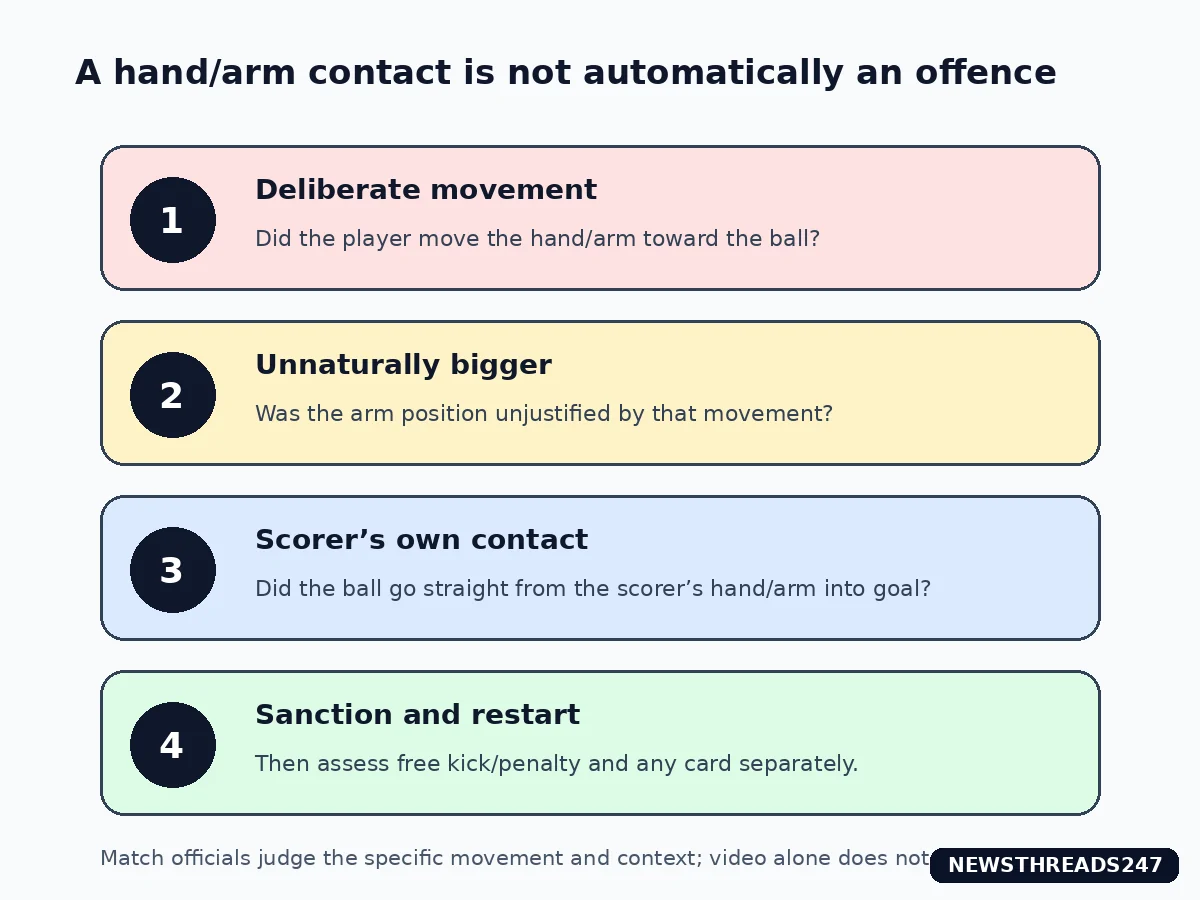
The current IFAB Law 12 identifies three main ways an outfield player can commit a handball offence. The player can deliberately touch the ball with the hand or arm, including moving it towards the ball. The hand or arm can make the body unnaturally bigger. A player can also score directly from, or immediately after, the ball touches that scorer’s own hand or arm, even when the contact was accidental.
| Question | What the law examines | What it does not prove by itself |
|---|---|---|
| Was there deliberate action? | Movement of the hand/arm towards the ball | That every visible contact was deliberate |
| Was the body unnaturally bigger? | Whether the arm position was justified by the player’s movement in that situation | That every arm away from the torso is an offence |
| Did the scorer’s own hand/arm touch the ball immediately before the goal? | The special scoring restriction | That an accidental contact by a team-mate automatically cancels a later goal |
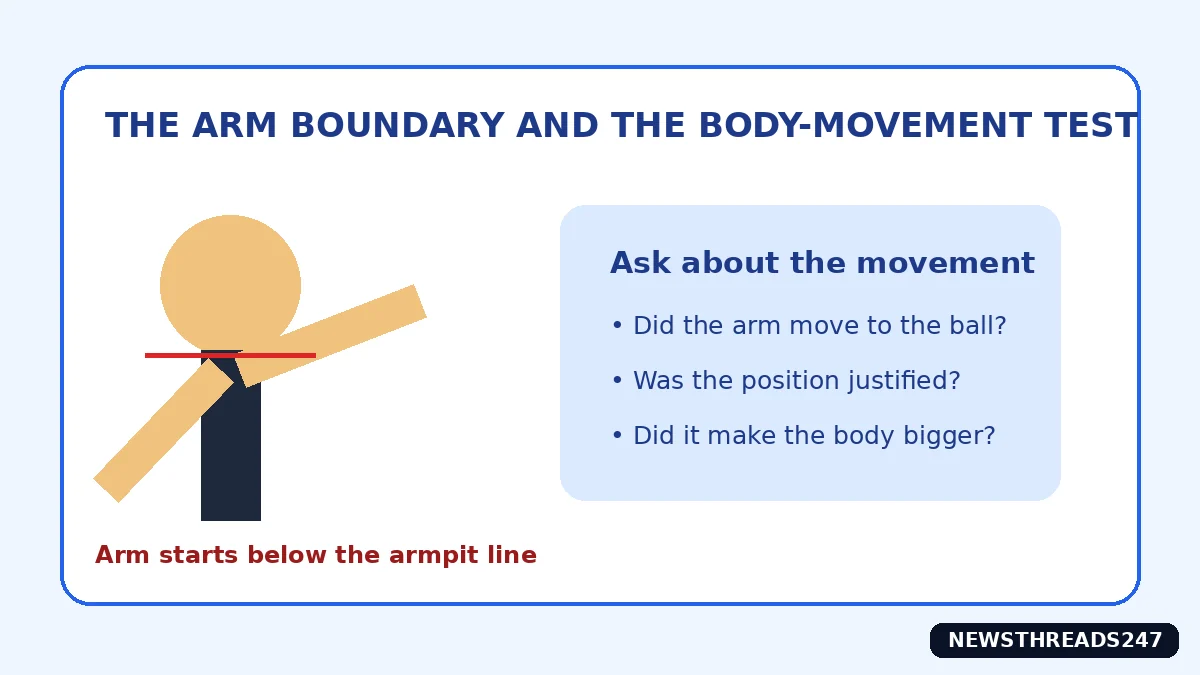
Where the arm starts for this decision
For handball decisions, IFAB uses the bottom of the armpit as the upper boundary of the arm. Contact above that line is treated as shoulder contact rather than hand or arm contact. Broadcast freeze-frames can make the boundary hard to judge, especially when shirts fold or the camera is oblique.
This is a classification step, not the final decision. Once the official decides the ball touched the hand or arm, the deliberate-action and body-shape tests still matter. A sleeve line is not a replacement for the law’s anatomical boundary.
What “unnaturally bigger” means
The law says a body is unnaturally bigger when the hand or arm position is not a consequence of, or justifiable by, the player’s movement for that specific situation. This language deliberately leaves room for football movement. Running, jumping, sliding and bracing for a fall can all place an arm away from the body, but the position still has to make sense for the action.
A useful viewing question is not “Was the arm out?” It is “Why was the arm there at that moment?” An arm deliberately extended into a passing lane presents a different case from an arm moving naturally with a player who is turning. Reasonable viewers may still disagree because the official must judge speed, sequence and justification.
Why ball-to-hand is an incomplete shortcut
“Ball to hand” is often used to describe unexpected contact, but it is not a complete standalone exemption in Law 12. A fast deflection can be important evidence about whether a player acted deliberately or could justify the arm position. It does not erase the body-shape test.
The opposite shortcut is also unreliable. Slow motion can make an unavoidable movement look deliberate because it removes the real speed of play. A good replay should help reconstruct the action, not replace it with a still frame chosen after contact.
The scorer’s own accidental contact is treated differently
Law 12 prevents a player from scoring directly from the hand or arm, even accidentally, and also covers the scorer gaining possession immediately after that contact and then scoring. This rule is narrower than saying every accidental attacking handball cancels a goal.
IFAB’s own clarification says an accidental contact by a team-mate is not automatically an offence merely because it leads to a scoring opportunity. It becomes relevant if that team-mate’s contact was deliberate or made the body unnaturally bigger under the ordinary tests.
A handball offence does not always mean the same card
The first decision is whether an offence occurred and where. The restart is normally a direct free kick, or a penalty kick when the defending team commits the direct-free-kick offence inside its own penalty area. The disciplinary sanction is a separate assessment.
A card can depend on what the offence stopped and whether the handling was deliberate. The IFAB penalty-kick guidance and examples illustrate that a non-deliberate handball which stops a promising attack is not treated identically to every deliberate denial. Do not assume “penalty” automatically means yellow or red.
How VAR fits without rewriting the law
Where VAR is used, the video match officials apply the same Law 12 tests. VAR does not create a separate definition of handball. Its intervention threshold and protocol determine when an on-field decision can be reviewed; the final legal question remains the player’s action and arm position.
A television replay may not show every angle available to the officials, and the public may not hear the reasoning. Describe the observable incident and the relevant test instead of claiming that a single frame proves bias or intent.
A five-question viewing checklist
- Did the ball contact below the bottom-of-armpit boundary?
- Did the player move the hand or arm towards the ball?
- Was the arm position justified by that exact body movement?
- Was the contact by the eventual scorer immediately before the goal?
- If there was an offence, where did it occur and what did it stop?
The method is similar to reading offside: freeze the relevant moment, then apply the rest of the law instead of treating position alone as the offence. See our offside position and deliberate-play explainer for that separate decision.
Sources and scope
Primary sources checked on 5 November 2026: IFAB Law 12, the FA’s 2026–27 Law 12 presentation, and IFAB’s penalty-kick law and examples. The diagrams explain the decision sequence; they do not depict or overrule a real match decision.