
Retired hurt and retired out are not interchangeable scorecard labels. Under the MCC Laws, a batter who leaves because of illness, injury or another unavoidable cause may resume later and is recorded as “retired — not out” if the innings ends first. A batter who leaves for another reason can face a different return condition and may be recorded as “retired — out”.
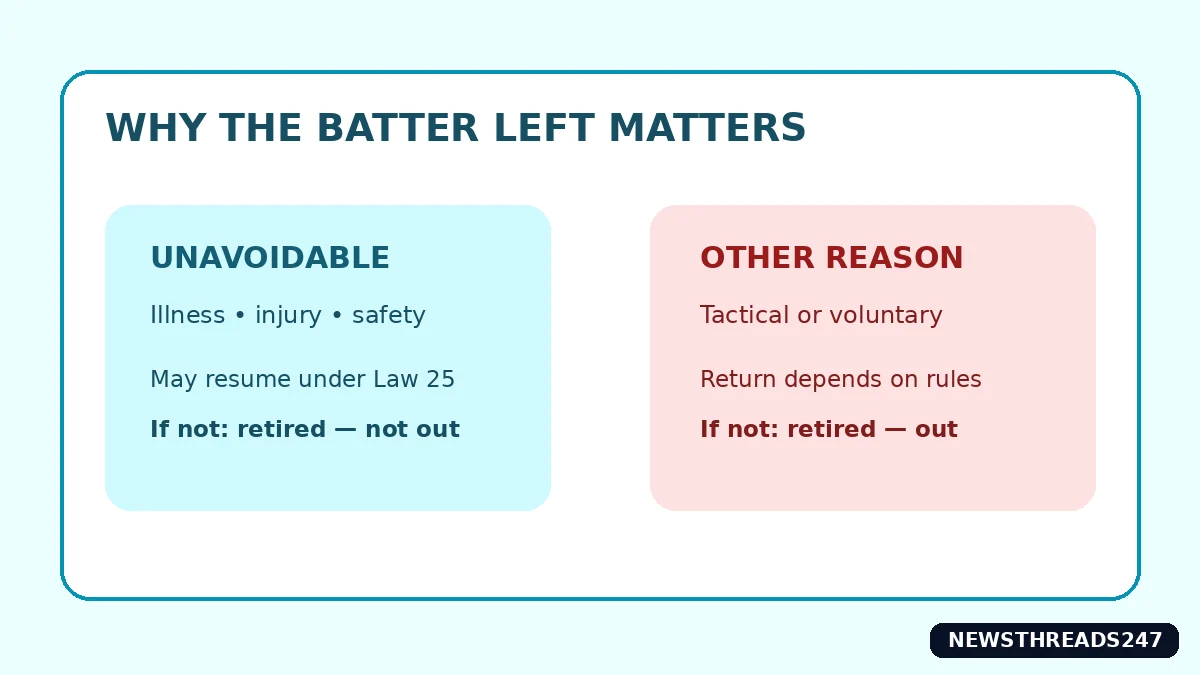
The difference matters whenever a television graphic says a batter has retired, especially in short-format cricket where a tactical change can be confused with treatment for an injury. The reliable way to read the incident is to identify the reason, the governing playing conditions and whether the batter later resumed. A broadcast phrase alone does not settle all three.
Start with MCC Law 25, then check the competition conditions
MCC is the custodian of the Laws of Cricket. Its 2017 Code, fourth edition for 2026, places batter retirement in Law 25.4. The law says a batter may retire when the ball is dead, and the umpires must be told why before play continues.
That is the general-law baseline. MCC also explains that professional and international competitions can replace or add provisions through their own playing conditions. The ICC playing-conditions page, for example, lists separate October 2026 documents for Tests, ODIs and T20Is. Do not assume a domestic league, an international match and a recreational game use identical return wording.
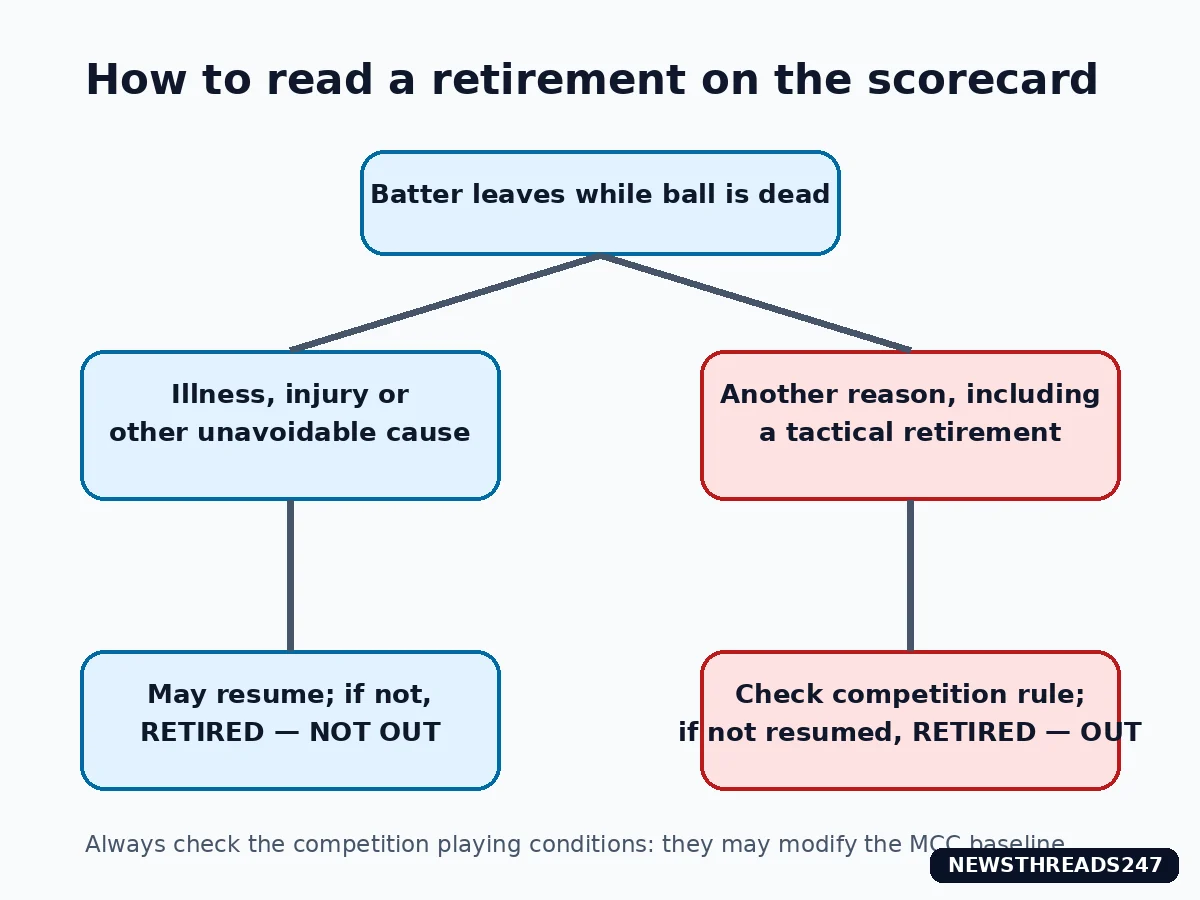
| Situation | MCC baseline | Scorecard if no return |
|---|---|---|
| Illness, injury or another unavoidable cause | The batter is entitled to resume, at an allowed resumption point | Retired — not out |
| Another reason, including a voluntary tactical retirement | Resumption requires the opposing captain’s consent under the MCC baseline | Retired — out |
| Competition-specific match | Read the event playing conditions as well as Law 25 | Use the governing competition’s wording |
What “retired hurt” usually means
“Retired hurt” is the familiar broadcast phrase for the first category: a batter has left because continuing is temporarily impossible or unsafe. Law 25.4.2 uses the broader wording illness, injury or another unavoidable cause. It gives that batter the right to resume the innings, subject to the law’s timing for a return.
If recovery does not happen before the innings finishes, the batter is recorded as retired — not out. This is why a scorecard can show eleven names without showing ten dismissals. The player has stopped batting, but the statistical record is not a dismissal.
The reason still needs to be communicated to the umpires. Viewers should avoid diagnosing an injury from television pictures or assuming that every temporary absence is tactical. The official scorecard and match report can clarify the entry after the incident.
What retired out means
A retirement for a reason outside the unavoidable-cause category can become retired out. It is a legal way to end a batter’s innings; it is not the same thing as being bowled, caught or run out. In a tactical example, a batting side might prefer a different hitter for the remaining deliveries.
The ICC described Ravichandran Ashwin’s 2022 IPL retirement as an evolving T20 tactic and linked the decision to Law 25.4.3. That historical example helps explain the idea, but it does not prove that every batter leaving late in an innings has retired out. Injury, illness and event-specific rules must still be checked.
When can a retired batter return?
Under the MCC baseline, a batter returning after retirement does so only at the fall of a wicket or when another batter retires. The unavoidable-cause category is entitled to resume. For another reason, MCC makes the opposing captain’s consent relevant.
International or league conditions can alter that baseline. That is why a confident answer to “Can this batter come back?” needs the match format and the current document, not only the player’s name. The ICC’s public playing-conditions index is the right starting point for an international match; a league should publish its own regulations.
A worked scorecard example
Imagine a batter reaches 42 and leaves with cramp while the ball is dead. The umpires are informed that the cause is physical and unavoidable. Another batter continues the innings. If the first batter recovers and the applicable conditions allow the return at the next wicket, the original innings resumes from 42. If the team’s innings ends first, the entry remains retired — not out on 42.
Now change one fact: the team replaces a slow-scoring batter for tactical reasons. If the batter does not resume under the applicable rule, the scorecard records retired — out. The runs already scored still count to the team total and to the batter, but the not-out status changes.
Retirement is separate from a Super Over eligibility question
A retirement in the main innings and eligibility in a later Super Over are related only when the competition document makes them related. Super Overs carry their own player-eligibility provisions. Our guide to tied Super Overs and player limits explains why a second one-over contest cannot be read solely from the main scorecard.
The same caution applies to statistics. A commentary label, the official dismissal field and eligibility for a later phase are separate pieces of information. Keep the governing rule with the conclusion instead of turning one label into a universal answer.
How to read the next retirement without guessing
- Confirm that the ball was dead and the umpires were informed.
- Look for the official reason rather than inferring it from the match situation.
- Check whether the scorecard says retired — not out or retired — out.
- Identify the competition and the version of its playing conditions.
- If the batter returns, note when the return happened and which condition allowed it.
Sources and scope
Primary sources checked on 5 November 2026: MCC’s explanation of its custodianship and playing-condition differences, the 2026 MCC Laws PDF, and the ICC’s current playing-conditions index. The worked examples are original illustrations, not reports of a specific match.