
Net run rate (NRR) is a tournament measure, not a label attached to one innings. Under the ICC Men’s T20 World Cup 2026 playing conditions, used here as a named event example, a team’s scoring rate across the relevant group is reduced by the rate it conceded across that group. The arithmetic looks simple, but three details repeatedly change the answer: cricket overs are recorded in balls rather than decimal tenths, an all-out innings can be charged the full available quota, and rain-adjusted results follow event-specific rules.
That means the safest way to check a table is to collect runs and legal balls for every result that counts, apply the competition’s exceptions, total each side of the equation and divide only at the end. This guide uses a fictional two-match example so the method can be followed without implying that an unofficial calculation replaces the organiser’s table.
In this article — jump to a section
The short answer
NRR answers a narrow question: over the matches included by the competition, how much faster did this team score than its opponents? A positive number means the team scored at a higher average rate than it conceded; a negative number means the reverse. A number near zero means the two rates were close. It does not measure batting quality, bowling quality, strength of schedule or the probability of winning the next match.
The governing document matters. ICC 2026 event clauses 16.10.4 and 16.10.7 provide the specific rules discussed below. ICC event conditions can specify which stage carries forward, which results count, how DLS-adjusted matches are represented and where NRR sits in the tie-break order. In the 2026 Men’s T20 World Cup conditions, wins are considered before NRR for teams level on points, Super Eights teams start that stage with zero points and no carried-forward NRR, and the Super Over is excluded from NRR.
The formula uses tournament totals
NRR = (total runs scored ÷ total overs faced) − (total runs conceded ÷ total overs bowled). “Total” is the important word. Do not calculate a separate NRR for each match and take the ordinary average, because matches can involve different numbers of valid balls. Pooling the numerators and denominators gives every legal ball the correct weight.
| Side of calculation | Add across included matches | Then calculate |
|---|---|---|
| For the team | Runs scored and valid balls faced | Runs ÷ (balls/6) |
| Against the team | Runs conceded and valid balls bowled | Runs ÷ (balls/6) |
| Final step | Scoring rate minus conceding rate | Keep sensible precision |
A published table may display only three decimal places while calculations retain more precision internally. A tiny difference can therefore be real even when a hand calculation looks equal after early rounding. Keep full precision until the final display.
Overs are not decimals
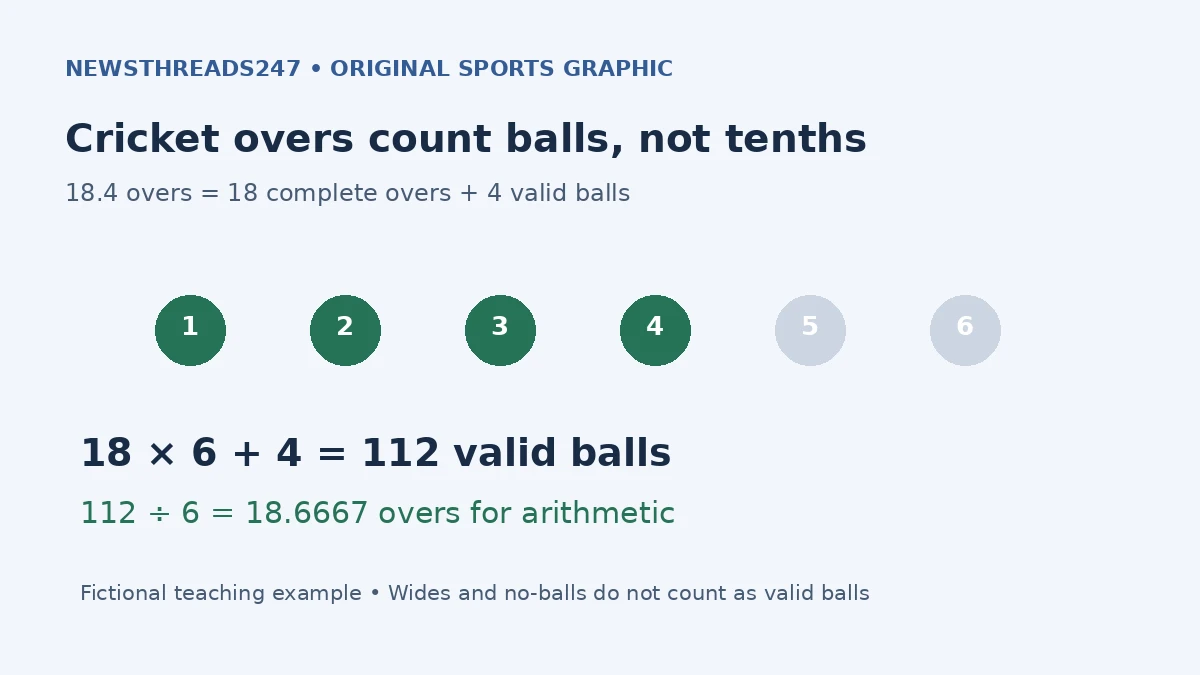
An entry such as 18.4 overs means 18 complete overs and four valid balls: 112 balls, or 18 + 4/6 = 18.6667 overs for arithmetic. It does not mean 18.4 in decimal notation. Similarly, 19.2 overs is 116 balls, or 19.3333 overs. Converting every innings to legal balls first prevents the most common spreadsheet error.
No-balls and wides add runs but are not valid balls, so the displayed over count already reflects the valid-delivery denominator. If you reconstruct a calculation from ball-by-ball data, count only legal balls. If you use a verified scorecard, convert its overs notation carefully rather than counting punctuation as a decimal point.
Why all-out innings use the full quota
The 2026 ICC event condition says that when a team is all out before using its full quota, NRR treats the innings as if it used the full number of overs to which it was entitled. In an uninterrupted T20 allocated 20 overs, 112 all out after 16.4 overs contributes 112 runs over 20 overs on that team’s scoring side. The rule prevents a dismissed team from appearing to have scored at an artificially high rate simply because its innings ended early.
This is not a universal instruction to replace every short innings with 20 overs. A successful chase that ends in 16.4 overs is not an all-out innings, so its actual valid balls normally remain the denominator. A rain-reduced innings may have a revised quota. Read the event condition and the scorecard status before changing the denominator.
Worked two-match example
Suppose Team Blue plays two uninterrupted 20-over group matches. In Match 1 it scores 180/6 in 20 overs and restricts Gold to 150/8 in 20 overs. In Match 2, Blue is dismissed for 130 after 17.2 overs; Silver chases 131 in 18 overs. Because Blue was all out, its second batting denominator is 20 overs, not 17.2.
| Measure | Match 1 | Match 2 | Tournament total |
|---|---|---|---|
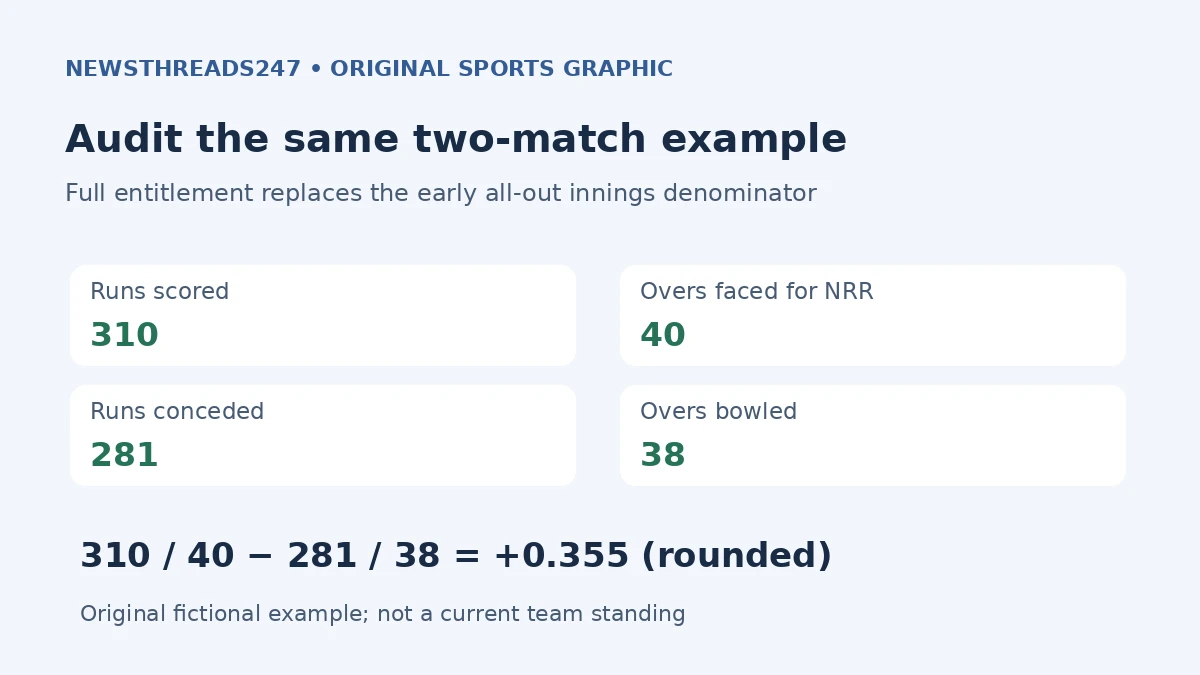
| Blue runs scored | 180 | 130 | 310 |
| Blue overs faced for NRR | 20 | 20 (all out) | 40 |
| Runs conceded | 150 | 131 | 281 |
| Overs bowled | 20 | 18 | 38 |
Blue’s scoring rate is 310 ÷ 40 = 7.750. Its conceding rate is 281 ÷ 38 = 7.394736842…. The resulting NRR is approximately +0.355. Calculating each match separately and averaging the two answers would give the wrong weighting; treating 17.2 as 17.2 decimal overs would also be wrong.
The worked example is deliberately compact. A real table can contain more matches, revised quotas, forfeits and different stage rules. The organiser’s published standing remains authoritative; this method is a way to audit the logic, not to override an official calculation.
Rain, no results and Super Overs
That event’s condition counts only matches where a result is achieved. A no-result does not contribute ordinary innings figures to the NRR calculation. When DLS produces a result, the same clause supplies adjusted credited scores and overs: the first innings may be credited with the chasing side’s par score at abandonment, or one run less than the final target over the allocated chase, depending on when DLS was applied.
Those adjustments are why copying raw scorecard totals can disagree with the official table after rain. They are also why a general-purpose online calculator can be misleading if it does not ask which event condition applies. The Super Over is explicitly excluded in this ICC event, even though it decides the match result.
For a fuller distinction between par score and target, see our DLS par score versus target explainer. It addresses the rain calculation concept; this page focuses on how an event then represents the result for NRR.
A practical audit checklist
- Confirm the competition, stage and current playing-condition edition.
- List only matches that the event says count for NRR.
- Record runs and legal balls separately for the team and its opponents.
- Replace an early all-out denominator with the full entitlement only when the rule applies.
- Apply the event’s DLS or forfeit treatment instead of copying raw totals blindly.
- Pool totals before division and round only the final displayed result.
- Compare with the organiser’s table and investigate differences rather than forcing a match.
Maintenance note: recheck this explainer when the ICC publishes new event conditions or changes the tie-break order, all-out treatment, DLS treatment or stage carry-forward rules. The formula is durable; the exceptions are competition-specific.
Sources: ICC playing-conditions index and the ICC Men’s T20 World Cup 2026 Playing Conditions, especially clauses 16.10.4 and 16.10.7. Rules checked 6 November 2026. The numerical example is original and fictional.