
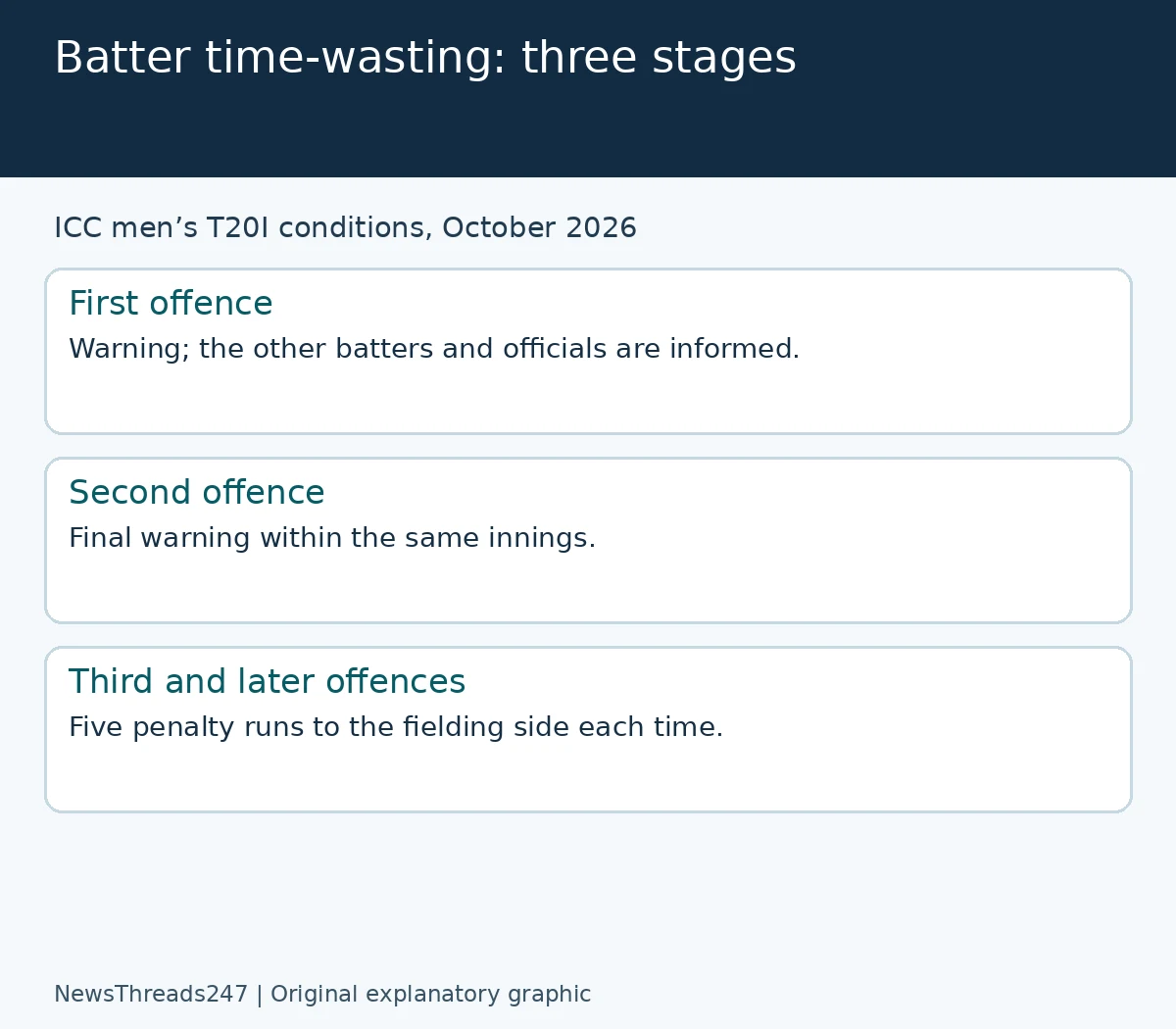
A batter changing ends does not give the batting side a fresh allowance to delay play. Under the ICC’s October 2026 men’s T20I playing conditions, the warning history belongs to the innings: a first offence brings a warning, a second brings a final warning, and the third and later offences bring five penalty runs to the fielding side.
That sequence is part of the ICC changes announced on October 1, applicable to international series beginning on that date or later. Series already underway retained their previous regulations. For viewers in India following international cricket, the practical question is which conditions govern the series, rather than simply whether the match is being played after October 1.
This is a guide to the men’s international conditions, not a claim that every domestic competition or women’s tournament uses an identical warning system. The detailed examples below use the October men’s T20I document, with the important Test-cricket difference identified separately.
Read the sequence across the innings
Clause 41.10 of the current men’s T20I conditions combines time-wasting warnings, including different forms of delay. Changing the striker does not erase them. Umpires communicate the warnings to the relevant players and officials; incoming batters are informed too.
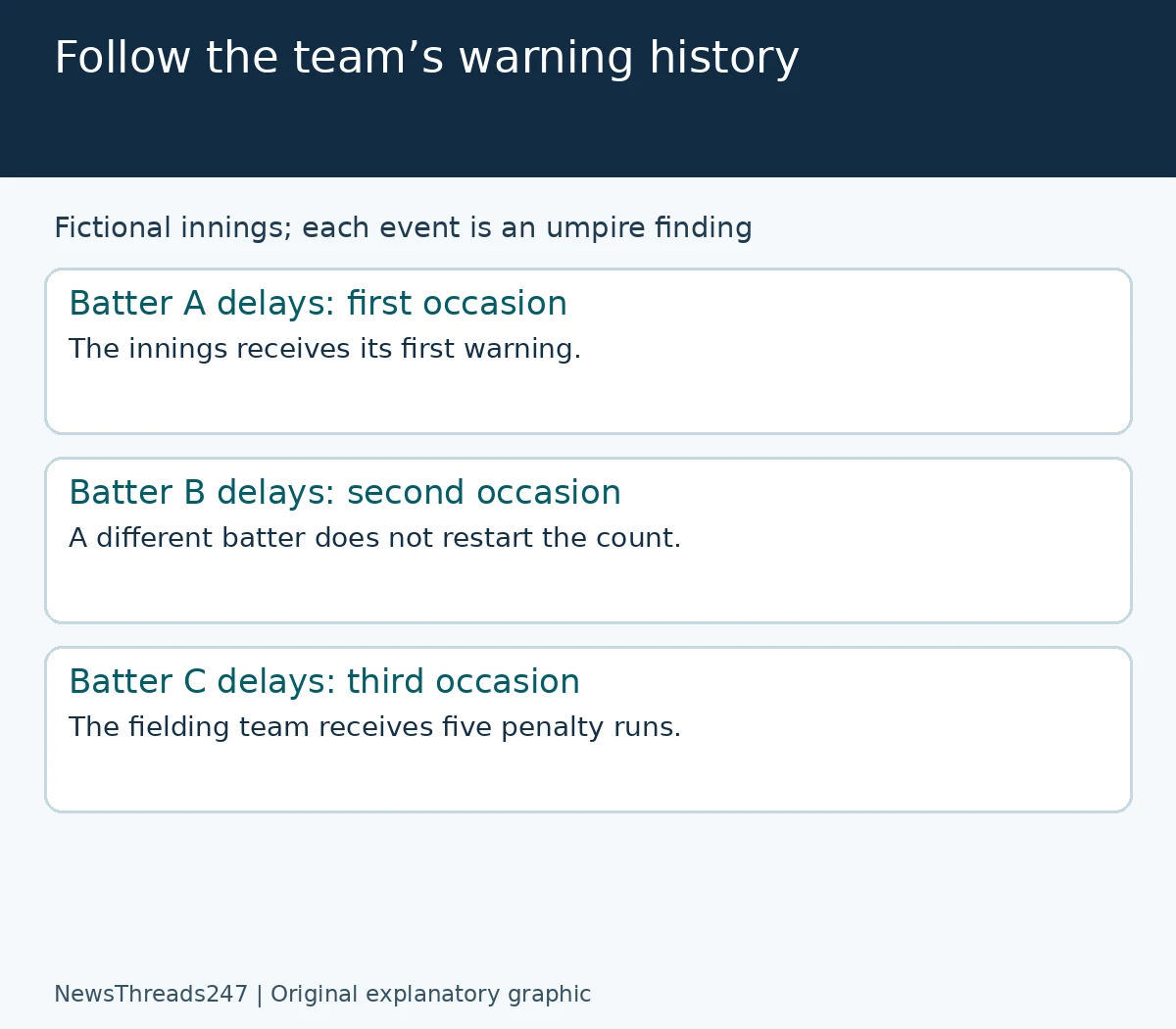
Consider a fictional innings. Batter A causes a delay that the umpire finds to be time-wasting. Later, Batter B causes another. When Batter C subsequently commits a third offence, the question is not whether C personally has already had two warnings. The innings has reached the penalty stage. That is why a replay of the third incident alone may not explain the decision.
For someone keeping notes while watching, record the over, the umpire’s decision and whether it was described as a first warning, final warning or penalty. This simple sequence is more informative than writing that one player was ‘slow’. It also prevents an earlier warning from disappearing from the story merely because a wicket fell.
Do not invent a universal seconds-per-delivery clock
The T20I wording expects the striker to be ready when the umpires and fielding side are ready to start an over, and when the bowler is ready to begin the run-up during it. That readiness test should not be replaced by an invented fixed allowance for every adjustment between balls.
A television shot can omit the start of an interruption or an official’s communication. Before calling a decision inconsistent, establish what the umpire actually ruled and whether the apparent delay was attributed to the batter. A short social clip is often missing the very context needed to answer that question.
For example, a viewer might start a stopwatch when a replay begins, while another starts it when the previous ball ends. Neither measurement necessarily reproduces the official’s assessment. A useful explanation names the relevant requirement and the identified offence; it does not manufacture precision from an incomplete broadcast.
Five runs are awarded to the other side
The penalty is not a dismissal and it is not five runs credited to the batter. The ICC’s announced sequence awards them to the fielding team. Keep that direction clear when reading a score update.
A fictional live commentary line saying ‘five penalty runs for time-wasting’ therefore needs a follow-up: which side was penalised, and which side received the runs? Writing both names avoids the ambiguity of ‘five runs lost’, especially when a scoreboard display changes in a way viewers do not immediately expect.
It also helps to separate the umpire’s immediate match decision from any later disciplinary action. The conditions permit Code of Conduct reporting for deliberate or repetitive time-wasting. That possibility does not establish that a named player has been charged or sanctioned. Report an actual disciplinary outcome only from the relevant official decision.
Tests have an extra reset point
The October 2026 men’s Test conditions, also at clause 41.10, specify a reset after each completed block of 80 overs in an innings. Do not apply that Test provision indiscriminately to a T20I, or treat it as a change of batter resetting the count.
This is an easy place for a short rule summary to mislead. ‘Warnings reset after 80 overs’ can be correct in the Test document while being irrelevant to the T20I being discussed. Always put the format beside the clause reference before using the example.
For a hypothetical Test note, mark the end of a completed 80-over block separately from any wicket or session break. Those events can occur near one another, but coincidence does not make them the same trigger. Use the document’s actual reset point rather than the most memorable interruption.
Keep three different timing questions apart
A new batter arriving, an established striker delaying readiness and the fielding side taking too long between overs are separate questions. Similar language about time does not make their procedures interchangeable. This article addresses the batter time-wasting sequence; it does not use that sequence as a substitute for the timed-out or fielding stop-clock provisions.
That distinction improves a discussion of a close match. Start by identifying the participant and behaviour involved, then the applicable format and clause, then the warning history. Only after that should you explain the penalty. Starting with a dramatic number and guessing the offence backwards can assign the wrong rule to the incident.
Other close finishes need different checks. Our men’s T20I Super Over guide covers tied-match procedures and player limits, rather than treating every late-game ruling as the same kind of penalty.
What to check when the next incident happens
Find the series’ applicable playing conditions, identify the umpire’s stated finding and reconstruct the relevant warnings. If the broadcast has not supplied enough information, say what is missing. A precise account can remain provisional without inventing a player’s intention.
The useful change for viewers is a clearer way to follow escalation. You can disagree about an incident while still distinguishing the readiness requirement, the innings count and the direction of the penalty. Those distinctions explain more than a generic complaint that cricket is taking too long.
Sources and visual credits
The ICC’s October 1 announcement and October 2026 men’s T20I and Test documents were checked on October 28, 2026. These are existing October changes, not a new announcement today. Scenarios and explanatory graphics are original teaching aids; none describes an actual player or match. Featured artwork is an AI-generated conceptual illustration, not an official clock or match photograph.