
A fielder’s mistake does not automatically mean the batting side receives the runs already taken plus four. The first question is whether the boundary resulted from an ordinary misfield or a qualifying overthrow. The ICC’s October 2026 clarification makes that distinction especially useful when watching an untidy finish.
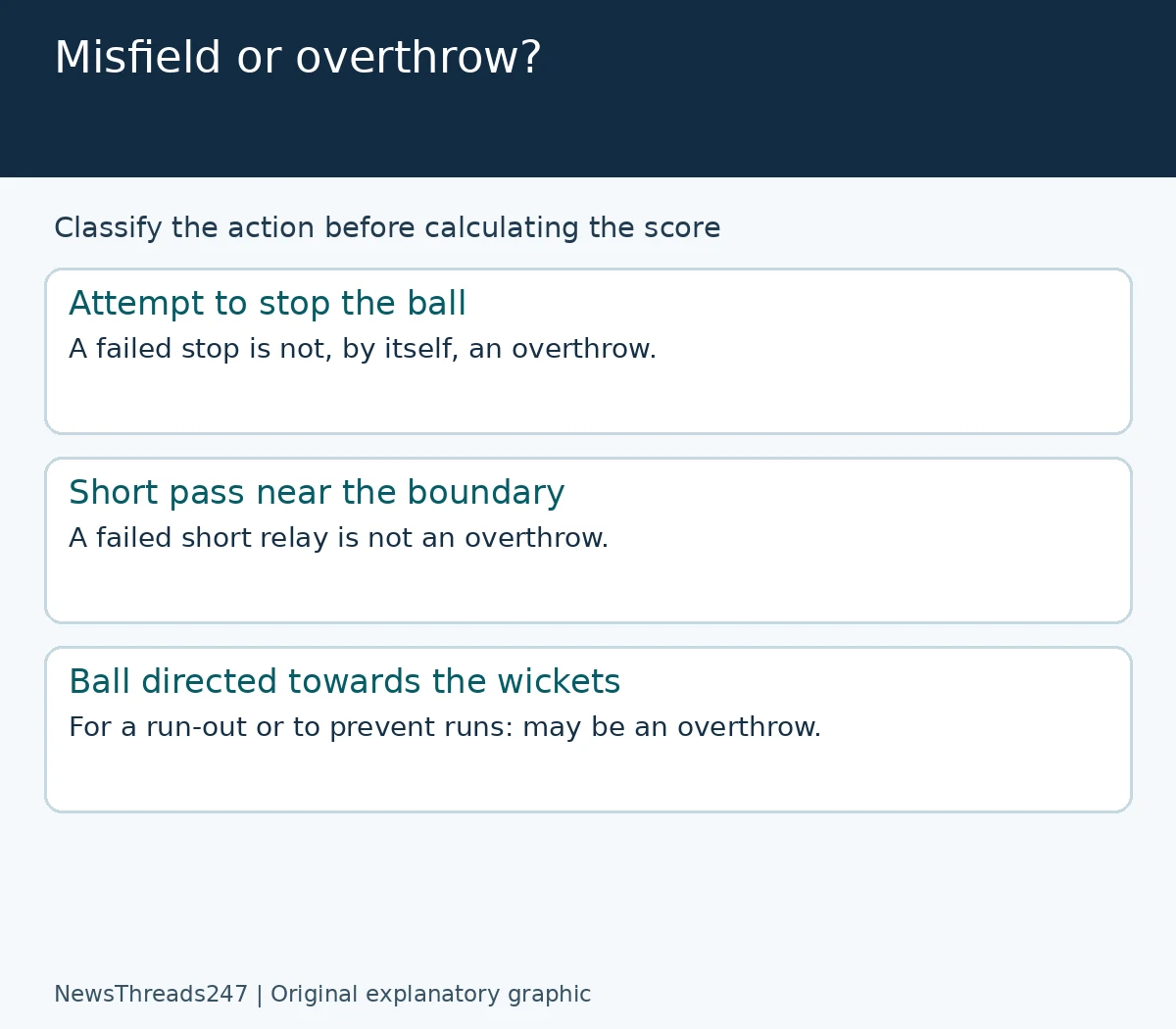
In its October 1 announcement, the ICC distinguished a ball directed towards the stumps to prevent runs or attempt a run-out from an unsuccessful stop or a short pass to another fielder near the boundary. The changes apply to international series starting October 1 or later; ongoing series retained the earlier regulations. This guide uses the October men’s T20I conditions for its precise examples.
Classify the fielding action first
Clause 19.8.2 in the October men’s T20I conditions describes the qualifying throw and exclusions. An attempted stop that sends the ball over the rope is not an overthrow. Nor is a failed short relay between fielders near the boundary. The umpire assesses the action, not merely whether a hand touched the ball.
Imagine a fictional deep fielder diving at a rolling ball and knocking it across the rope. Compare that with a fielder collecting it and directing a throw towards the wickets for a run-out, after which it reaches the boundary. Both involve poor outcomes for the fielding side, but the action that produced the boundary is different.
A replay that begins only as the ball reaches the rope may hide this distinction. Look earlier: was there a stop, a short relay or a throw towards the wickets? The scoring explanation should start there before asking where the runners were.
For a qualifying overthrow, freeze the throw
Under clause 19.8.1, a qualifying overthrow boundary adds the boundary allowance to the runs completed at the throw, with the run in progress included if the batters had already crossed then. Applicable penalties are considered separately. The reference moment is the throw, not the later moment when the ball crosses the boundary.
That timing is the heart of the calculation. Two batters can cross while a long throw is travelling. Seeing them cross before the ball reaches the rope does not establish that they had crossed when the fielder released it.
For an illustrative replay exercise, pause at release and note three things: completed runs, whether the runners have crossed for their current run, and the applicable boundary allowance. Keep that freeze-frame note while watching the remainder. Otherwise the final picture can overwrite the earlier information the rule requires.
Two examples that differ by one crossing
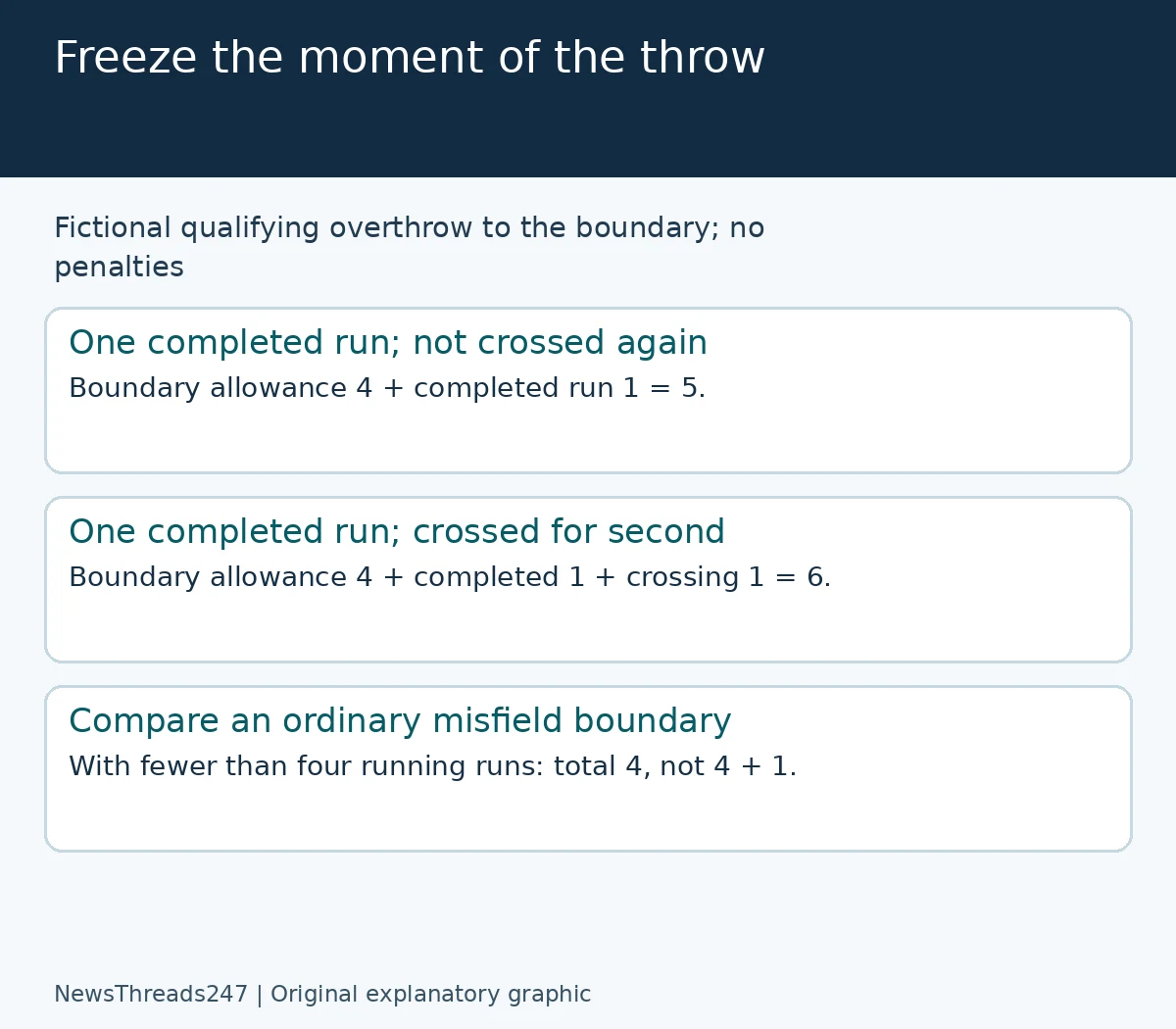
Assume a fictional qualifying overthrow reaches the boundary, the allowance is four and there are no penalties or other extras. At release, the batters have completed one run and have not crossed for the second. The calculation is 4 + 1 = 5.
Now change only one fact. At release, the same pair has completed one run and has crossed for the second. The calculation becomes 4 + 1 + 1 = 6. The extra run comes from the crossing at the specified moment. It is not an automatic extra for a particularly bad throw.
These examples are deliberately controlled. They do not try to resolve a real disputed finish, a short run or a sequence of multiple throws. If another event matters, identify it and read the relevant provision instead of forcing it into a simplified example.
An ordinary misfield boundary uses a different comparison
Clause 19.7.3 generally compares the ordinary boundary allowance with completed runs plus the eligible run in progress at the boundary, awarding the greater rather than adding the two. The special overthrow calculation is an exception.
For a fictional ordinary boundary four after one completed running run, with no penalties and no larger running total, the total is four. It is not five merely because the batters ran before a fielder’s failed stop sent the ball across the rope.
A useful test is to write the operation before the numbers. For the ordinary boundary example, you are comparing alternatives. For the qualifying overthrow example, you are adding the specified components. The same visible boundary can therefore produce different totals without the scorer applying an arbitrary bonus.
A wild throw is not automatically a six
A ball sailing over a rope may resemble a batter’s six in a short clip. But the reason for the boundary matters. The overthrow examples here use a four-run allowance; they do not award six merely because the throw did not bounce.
When sharing an explanation, describe the origin of the ball as well as where it landed. ‘The fielder’s throw crossed the boundary’ is useful context that ‘it went straight over’ omits. It prevents readers from importing the batting-six rule into a different event.
Keep wilful acts and boundary catches separate
Clause 19.8 also covers a defined wilful act, a separate category with its own wording. Do not accuse a player of that conduct merely because a throw looked careless. An error and a deliberate act are different descriptions, and a commentator’s frustration does not establish the latter.
Catches near the rope raise another set of questions. Our boundary-catching explainer deals with grounded contact and returning to the field. It should not be used to calculate overthrow runs simply because both events happen near the boundary.
For a real incident, record what the umpire ruled, which playing conditions apply and which moment the replay establishes. If the available angle does not show the runners at release, acknowledge that limitation instead of deciding the missing fact from the final scoreboard.
Explain the score in one reproducible line
A good account can be short once the observation work is done: identify a qualifying overthrow, state the completed runs and crossing at release, then show the addition. For an ordinary misfield boundary, identify that action and explain the greater-of comparison instead.
That method is useful for viewers in India and elsewhere following international cricket because it makes the reasoning checkable. A reader can disagree about what the video shows without confusing the formula with the evidence. Neither a viral caption nor a confident total substitutes for both.
Sources and visual credits
ICC October 2026 men’s T20I clauses 19.7–19.8 and the ICC October 1 explanation were checked October 28, 2026. Use the applicable competition document for other formats or domestic matches. Arithmetic and scenarios are original illustrations with stated assumptions, not disputed-match reconstructions. The featured image is AI-generated conceptual artwork; the contextual and worked-example graphics are original NewsThreads247 teaching aids.