
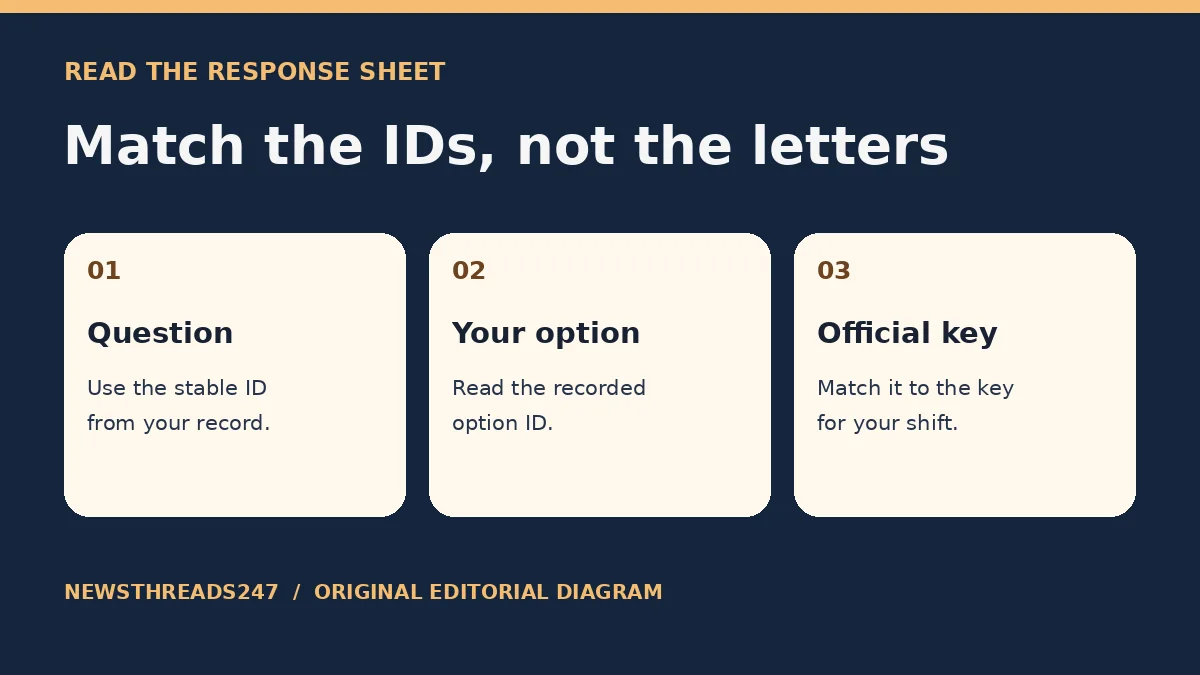
Before paying to challenge a JEE Main answer, match the year, session, paper and shift. Then match the question ID and compare your recorded option ID with the provisional key. A different letter on a coaching screenshot is not enough: you need to know that both records describe the same question and option.
In this article
Start with three separate records
The response sheet tells you what the system recorded for your sitting. The provisional answer key tells you what the National Testing Agency (NTA) proposes to accept before reviewing objections. The final answer key reflects the agency’s decision after that review and is the basis for preparing results. You may need to save all three at different times; one cannot substitute for another.
Start on the official JEE Main documents page and check that the notice names your paper. Paper 1 is for B.E. and B.Tech.; the architecture and planning papers have their own records and may have different notices. Even for Paper 1, a key for another session, shift or examination year can look plausible. Put the year, session, paper, date and shift at the top of your comparison notes before you copy a single answer.
| Record | Question it answers |
|---|---|
| Recorded responses | What did the exam system save? |
| Provisional key | What does NTA propose to accept? |
| Final key | Which answers are used for results? |
Compare identifiers, not the A–B–C–D labels
Open the question and recorded responses side by side with the official provisional key. Find the question by its ID. For a multiple-choice item, match the recorded option ID and the key’s accepted option ID. If the paper is a numerical-response item, compare the recorded value with the type of answer the key gives and use the paper’s instructions. Do not compare a numerical value with an option identifier.
In the April 2026 Paper 1 notice, NTA identified the correct option by ID and used the same identifiers in its challenge form. That notice is an example of the format, not a live deadline or a guarantee that the next interface uses the same labels. Treat unofficial letters and question numbers as navigation aids only.
Here is a fictional example. Your response sheet shows question Q501 and option 704. The provisional key for that sitting shows Q501 → 704. A coaching page labels its answer “C,” while the option appeared as “B” in your copy. If the official IDs agree, the difference in letters is not itself a reason to pay. If the key instead shows Q501 → 702, you have identified a real mismatch. The next step is to decide whether the answer key is wrong, rather than assuming every mismatch is an error.
What makes a challenge worth submitting?
Start by solving the exact question without looking at either answer. Check the instructions, units and any rounding rule. Then ask which explanation you can support: the keyed answer is incorrect, more than one answer fits, or there is a genuine defect in the question. If a textbook supports your reasoning, record the title, edition and relevant page and explain how it applies. A bare screenshot or a tally of poll votes does not do that work.
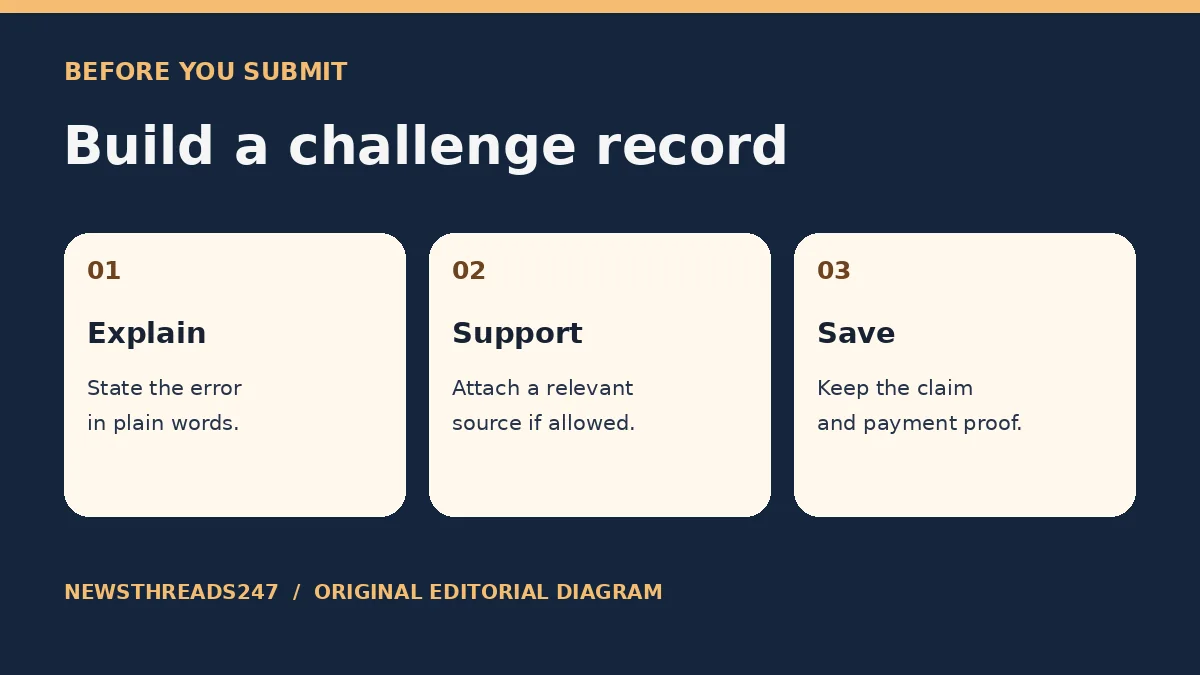
When the current notice allows supporting evidence, give the reviewer the shortest route to verify it. State the question ID, the answer you propose and the exact reason it follows. If the issue depends on a diagram or a word in a language version, identify the relevant text instead of asking the reviewer to guess. Keep your application number, login details and payment data out of anything you share outside the official portal.
Check the notice again before paying
Chapter 11 of the JEE Main 2027 Information Bulletin specifies a non-refundable processing charge of ₹200 per question challenged. Use the session-specific notice for the actual submission window, method and any later changes. This guide is not announcing an open challenge window.
In the April 2026 procedure, saving the claim led to a separate final payment step; the notice said challenges without receipt of the fee would not be considered. In your own sitting, check that the portal shows the submission outcome required by the current instructions. Save the claim summary, receipt or reference and timestamp. If your bank shows a debit but the portal does not show completion, use the official help route and preserve the evidence rather than treating the debit as a successful filing.
When the final key changes your estimate
For the 2027 Paper 1 scheme, the bulletin distinguishes several outcomes that people often call “bonus marks.” If more than one option is accepted, the marks go to candidates who selected an accepted option; if all options are found correct, the bulletin gives the marks to those who attempted the item. A dropped question is treated differently: the bulletin gives full marks to candidates who appeared in that shift. It also states the rule for incorrect or dropped numerical items. Check the exact wording in Chapter 2 rather than applying these rules to other papers or years.
For a small illustration, suppose a recorded multiple-choice answer earns −1 under a provisional estimate and becomes an accepted option under the final key, earning +4. That is a five-mark difference for that item, not five percentile points. A change to a raw estimate cannot tell you your rank or normalized NTA score. See our guide to percentile versus percentage before comparing figures with friends in other shifts.
NTA’s April 2026 notice also explained that a revised key was applied to the affected candidate responses and that it would not issue individual decisions to challengers. Consult the latest notice to see how your session handles notifications, then compare the final key with the original notes rather than relying on a message thread.
Keep a short record you can use later
Use one line per disputed item: sitting, question ID, recorded response, provisional answer, reason, evidence reference, challenge status and final answer. If you are only estimating your score, mark provisional assumptions clearly and do not fill missing evidence from memory. That simple record lets you revisit the official outcome without repeating the whole exercise.
Recheck this guide whenever NTA publishes a new bulletin or challenge notice, especially the fee, permitted attachments, deadlines and scoring treatment. The examples and diagrams are original editorial illustrations, not portal screenshots or questions from an NTA exam.