
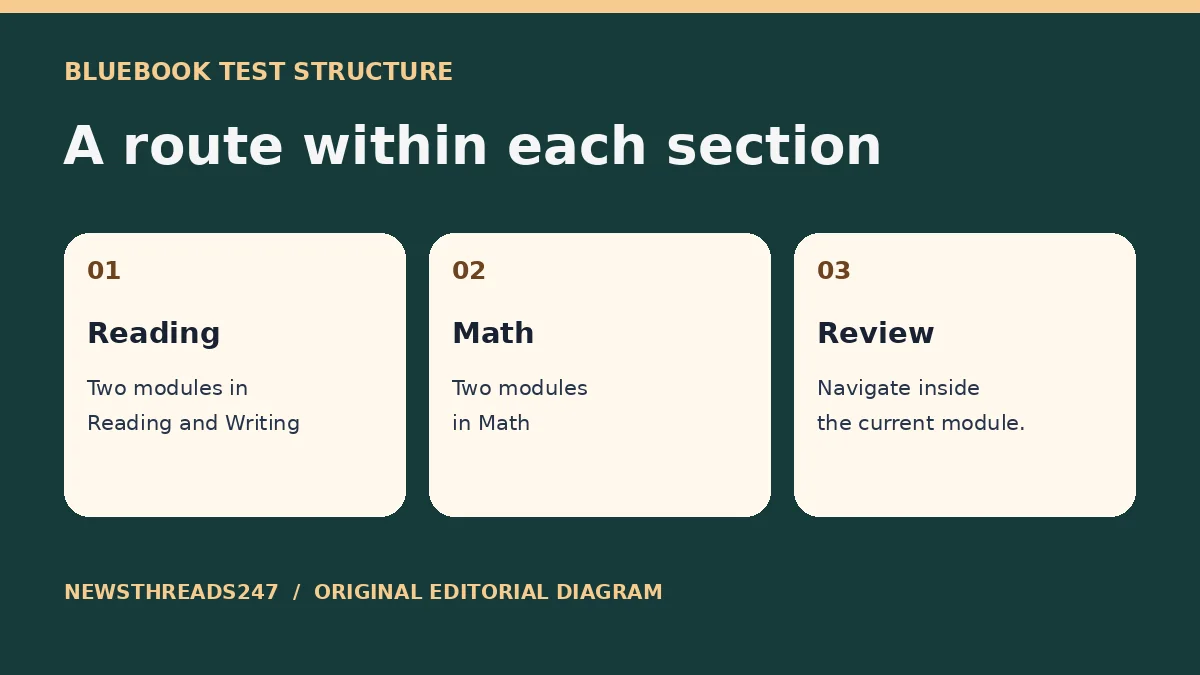
The digital SAT adapts between modules, not after each question. Reading and Writing and Math each have two modules, and each section score draws on both. That is why a second module that felt difficult is a poor score forecast, and a count of correct answers is a better study clue than a score calculator.
In this article
How the two modules work
In the College Board’s scoring explanation, the first module in each section samples a range of difficulty. Performance there determines which second module you receive in that section. Both versions of the second module still contain a mix of question difficulty; they differ in the mix, not in whether every question is hard or easy.
Reading and Writing routes separately from Math. Within a timed module you can move around and revisit questions before it ends, but there is no practical reason to spend that time trying to diagnose the route. A demanding passage may be a personal weak spot rather than a signal about the module. Once you move into the next module, put your attention on the questions in front of you.
The assessment framework distinguishes this design from question-by-question adaptivity. That distinction changes your tactics: previewing or returning to a question within the module is compatible with the test design. You do not have to answer an item before you can see the next one.
Why equal correct counts can produce different scores
The SAT reports a total on a 400–1600 scale, formed from the two section scores. College Board describes a scoring model that takes account of the characteristics of questions and the pattern of responses. It also includes two unscored pretest questions per module. So a simple count of correct answers is not a complete input to the scoring model.
Imagine that two students reviewing a practice section each tally the same number correct. One missed several items on a skill the other handled; the other missed different items. The equal tally does not settle whether their reported scores should match. For a practice test, use the score Bluebook reports. For studying, use the tally only alongside the actual error patterns.
There is a useful limit to the inference: the public explanation does not give you a reliable hand calculation from a recalled question, and you cannot reliably tell which questions were unscored while testing. Avoid online rules that promise a precise score from two guessed module counts. They can turn uncertainty into a falsely precise number.
Make a timing decision you can control
Try a two-pass approach within a module. On the first pass, answer questions you can complete cleanly. Flag a time-consuming one and move on rather than giving it several extra minutes simply because it appeared early. On the second pass, return to the flags, eliminate choices where you can and check you entered the answer you meant to enter. Leave enough time for that last check.
College Board says that for most students who are trying their best on every question it is better to guess than leave a blank, especially after eliminating choices. This is different from a conventional exam that explicitly subtracts a fixed mark for a wrong answer. Use the guidance for the SAT rather than borrowing a guessing formula from a different exam.
Example: you have four questions left, one of them already flagged, and only a few minutes remaining. Complete a question you can solve now, then return to the flagged one if there is time. In review, ask whether you ran short because the module was demanding or because you spent too long on one item. You cannot confirm the first explanation from memory, but you can test the second on your next timed practice.
Read a Bluebook practice result in the right order
Take a full-length official practice test under reasonably comparable conditions. In College Board’s My Practice guide, the score report lets you review the questions, the answers you chose and the explanations. First record the form and both section scores. Next list the items that reveal a repeatable problem, including correct guesses if you remember them. Do not judge improvement from one easy or difficult feeling.
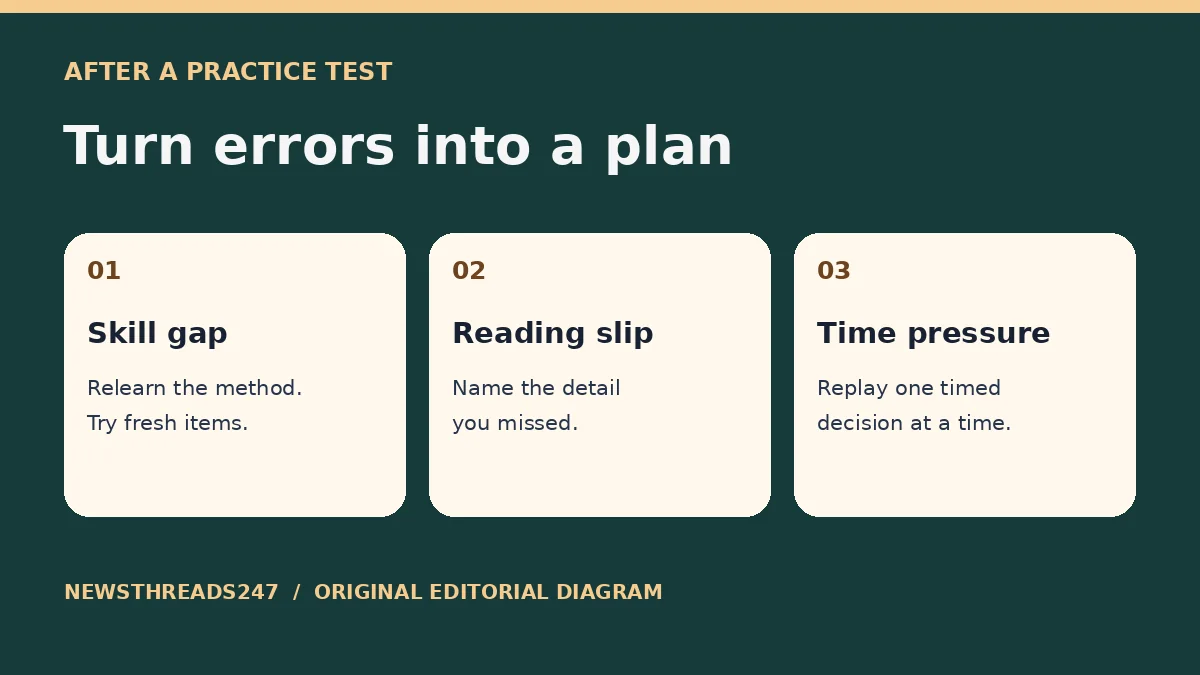
Divide the review into three groups. For a skill gap, work through the method and try new questions of that type. For a reading slip, write down the detail you missed and build a specific check, such as reading the units before solving. For timing, write down the decision that cost time, then practise making that decision sooner. This is more useful than copying a list of wrong answers into a notebook.
Here is a fictional two-test pattern: the Reading and Writing score rises slightly, but the student still misses questions that ask what a sentence does in the paragraph. The study decision is to practise that task again, then test it on new material, not to change a whole strategy on the strength of a small score movement. Our mock-test review guide has a separate framework for turning recurring errors into a study plan.
| After practice | Better next step |
|---|---|
| Repeated skill gap | Relearn the method and try fresh questions |
| Repeated reading slip | Name the detail you miss and build a check |
| Timing loss | Practise the decision to flag and move on |
Keep test readiness and score reporting separate
The practice score tells you how you performed on that practice form; it does not guarantee a future result. Use it to decide where your next study session goes. If you need to prepare the device or verify admission documents, follow the separate Bluebook test-day checklist. If your decision is which scores to send, check the college’s own policy instead of inferring it from the scoring model.
Before your next practice, choose one measurable task: reduce avoidable reading errors, finish the first pass with time for flags, or correctly solve a particular type of problem across several new questions. Recheck this explanation if College Board changes the test structure, scoring documentation or My Practice reporting. The graphics are original explanations, not Bluebook screenshots or sample test items.