
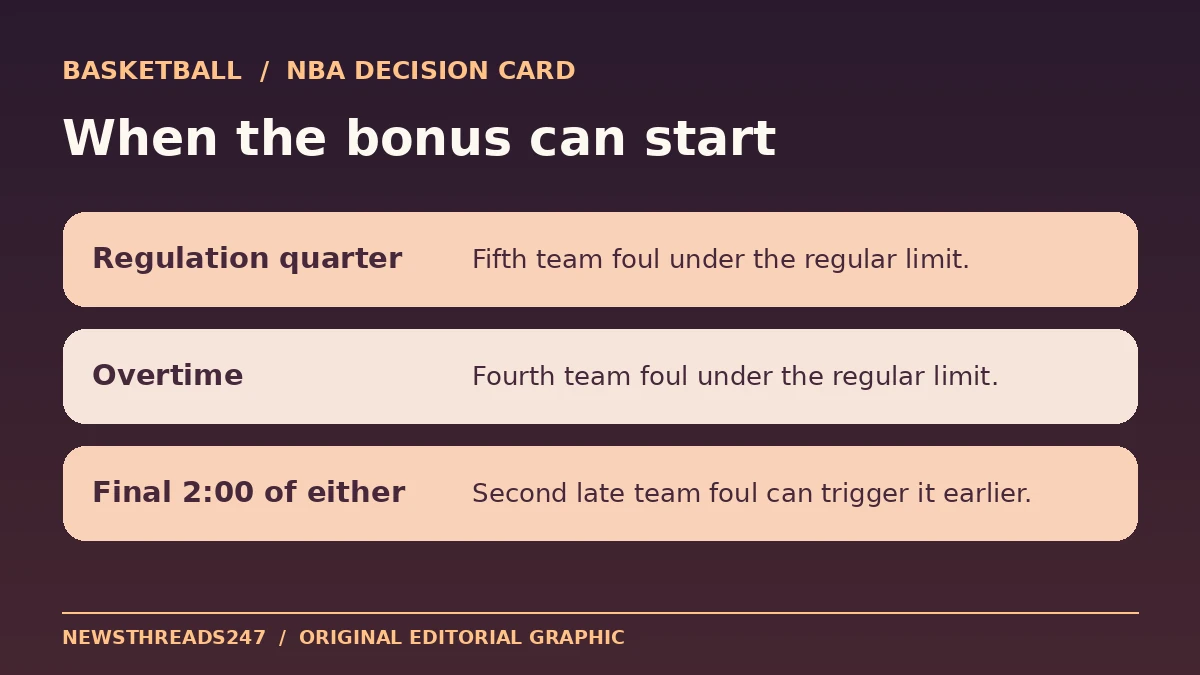
In the NBA, a common defensive foul away from a shot can send the other team to the free-throw line once the defending team is in the penalty, often called the bonus. Usually that happens on the fifth team foul of a regulation quarter. But a team that is still below the limit when the clock reaches 2:00 gets only one team foul without that added penalty in the remaining time. The next one can mean two free throws even when the total is only three or four.
In this article
Use the team count for the current period
The NBA’s official foul rule, Section V sets a four-team-foul allowance for a regulation quarter and a three-team-foul allowance for each overtime. For an ordinary defensive foul on a player who is not shooting, the usual contrast is a throw-in before the penalty applies and two free throws after it applies. The foul that exceeds the allowance is itself penalised; the referee does not wait for one more.
The team count concerns the current period, not the whole game. A player’s individual foul total is a different number. If you are following a close game and see a starter with five personal fouls, that tells you something about their risk of fouling out. It does not answer whether the next common foul by a teammate gives away free throws.
Watch which team’s count is being used. If the team in white has reached the penalty, it is the opponents who can receive bonus free throws when white commits another qualifying foul. A broadcast can display a bonus indicator next to the team entitled to shoot; it need not appear next to the team that used up its allowance.
See what changes when the clock reaches 2:00
There are two ways to reach the penalty: exceed the usual period allowance, or, if the defending team entered the final two minutes below that allowance, commit a second team foul in that window. The NBA’s clock definitions include 2:00 itself in the final-two-minute period. The earlier limit still applies. For example, if a team reaches 2:00 with four team fouls already, its next qualifying foul is the fifth and gives free throws. It does not get another foul to give because the clock changed.
Start with a team that has committed two fouls when 2:00 arrives. At 1:54 a defender grabs a cutter before any shot. The whistle is the third team foul and the first one in the last two minutes, so play resumes with a throw-in in this example. At 1:31 another defender commits an ordinary non-shooting foul. That is team foul four but the second in the late window. The fouled player gets two free throws.
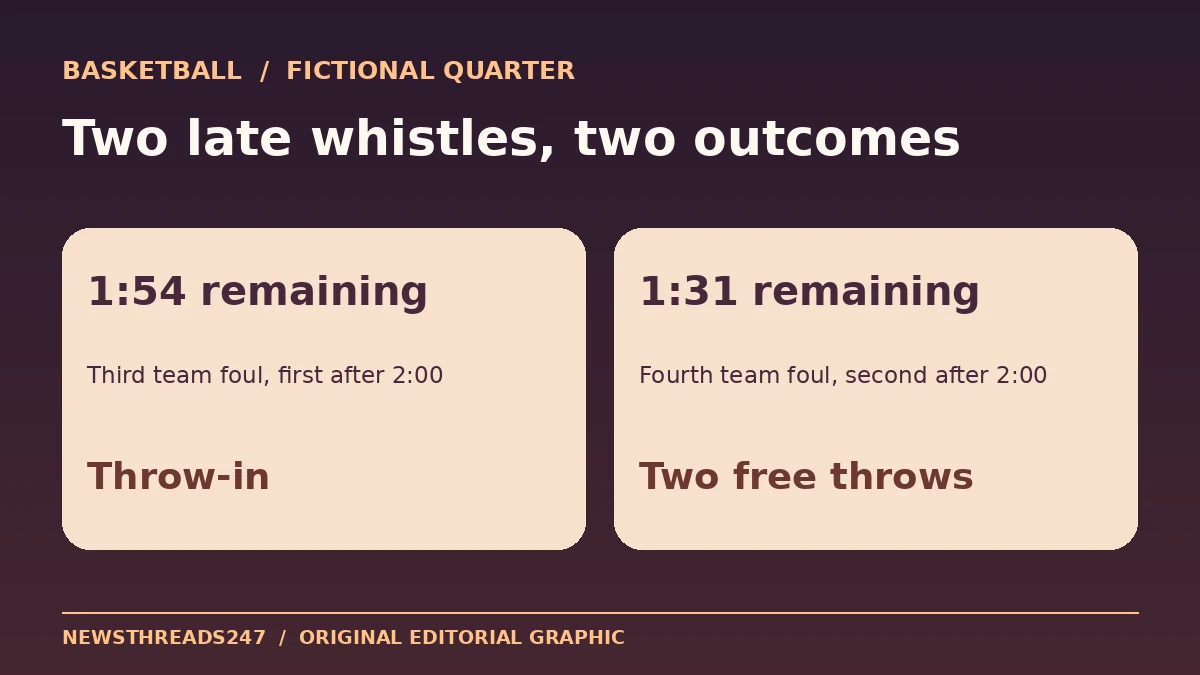
Move the second whistle earlier for a useful comparison. If the same team committed its third and fourth common non-shooting fouls at 2:30 and 2:15, neither would by itself bring bonus free throws. But it would enter the last two minutes with the allowance already used up. Its first ordinary defensive foul at 1:31 would then be team foul five and lead to shots by the usual route.
Start a new count in overtime
Each NBA overtime period uses its own three-foul allowance. The fourth team foul can trigger the penalty by the regular overtime limit. The final-two-minute exception also applies in overtime, so the second late team foul can trigger it earlier if the team was below the limit entering that window.
Consider a team with no fouls when overtime has two minutes left. If it commits common defensive non-shooting fouls at 1:45 and 0:48, the second brings the penalty even though it is only the team’s second foul of overtime. If the game goes to another overtime, start a new overtime team count. Do not carry over the team’s final regulation tally or the previous overtime’s tally.
Classify the whistle before predicting the restart
The bonus rule helps with ordinary defensive non-shooting fouls. A foul on a shot has its own outcome. A made basket with a foul can bring one additional free throw even when the defence is in the bonus; the penalty does not add two more attempts on top of it. The NBA also assigns separate penalties to events such as flagrant, clear-path and transition take fouls. Some of those count toward the team total but are not decided solely by the bonus indicator.
If the replay shows a foul by the team with the ball, check the official’s signal. An ordinary offensive foul typically turns possession over; the NBA’s rule on offensive fouls distinguishes it from a common defensive foul. An offensive foul with a separate special penalty is another reason to wait for the call. If a coach challenges the ruling, the outcome can also change; see our guide to the NBA coach’s challenge and timeouts.
Keep a simple two-number note
If the scoreboard does not say how many fouls the defence has to give, write down two numbers at the next stoppage: the defending team’s total in the period and how many of those fouls came at or after 2:00. Then check the type of foul. This is more useful than trying to infer the penalty from who heads toward the line. It also makes clear when a graphic is showing a count for a different team or a different period.
This explanation applies to NBA play. College, international and local competitions can use different team-foul counts and overtime rules. For a different competition, check its current rulebook rather than applying the NBA’s clock rule by habit.