
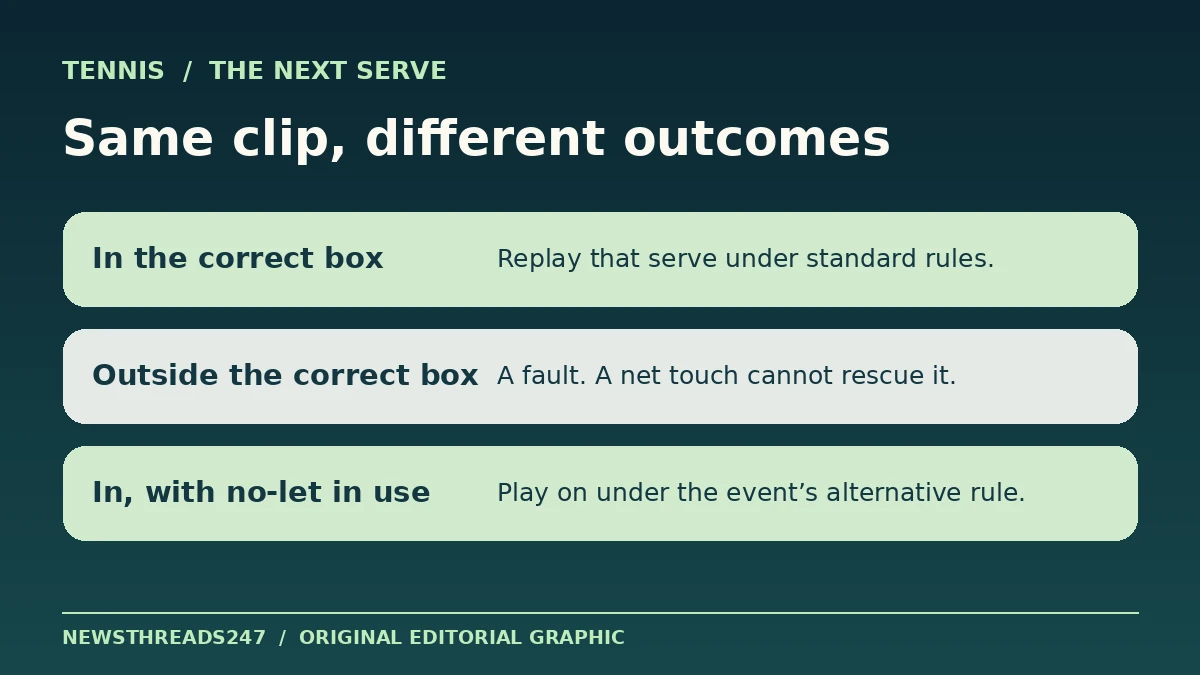
A tennis serve that clips the net and lands in the correct service box is usually replayed. If it was the first serve, the server gets another first serve. If the first serve was already a fault, the server repeats the second serve only. There is a separate outcome when play stops for outside interference during a rally: a replay of the whole point generally starts with a first serve, even if the rally began on a second serve.
In this article
Watch where the serve bounces
The first thing to watch after a net clip is the bounce. Under ITF Rules of Tennis 19 to 22, an otherwise legal serve that clips the net, strap or band and lands in the correct service box is a service let. No point is awarded and that delivery is taken again. The USTA’s serving guide and the Lawn Tennis Association’s scoring guide describe the same everyday case.
A net clip does not make a serve good. If the ball drops back on the server’s side, or crosses but lands outside the correct service box, it is a fault in the ordinary bounce scenario. A ball touching the boundary line of the correct box counts as in. If you can hear the net but cannot see the bounce from your seat, wait for the call before assuming the server gets a replay.
The ITF also covers a less common case: after hitting the net, strap or band, a serve that hits the receiver, their doubles partner or something they wear or carry before the bounce is a service let under the standard rule. There is also a let when the receiver genuinely is not ready. Rule 21 treats an attempted return as a sign of readiness, and the receiver is expected to keep to the server’s reasonable pace. A service let is therefore a type of call, not another name for every ball that brushes the net.
Keep track of the last valid attempt
Imagine the score is 30–30. The first serve goes long, so the server has one serve left. The next ball brushes the net and lands inside the correct box. The umpire calls a service let. The score stays 30–30, and the server is still on a second serve. If the replacement delivery goes wide, it completes a double fault and the receiver wins the point. The let did not become a fault, and it did not erase the first fault.
Now imagine the net clip happened on the first delivery and the ball landed in. A replayed first serve that subsequently misses still leaves an ordinary second serve. There is no need to count the number of times the ball left the racket. Ask which attempt was active when the let was called. Multiple service lets do not create additional attempts; each one leaves the server in the same position.
On a score feed, the points alone cannot distinguish a first-serve let from a second-serve let. The point score is unchanged in both cases. If a broadcast comes back from a replay and you hear “second serve,” that may simply be the umpire preserving an earlier fault.
Tell a service replay from a point replay
Take the same score and the same first-serve fault. This time the second serve is good and the players trade two shots. A ball from a neighbouring court rolls into their path, play is stopped and a let is called for the point. In the exact in-play example attached to ITF Rule 23, the server starts again with a first serve. The earlier first-serve fault belonged to the point being replayed in full.
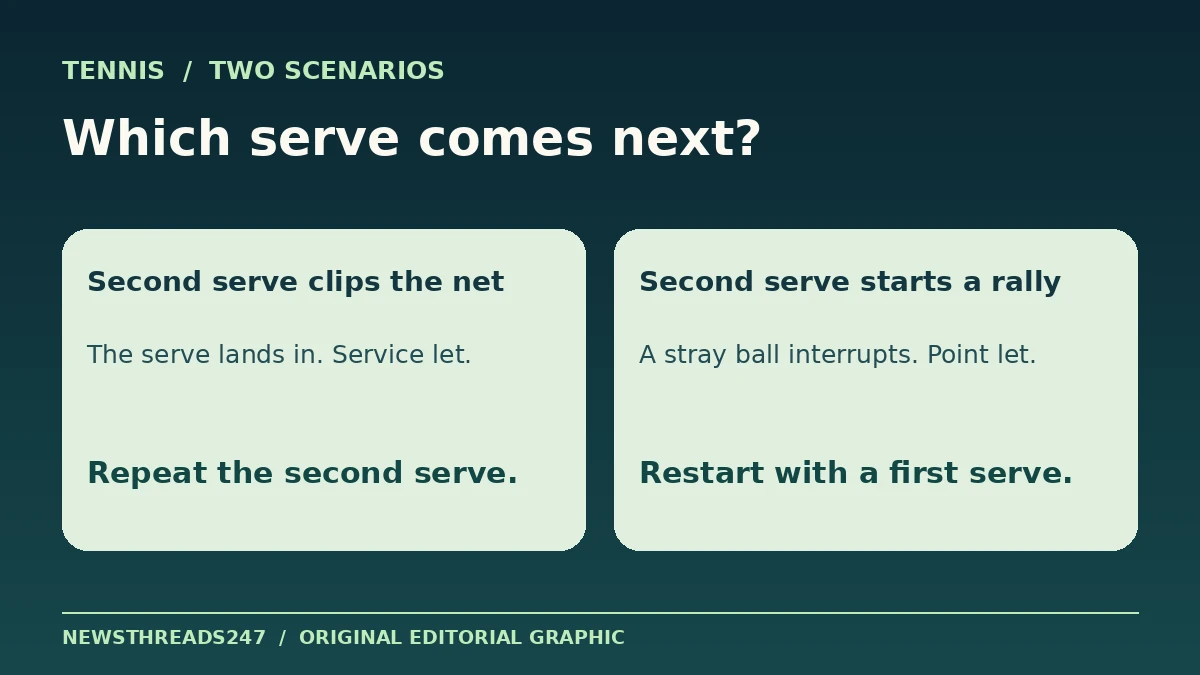
Timing matters. A ball on court between the first and second delivery is not automatically the same as interference during an active rally. The USTA’s guidance on an interrupted service sequence discusses the stage of the serve, who caused the interruption and whether a delay was prolonged. In an organised match, let the official decide which serve comes next. In an unofficiated match, follow the event’s code rather than treating a brief delay and an interrupted rally as interchangeable.
Check whether the event uses no-let
ITF Appendix VI allows an alternative in which the usual net-touch service let does not apply. With that no-let procedure in use, an otherwise good serve that brushes the net stays in play. A serve that lands out does not become valid. Nor should you assume that the alternative makes all other kinds of lets disappear.
The easiest time to check is before warm-up, especially when moving between a club competition and an event that uses its own format. Look for the event conditions or ask the tournament desk whether no-let applies. “No-ad” answers a different question about how a game is scored at deuce; the similar names are not evidence that both alternatives are in use.
Read the score after the call
For a quick check, put three questions in order: Was the serve in the correct box? Was it the first or second delivery? Was the call about the serve itself or an interrupted point? Then apply the event’s published conditions. That sequence is also useful in a tie-break, where it can be easy to mistake a replay for the next point in the service order. Our tennis tie-break guide covers how the service order works once a point is actually completed.