
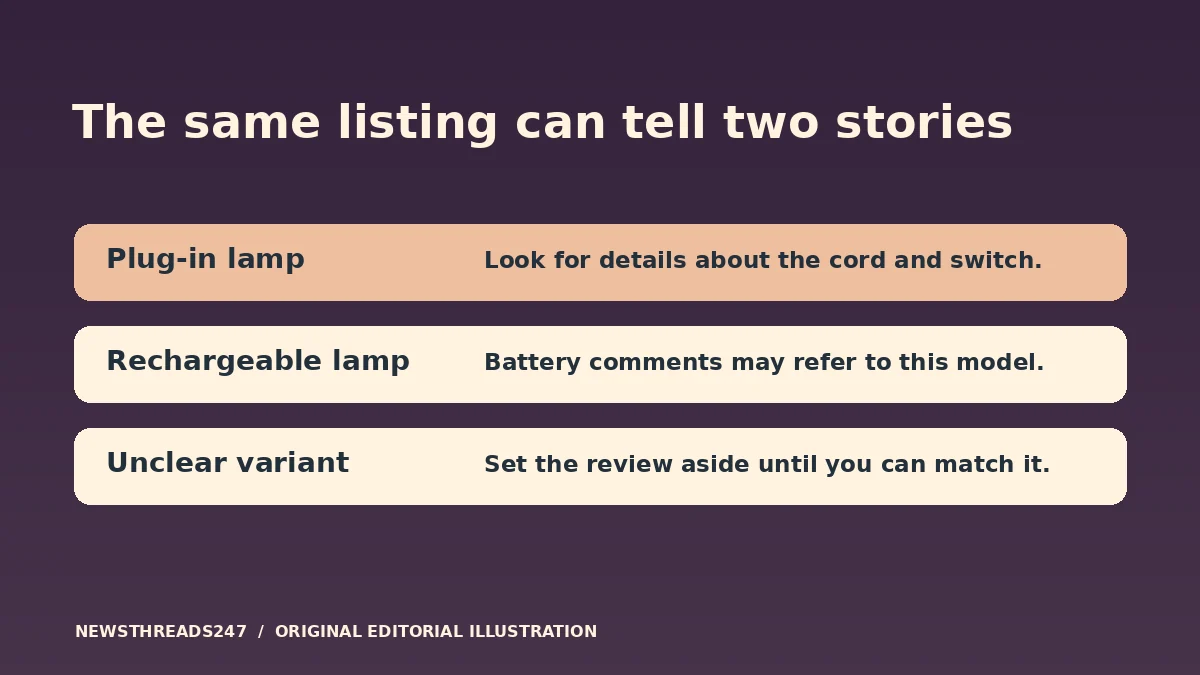
Before buying from an online listing, check whether the reviews describe the exact item, the seller you’ll order from, and the way you intend to use it. A high average score can be useful for orientation. It cannot tell you whether a repeated complaint applies to your model, or whether the problem came from the product, shipping or a different seller.
In this article
Match the review to the product you will actually receive
Write down the model number, size or version you have selected, plus the seller if the marketplace shows one. When you open a review, look for clues that it describes the same choice. A review about a different size, an older version or an accessory in a bundle may be sincere and still be irrelevant. If the page does not tell you which variant the review describes, put it in an “unclear” pile instead of using it as evidence either way.
Use the product specifications or manual to confirm a measurable requirement. For instance, reviews saying that a lamp is “small” do not tell you whether it fits on a 25-centimetre shelf. Check the base dimensions and allow room for the cord. Then look for reviews about a question a specification cannot settle, such as how easily a switch can be reached.
Separate product problems from order problems
A review saying “arrived broken” might tell you something about packaging or transport; it does not establish that the design fails during normal use. A review saying “the hinge loosened after a month” is more relevant to durability if it describes the same model and use. Read the rest of the account before assigning it to either group. If several comments mention late delivery or trouble getting a return, check whether they apply to your seller and read the current terms before paying.
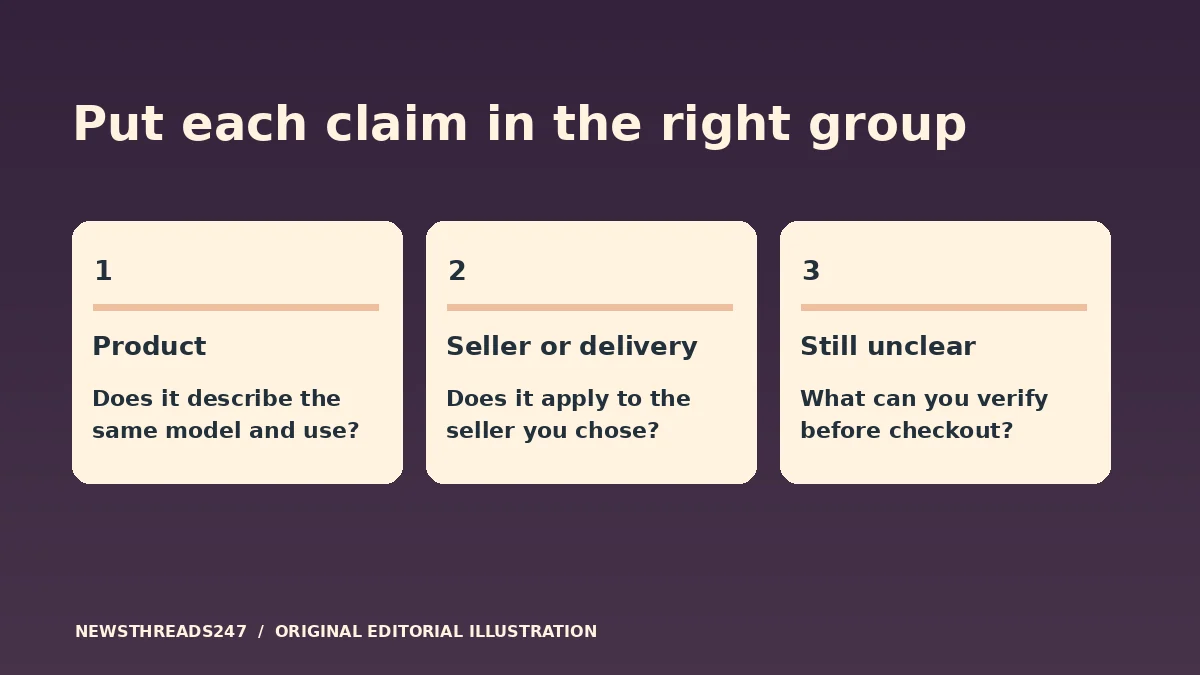
The US Federal Trade Commission’s online shopping guidance recommends looking beyond star ratings and checking more than one source. For the purchase decision, write a note under three headings: the item itself, the seller or delivery, and what you still need to confirm. That keeps a visible complaint from answering the wrong question.
Read for patterns without trying to identify every fake
Open a handful of recent positive, mixed and negative reviews. Read for specific descriptions of use, what changed over time and which version was involved. Search for the concern you care about rather than reading only the most prominent posts. A cluster of nearly identical wording or a sudden burst of brief reviews can be a reason to look elsewhere, but it is not proof of manipulation. A verified-purchase badge or a photo does not independently establish that a claim is accurate or that the item matches yours.
The FTC’s guide to evaluating reviews warns that fake reviews can be positive or negative and can look plausible. Check disclosed free products, discounts or other incentives, and compare with a source that explains how it gathered or tested its evidence. Do not assume every reviewer with an incentive is wrong. Give more weight to a claim you can cross-check than to an enthusiastic or angry tone.
Try the method on a fictional listing
Suppose two desk lamps share a listing. You want the plug-in model, but some recent reviews discuss charging and battery life. Set those aside until you can identify the variant. Next, two reviews for the plug-in lamp report a stiff hinge and describe adjusting it each day. That is a useful question to investigate, even though two reviews cannot tell you how common the problem is.
A third review describes a scratched base on arrival, but gives no seller name. Keep it as a possible delivery concern rather than evidence about the hinge. Check the dimensions in the manual, compare other accounts of the hinge, and see what the selected seller says about damaged deliveries and returns. If you cannot verify a feature you need, ask for the exact specification or choose a better documented listing.
Decide what would make you buy, wait or walk away
Before checkout, finish this sentence: “The thing that matters most is ___, and I checked it using ___.” If the answer is still “the stars looked good,” pause. A sensible next step may be to compare another model, ask the seller a narrow question, or confirm the return terms. For buyers in India, our guide to online shopping returns in India covers that separate post-purchase issue; US and Indian rules are not interchangeable.
This method cannot certify that a review is genuine. It helps you use comments for what they can establish and look for other evidence when a decision matters. Repeat the check if you change the model, seller or listing.