
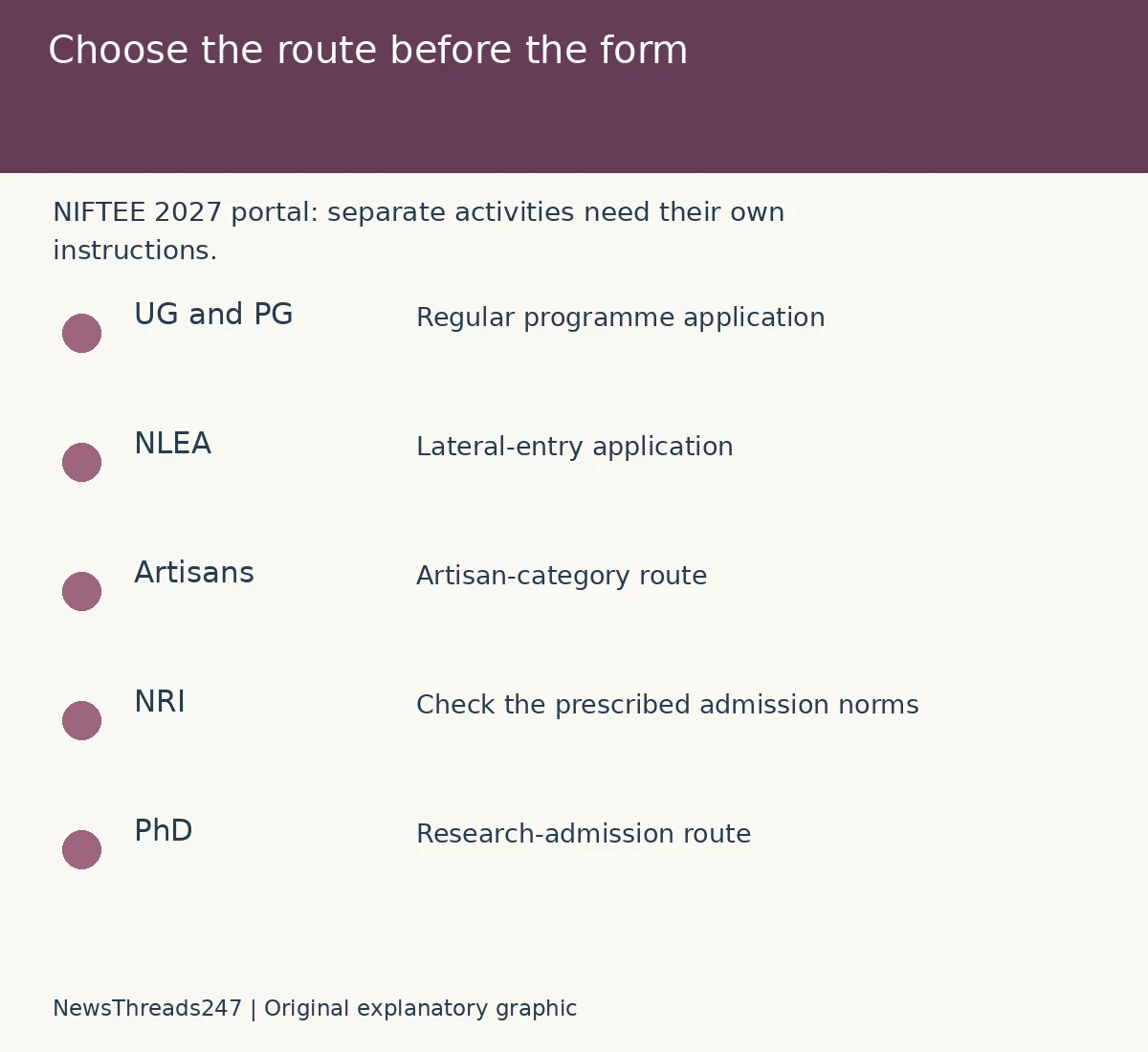
Before filling a NIFTEE 2027 application, identify the admission route you actually need. The official NTA portal has separate activities for UG and PG, NLEA, Artisans, NRI and PhD. A general headline saying “NIFT registration is open” does not tell every applicant which form, calendar or later assessment applies.
The NIFTEE portal is the starting point for the current application activities. Read it alongside NIFT’s 2027 admissions material. The useful decision is not which link appears first, but which route matches your intended programme and qualification record.
Separate the programme from the entry route
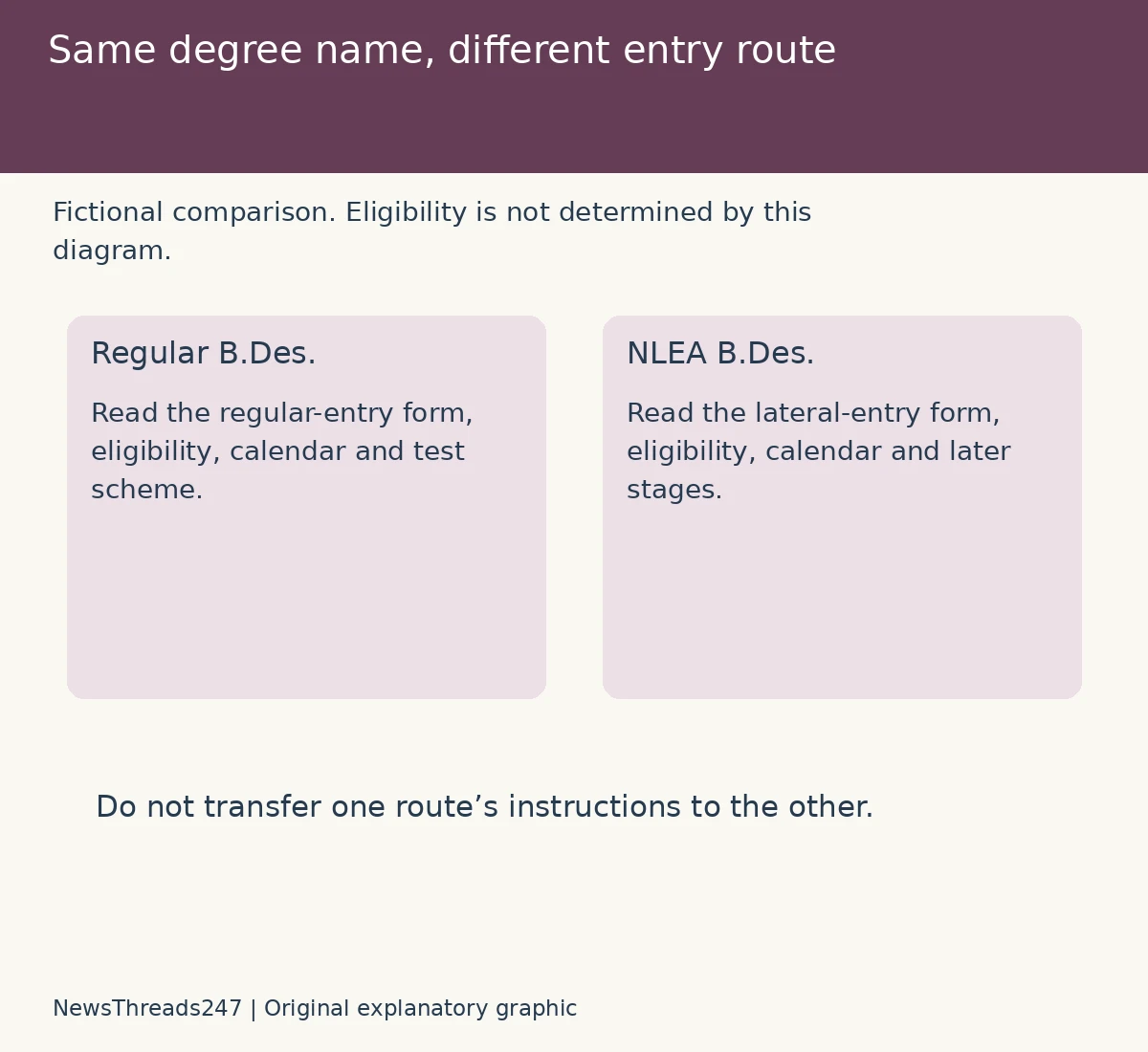
B.Des. and B.F.Tech. are programme names; regular entry and lateral entry answer a different question. The same degree abbreviation can therefore appear in more than one part of the admissions material. Copying a preparation plan or deadline from a paragraph that names the degree, without reading its route heading, can lead you to the wrong instructions.
Make a two-line note before registering: the full programme sought and the entry route. For a fictional comparison, one student seeks regular undergraduate entry while another is investigating NLEA into a degree with a similar name. They should not assume the same application activity or subsequent tests simply because both mention B.Des. Their eligibility still needs its own official check.
The October 16 NTA public notice directs candidates to check age, qualifications, subject combinations where applicable and category-specific requirements in the 2027 guidelines and bulletin. This is not a rule that every qualification is accepted for every route. Locate the relevant section before choosing the form.
Read the heading above the date table
The NIFTEE 2027 information bulletin contains separate calendars for different routes. Its regular and NLEA schedule lists November 16, 2026 for applications at the applicable fee, November 21 with a ₹5,000 late fee in addition to that fee, and November 22–25 for corrections. These dates must remain attached to that schedule, rather than becoming a universal calendar for every link on the portal.
Elsewhere, the bulletin lists later timelines for Artisans, PhD and NRI-related admissions. Do not switch routes because one appears to provide more time. A later calendar does not establish that you meet that route’s conditions. If the public notice and the route-specific material leave your case unclear, ask the official helpdesk which provision applies before paying.
Keep the document title, year, section heading and access date with your notes. Recheck subsequent notices before relying on a calendar. A correction period is also a separate event from initial registration; it is not permission to postpone an application until that period opens.
Do not turn a shared abbreviation into a shared test plan
NIFT admissions use several assessment labels, including GAT, CAT, Situation Test, Studio Test and interviews in the relevant routes. Read the full route heading and the programme-specific scheme. A lateral-entry table mentioning a Studio Test does not rewrite the regular-entry scheme elsewhere in the bulletin.
This is especially important when assembling a study timetable. First list the components actually required for your programme and route, then the official syllabus or instructions for each. Put any component you have not verified in a question column. A coaching timetable may help organise practice, but it cannot decide which examination you are required to take.
This guide does not reproduce a single “NIFT exam pattern” for all applicants. Nor does a January examination headline settle a PhD applicant’s subsequent research-proposal or interview process. Verify the sequence that belongs to the route you selected.
Choose combinations only where the rules permit them
NIFT’s 2027 admissions FAQ describes specified combined-programme options through an integrated application, subject to eligibility. Do not infer that any two programmes can be combined, or create separate applications as a workaround without checking the current instructions.
Compare the programme names on the actual form with your written route note. If the desired option is absent, pause and establish why. It may be the wrong route, an eligibility issue or a programme combination that is not offered. Selecting a similar-sounding option solely to move to the next screen can create a problem that a later correction does not necessarily solve.
Read the fee for the actual category and number of programmes in the bulletin. A quoted single-programme amount is not automatically the total for a permitted combined application. The late charge is an additional charge in the relevant schedule, not a replacement for the application fee.
Keep the application record tied to the chosen route
Review the final programme and route, submitted answers, uploaded documents and payment status together. NIFT’s FAQ tells candidates to retain the confirmation page and proof of fee paid. Save them with a filename that identifies the cycle and application, rather than collecting several unlabeled screenshots.
If you need clarification, a focused question might say: “I am considering this programme through this route; which section governs my qualification and test components?” Attach only what the official support channel requests. Do not post personal records or credentials publicly, and do not pay someone who guarantees admission.
Later, use the actual admit card for the allotted centre and shift. Our exam city-slip guide explains why advance city information and an admit card serve different purposes. Neither makes an incorrect application route correct.
Sources and scope
India admissions guidance checked October 29, 2026 using the current NTA portal, October 16 public notice, NIFTEE 2027 bulletin and NIFT’s 2027 FAQ. The comparison is fictional and no applicant account was tested. Eligibility, permitted combinations and later selection stages need the rules for the actual programme and route; submitting a form is not a guarantee of admission.
Visual credits: featured artwork is an AI-generated conceptual illustration. The two original NewsThreads247 graphics explain records and decisions; they are not official forms, interfaces or evidence about a real applicant.