
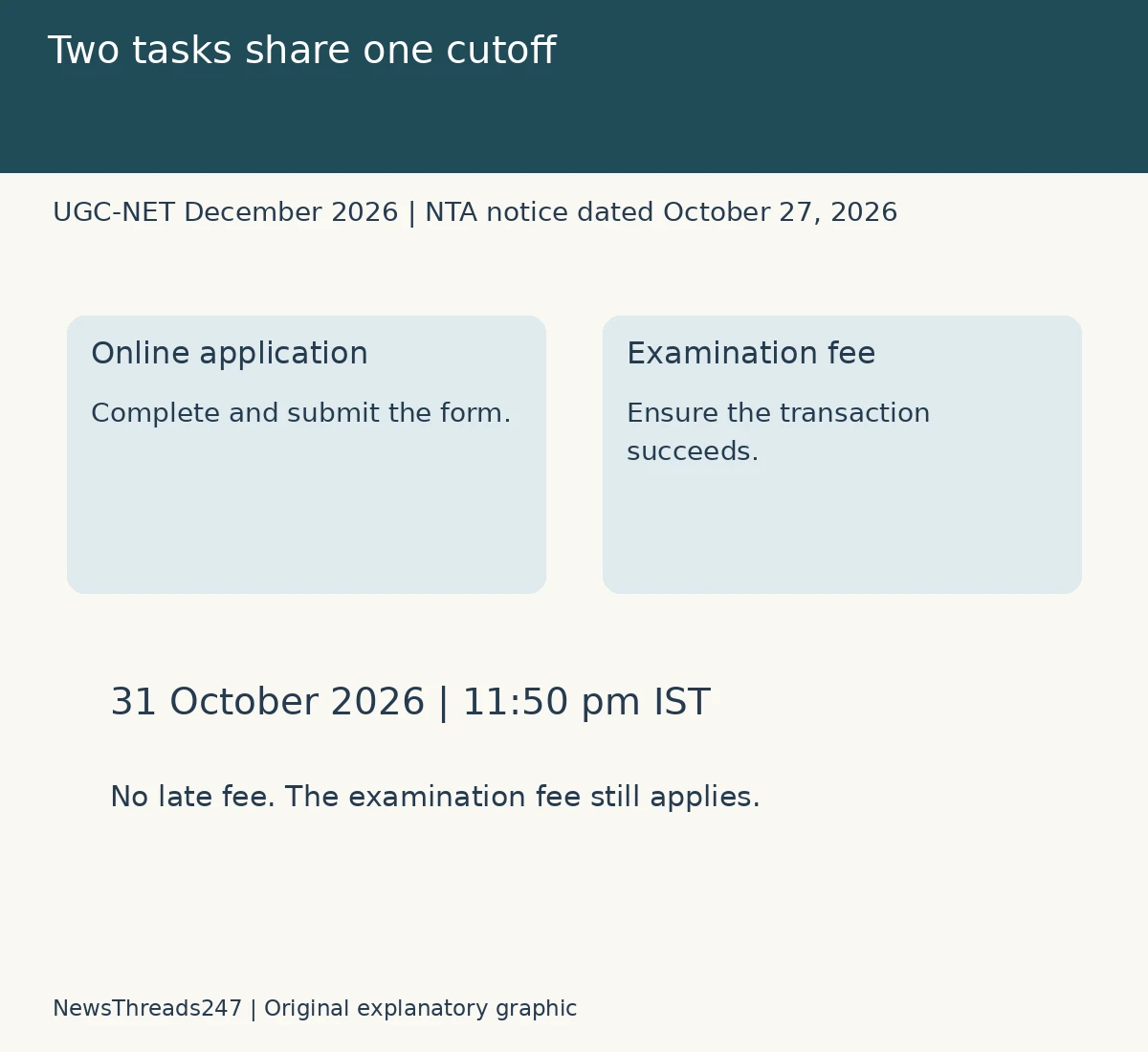
UGC-NET December 2026 applicants in India now have until October 31, 2026, at 11:50 pm to submit the online form and complete the examination-fee transaction. The extra time carries no late fee. It is an opportunity to finish an incomplete application, not a waiver of the examination fee or a declaration that everyone who registers is eligible.
NTA’s October 27 extension notice sets the same cutoff for both activities and leaves other bulletin terms unchanged. Record the deadline as October 31, 11:50 pm IST. Do not replace it with midnight or assume a bank debit initiated before the cutoff necessarily establishes successful receipt.
Find the unfinished step before trying again
Start at the official UGC-NET website and choose the December 2026 application activity. Check the cycle before entering credentials. The site also contains older registration, result and certificate links; being on an official domain does not make every link the current application.
Then identify your actual position: no registration yet, an application still being completed, a payment requiring verification, or a downloadable confirmation page. Write the application number beside that status. This small record helps avoid asking support about one application while looking at a payment for another.
For a fictional applicant, a registration number is visible but the fee section remains incomplete. The next task is the outstanding payment through the supported process, after checking the form. Creating a second registration because the first one lacks a confirmation page could make the records harder to reconcile. This is a planning example, not a diagnosis of an actual account.
No late fee does not mean no fee
The extension changes the time allowed. Read the applicable fee in the current bulletin and the amount shown for your own category and application. Do not use the phrase “free extension” as shorthand for a free examination. Equally, an intermediary’s extra charge is not an NTA late fee merely because the deadline is near.
Before authorising a transaction, match the examination cycle, application number and displayed amount. Retain the transaction reference and the proof generated by the payment route. Do not share a UPI PIN, card credentials or one-time password with someone offering to complete the form on your behalf.
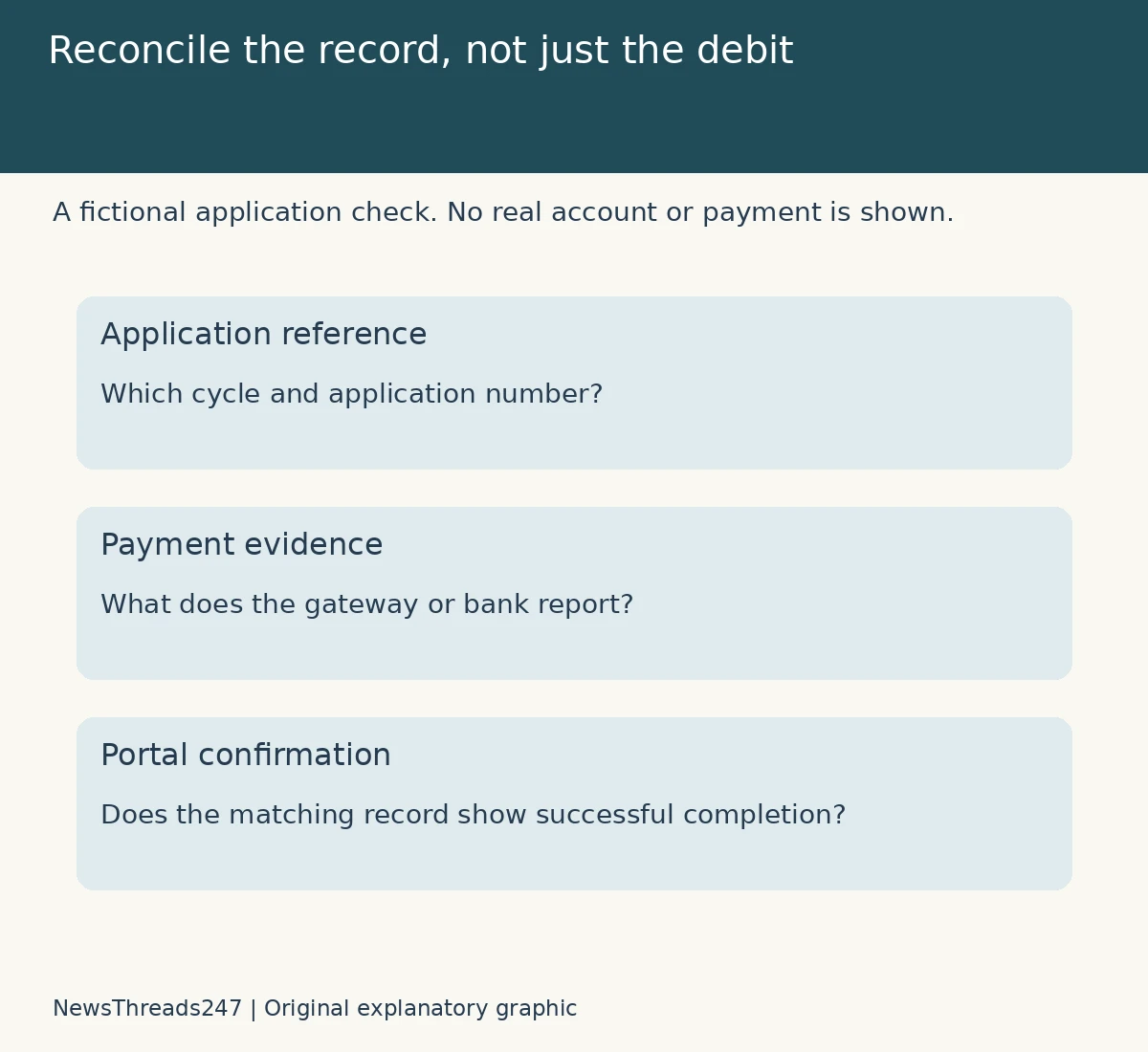
A bank debit and a confirmation page answer different questions
The October updated information bulletin, in its application procedure, says a confirmation page is generated after successful payment. If it is missing after payment, it directs candidates to the relevant bank or payment gateway to establish successful payment or seek reconciliation of duplicate transactions. Follow the current official instructions for the actual status rather than repeatedly paying without checking it.
Keep three items together: what the bank or gateway reports, what the application portal reports, and any support acknowledgement. An amount leaving a bank account is evidence about the transaction; it does not by itself show every application step has been completed. Conversely, a delayed display should be investigated through the supported route, rather than declared a failed payment on the basis of a single screenshot.
If the fee has genuinely not been successfully received, the bulletin explains that the application process still needs successful payment. Obtain the status clarification early enough to act. This guide does not promise a refund date or authorise a payment for you.
Check the saved answers while there is still time
Review your name, contact details, category, subject choice and qualification entries against your own documents and the current eligibility conditions. The extension is not an amendment to those conditions. Choosing JRF, Assistant Professor or PhD-related eligibility options needs the relevant bulletin provisions; an application being accepted online is not an individual eligibility ruling.
Pay particular attention to uploaded evidence. A file existing on your device does not prove the intended file was uploaded to the right field. Reopen what the supported application flow lets you review, check legibility and keep the final version with the application record. Avoid putting identity or disability documents into public support comments.
Do not use a later correction window as a reason to knowingly submit inaccurate information. Which fields can be changed, when and under what conditions is governed by NTA’s actual notice. A general extension headline does not establish an unlimited right to edit every field later.
Use a short completion record
Keep a final note containing the application number, cycle, last status checked, fee status, confirmation-page filename and any unresolved question. Store it securely with the confirmation page and payment proof. A family member helping you can then check the same record instead of relying on several inconsistent messages.
If something remains unresolved, send a focused enquiry through the current official contact route: the application reference, exact message, time observed and relevant transaction reference. State what needs checking. Do not include passwords or full banking credentials. Retain the acknowledgement and check the response through the same verified route.
The useful finish is a completed application supported by a matching record, not simply a calendar reminder that the deadline moved. Our city-slip and admit-card explainer covers the later travel-document distinction; neither replaces the application confirmation discussed here.
Sources and scope
India application guidance checked October 29, 2026 against NTA’s October 27 extension, the current official application listing and the October updated bulletin. Examples are fictional; no applicant account or payment was tested. This is not a personal eligibility determination. Recheck official notices before acting, especially if reading after the stated deadline.
Visual credits: featured artwork is an AI-generated conceptual illustration. The two original NewsThreads247 graphics explain records and decisions; they are not official forms, interfaces or evidence about a real applicant.