

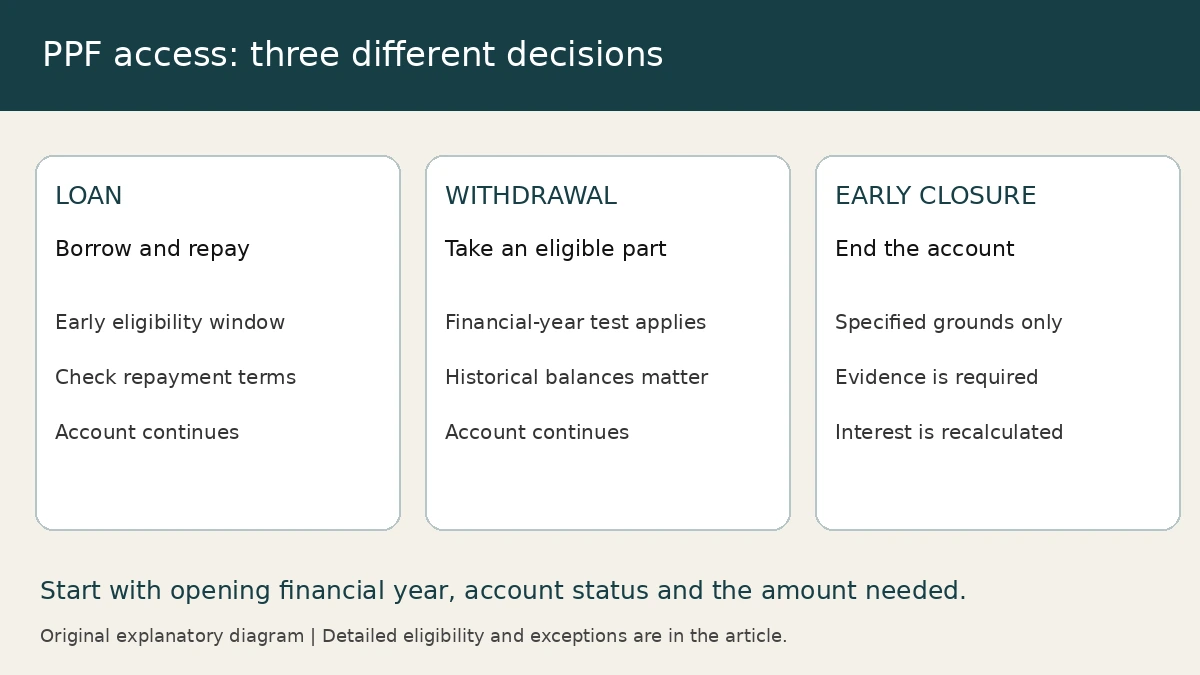
A Public Provident Fund account is long-term savings with limited access before maturity. A loan, a partial withdrawal and premature closure are three different transactions. The right route depends on the account’s opening financial year, its status, the amount needed and, for closure, the reason. Having a large balance does not mean the whole amount is available.
For an Indian household facing an expense, the useful first question is not “Can I break my PPF?” It is “Which access route am I eligible for, and what does using it change?” This editorial explains that decision with a financial-year example and a withdrawal calculation. It does not recommend a personal investment or borrowing choice.
In this article — jump to a section
Choose the transaction before calculating the amount
Start by separating a temporary cash shortage from a permanent need to use savings. Borrowing creates a repayment obligation. A withdrawal reduces the savings left to earn returns. Closure ends the account and is not a general-purpose exit simply because the holder would prefer cash.
| Route | What happens | Main question |
|---|---|---|
| Loan | Money is borrowed and must be repaid under the scheme’s terms. | Is the account in the loan window, and can repayments be made? |
| Partial withdrawal | An eligible portion is taken while the account continues. | Have the timing, account-status and balance tests been met? |
| Premature closure | The account is closed on a permitted ground, with interest recalculated. | Is there a qualifying reason and adequate documentary proof? |
The formal starting point is the National Savings Institute’s Public Provident Fund Scheme, 2019, especially paragraphs 8–10 and 13. A provider’s online menu does not itself expand scheme eligibility. Ask for the transaction to be identified by name rather than treating every request as a “withdrawal.”
Count from the end of the opening financial year
The scheme uses financial years. For partial withdrawal, the rule is after five years have expired from the end of the financial year in which the account was opened. Counting five anniversaries from the opening day can produce an incorrect date.
Take an illustrative account opened in November 2020. Its opening financial year is 2020–21, ending on 31 March 2021. The five subsequent complete financial years end on 31 March 2026. On that basis, the first partial-withdrawal financial year begins on 1 April 2026: 2026–27, the seventh financial year when the opening year is included. Other conditions still apply.
This is why shorthand such as “after five years” is insufficient for planning a payment. The Department of Posts savings booklet describes withdrawal access from the seventh financial year. Keep the opening-year entry from the account record and get the accounts office to confirm the eligible date in writing if an expense depends on it.
When a PPF loan can help
A scheme loan belongs to an earlier window: after one year has expired from the end of the opening financial year, and before five years have expired from that same year-end. Its ceiling is 25% of the balance at the end of the second financial year immediately preceding the loan year. The SBI PPF FAQ also describes the historical-balance limit and repayment period.
That ceiling is not 25% of whatever the app displays today. Recent contributions can make the current balance much larger than the reference balance. Before relying on a loan, obtain the accounts office’s calculation, the sanctioned amount, the repayment deadline and a written explanation of interest.
The scheme provides a 36-month principal repayment period, counted from the first day of the month following the month of sanction. Treat repayment as a budget commitment. A low-looking interest label alone does not establish that the transaction is the best choice; compare the complete cost and the effect on long-term savings with any alternative actually available to you. Do not apply a generic calculator’s result to a different account year.
Calculate a partial withdrawal from the right balances
For an eligible ordinary pre-maturity withdrawal, the scheme ceiling is 50% of the lower of two historical balances: the balance at the end of the fourth financial year immediately preceding the withdrawal year, or at the end of the preceding financial year. Withdrawal is available once in a financial year from an account that is not discontinued. Any outstanding scheme loan and its interest must first be paid.
For a withdrawal during 2026–27, the two reference dates are 31 March 2023 and 31 March 2026. Suppose the relevant balances are ₹4,00,000 and ₹6,40,000. The lower is ₹4,00,000, so the calculated ceiling is ₹2,00,000. These are invented figures for explaining arithmetic, not an account statement or a promised sanction.
If the household needs ₹1,20,000, a ₹2,00,000 ceiling is not a reason to take the extra ₹80,000. First identify the unavoidable expense, the cash already available and the amount genuinely needed. The calculation answers what may be permissible; it does not decide what is sensible for the household.
Premature closure needs a qualifying reason
Premature closure has a separate purpose and evidence test. Permitted grounds include a life-threatening disease affecting the holder or specified family members; higher education of the holder or dependent children with the required admission documents; and a change in the holder’s residency status supported by the specified records. The SBI products and services booklet sets out these grounds and the minimum timing condition.
An account cannot be closed under this provision before five years have expired from the end of its opening financial year. Closure also involves interest being recalculated at one percentage point below the rates credited under the applicable scheme provision. That is not the same as simply deducting 1% of the current balance. Ask for a written settlement illustration before consenting.
A renovation, holiday or routine purchase does not become a qualifying closure ground merely because the expense feels important. Equally, a qualifying need does not remove the minimum account-age condition. Where the account is a minor’s account, obtain the applicable guardian and purpose requirements rather than assuming the adult-account process is identical.
What to ask the bank or post office
Prepare a short request with the account-opening financial year, account number through a secure channel, transaction sought, amount needed and desired payment date. Ask the office to confirm whether the account is active, whether a loan remains outstanding and which historical balances its calculation uses.
For closure, request the exact supporting-document list before submitting sensitive medical, educational or residency records. For any route, use the current form accepted by that provider. A scheme’s numbered form and a post-office operational form can have different labels; a downloaded form from an unrelated bank may not be the right submission.
Keep the application acknowledgment, calculation, repayment or settlement terms and the updated account record. If access is refused, ask which eligibility condition failed. An explanation such as “the account is too new” is less useful than the precise opening financial year and the earliest permitted date.
Protect the purpose of the account
PPF access should be planned around the expense and the account’s purpose. A withdrawal can solve today’s shortfall while leaving less for a later goal; a loan preserves a repayment obligation that the household must be able to meet. Neither consequence disappears because the transaction is permitted.
For other borrowing decisions, see our separate explanation of loan prepayment charges; check the actual lender’s terms before comparing alternatives. The practical next step here is simpler: obtain the PPF office’s eligibility and amount calculation before promising money to anyone else.
Source and maintenance note: This is a source-based editorial, not a report of personal account handling. Rules and provider procedures were checked for this preparation on 6 November 2026. Reverify against the current scheme after a government amendment, a provider procedure change, or before acting on a time-sensitive withdrawal. Post-maturity extension rules are a separate decision and are outside this guide. Illustrations are disclosed AI artwork; the decision diagram and numerical example are original explanatory work.