

A bank locker offers a secure place to store permitted valuables, but the annual rent is not a premium insuring everything inside. Indian bank locker policies describe liability equal to 100 times the prevailing annual rent in specified circumstances. That conditional liability should not be mistaken for automatic replacement of the contents at their full value.
The distinction matters before there is a loss. A family can carefully choose a branch and still misunderstand how its jewellery, documents or other belongings would be valued and evidenced. This editorial shows how to separate security, bank liability, proof of contents and any independently arranged insurance. They answer different questions.
In this article — jump to a section
What the rent multiplier actually means
The SBI safe-deposit-locker page states the bank’s responsibility for the safety of its premises and describes the 100-times-rent liability for losses arising from specified incidents or employee fraud. Its wording covers fire, theft, burglary, robbery, dacoity and building collapse in the stated responsibility framework.
This is a rent-linked measure, not a declaration that the bank has checked the contents, agreed their value or issued an all-risks policy. Paying a higher rent may reflect a larger locker or a location. It does not establish that an insurer has accepted the replacement value of every item.
The useful question is therefore two-part: does the incident fall within the applicable liability provision, and what evidence supports the claim? A multiplier alone answers neither. Avoid treating this guide’s arithmetic as a guarantee of compensation or as a final assessment of legal remedies in a disputed case.
A worked example exposes the possible gap
Assume, purely for illustration, that the prevailing annual rent is ₹4,000. Multiplying that by 100 gives ₹4,00,000. Now assume the contents would cost ₹12,00,000 to replace. The difference between those figures is ₹8,00,000.
| Illustrative item | Amount | What it establishes |
|---|---|---|
| Assumed annual rent | ₹4,000 | An input chosen for arithmetic, not a bank tariff. |
| 100 × annual rent | ₹4,00,000 | The rent-based benchmark if the relevant liability provision applies. |
| Assumed contents value | ₹12,00,000 | A separate assumption needing real evidence in an actual case. |
| Difference | ₹8,00,000 | A planning comparison, not an insurance quote or certain uninsured loss. |
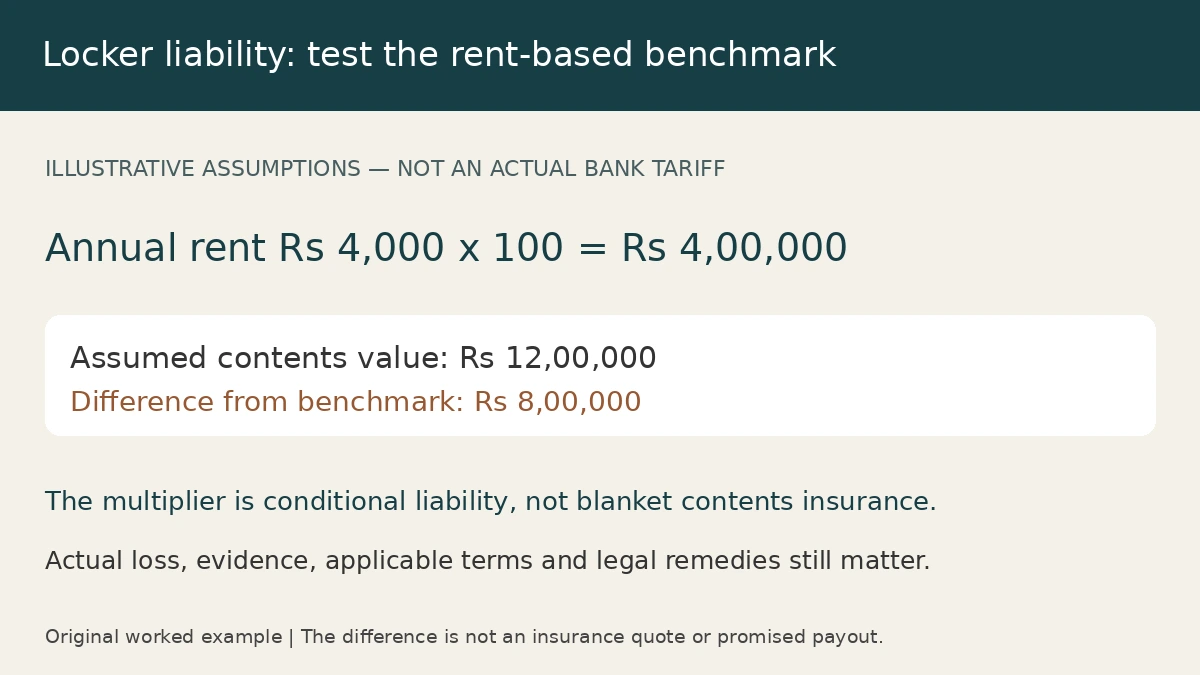
The comparison reveals why a household should not substitute the rent receipt for a protection review. It does not predict an actual claim outcome. The amount of loss, applicable agreement, circumstances, evidence, any insurance and available legal remedies all require separate examination.
Use your own figures for a private planning exercise: current annual rent, a documented inventory and a defensible valuation. Do not increase the locker size solely to make the multiplier larger without considering cost, suitability and the actual terms. Security and financial protection deserve separate decisions.
Check the event, responsibility and evidence
The Standard Chartered India locker management policy, Part G distinguishes specified bank-liability events from natural calamities and loss attributable solely to customer fault or negligence. It also says the bank must exercise appropriate care to protect the premises. These qualifications are important: “the bank is never responsible” is as misleading as “everything in a locker is insured.”
The Central Bank of India safe-deposit-locker policy separately addresses liability and insurance. Read your own bank’s current policy and signed agreement, because an explanation of a general framework is not a substitute for the record governing your locker.
In a real incident, record what is known and what is uncertain. A missing item does not by itself prove employee fraud; an alarming message is not proof that a locker has been breached. Avoid accusations until supported by evidence. Request the bank’s account of the incident and preserve your own records.
Build a private record of what you store
Create a private inventory before storing valuable items, then update it when something changes. Record a description detailed enough to distinguish one item from another, relevant invoices, any professional valuation, distinguishing marks and dated photographs. For documents, record what the original is and where a usable copy is held.
An inventory is an evidence aid, not a guarantee that an insurer, bank or court will accept a stated value. An old purchase price, a recent metal price and the cost of replacing a specific piece are different measures. Ask a prospective insurer which valuation it requires rather than choosing the largest convenient figure.
Store the record separately from the locker contents so that a single incident does not remove both the property and the evidence. Protect digital copies with appropriate account security and restricted access. Do not publish photographs showing locker keys, identifying numbers, access routines or the location of valuables on social media.
For items of sentimental value, recognise the limit of money as a remedy. A replacement-value estimate cannot recreate an inherited object or an original handwritten record. Keeping appropriate copies and a family access plan can matter even where financial protection exists.
Ask precise questions about separate insurance
If the potential gap matters to the household, investigate a suitable policy independently. Do not assume that ordinary home contents cover automatically extends to valuables kept in a bank locker, or that jewellery cover while stored is identical to cover while worn or in transit. Ask the insurer to point to the relevant wording.
Useful written questions include: Which items and locations are covered? Is each item subject to a limit? Is a valuation or itemised schedule required? What events and causes are excluded? Does transit between home and bank count? What deductible applies? What security conditions and notification duties must the policyholder meet? How is a claim valued?
A salesperson’s reassuring answer should be matched to the policy schedule and wording. Compare the same risks and values across alternatives; a lower premium alone does not establish better protection. No particular insurer, premium or product is recommended here.
Standard Chartered’s published policy also makes clear that the bank does not inventory ordinary locker contents and does not insure those contents against all risks; it states that it will not offer locker-contents insurance directly or indirectly. Do not mistake the bank’s own premises insurance for a policy issued to you.
Review the agreement and access arrangements
Keep a copy of the signed locker agreement and current rent information. Check who may operate the locker, whether contact details are current and how the bank communicates access alerts. An unexpected alert deserves prompt verification using an independently known bank contact, not a number supplied in a suspicious message.
Confirm the permitted contents and prohibited items. Do not use a locker for hazardous or unlawful material. Ask about lost-key and access procedures before a problem occurs, and retain the answers. Keep rent payments current and understand the bank’s notice and break-open process rather than assuming paid rent removes every operational condition.
Joint operation, nomination and inheritance are related but different matters. A household should know who can access the locker during the hirer’s lifetime and what records may be needed after death. This article does not determine ownership or succession rights; obtain appropriate advice where family rights are disputed.
What to do if something goes wrong
Notify the bank promptly through its official channel, make a factual written complaint and obtain an acknowledgment. Set out the locker details securely, the date the issue was discovered, what is missing or damaged and the documents available. Preserve correspondence and any relevant access alerts.
Ask for the applicable policy, the basis of any proposed compensation and the complaint reference. Follow the bank’s escalation process if the response is inadequate. Our separate guide to the RBI Ombudsman complaint route explains why a documented complaint to the regulated entity matters; check the current scheme’s jurisdiction and admissibility before escalating.
The strongest preparation is done before an incident: understand the agreement, maintain a private inventory, test the rent-based benchmark against the value at risk and read any separate insurance wording. A locker can be useful without being mistaken for blanket contents insurance.
Source and maintenance note: This India-focused, source-based editorial explains publicly available bank policies checked for this preparation on 6 November 2026. It is general information, not personalised insurance or legal advice. Reverify following an RBI direction, a revised bank agreement or tariff, or a material change in stored items or insurance. No branch inspection or product testing is claimed. Photographs are AI-generated editorial illustrations; the diagram and numerical comparison are original explanatory work.