
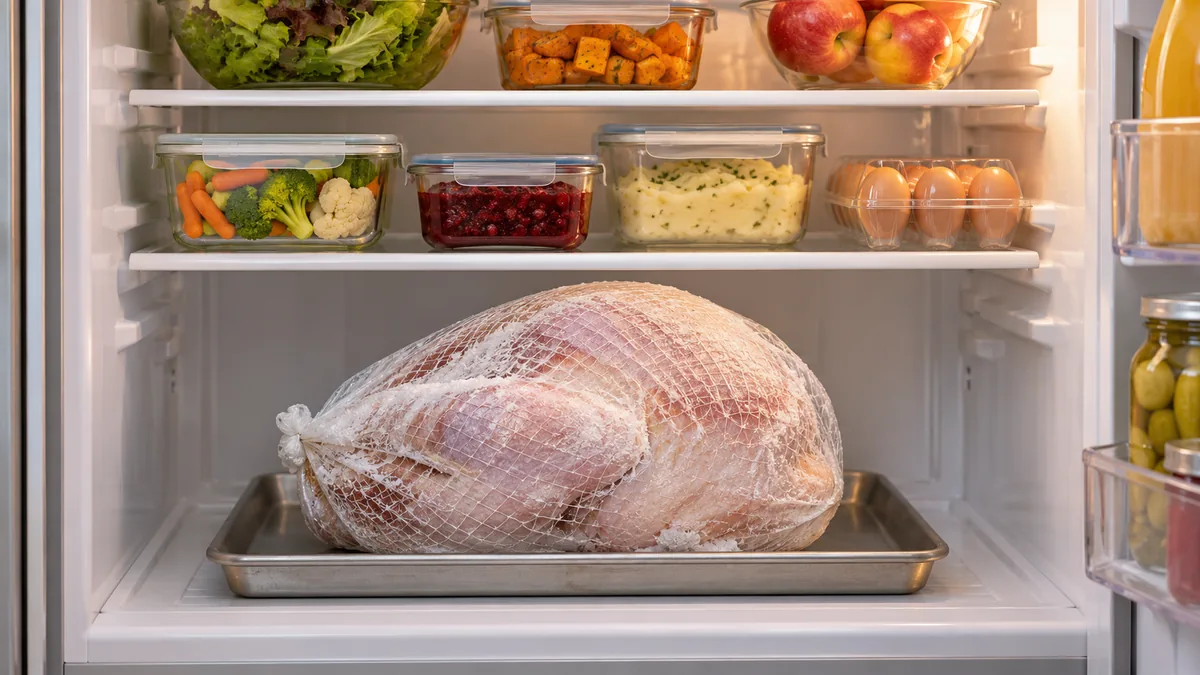
For Thanksgiving on Thursday, November 26, 2026, a frozen whole turkey needs a calendar, not a last-minute guess. USDA guidance allows about 24 hours of refrigerator thawing for every 4 to 5 pounds. That puts a 16-pound bird in the refrigerator three to four days before cooking and a 20-pound bird four to five days before cooking. If you use cold water, allow about 30 minutes per pound, change the water every 30 minutes and cook immediately after thawing.
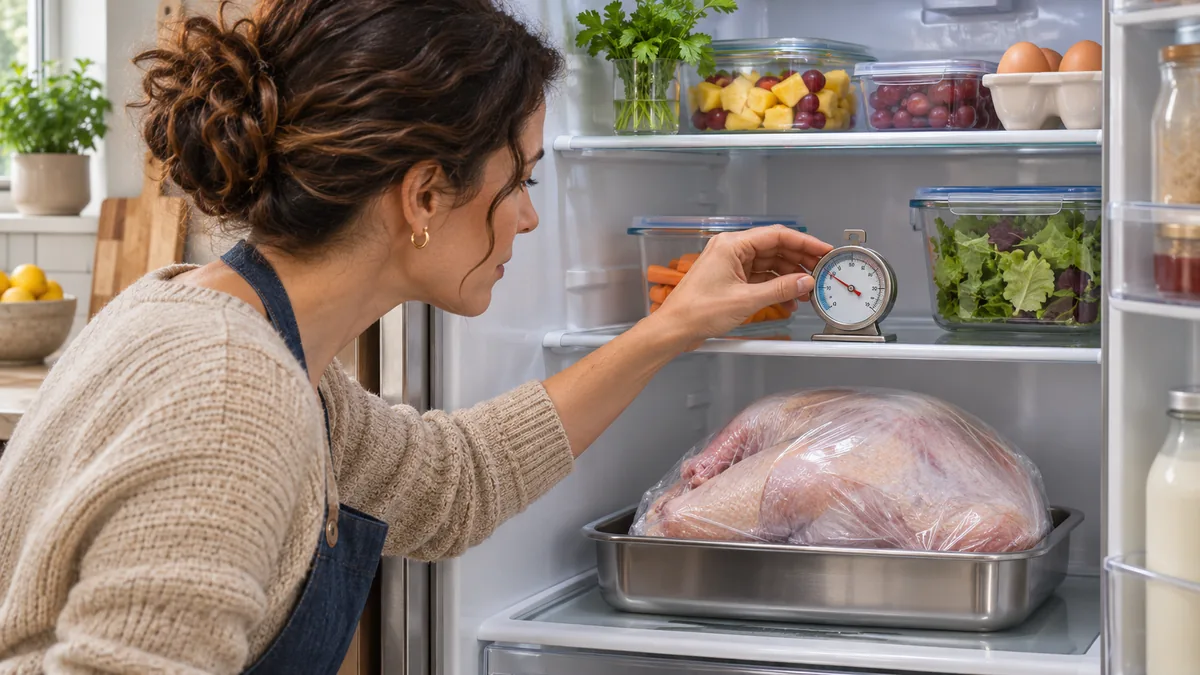
The practical problem is not simply “how many hours?” You also need room on the bottom shelf, a tray that can contain raw juices, a refrigerator at 40°F (4°C) or below, and enough buffer to avoid moving the bird to a countertop when the schedule slips. This guide turns the federal time ranges into a usable plan while keeping the limits visible.
Choose the thawing method before you buy the bird
The federal FoodSafety.gov turkey chart gives two predictable methods: refrigerator thawing and cold-water thawing. The CDC also accepts microwave thawing when the appliance manufacturer’s instructions are followed, but the turkey must be cooked immediately afterward.
| Method | Time rule | What you must do | When to cook |
|---|---|---|---|
| Refrigerator | About 24 hours per 4–5 lb | Keep wrapped on a tray; fridge at 40°F/4°C or below | Within 1–2 days after fully thawed |
| Cold water | About 30 minutes per lb | Use a leakproof bag; submerge in cold tap water; replace water every 30 minutes | Immediately |
| Microwave | Follow the appliance instructions | Confirm the bird fits and rotates safely | Immediately |
Refrigerator thawing is the lowest-attention option. Cold water is a legitimate backup, but it ties you to the sink for repeated water changes. Neither method makes countertop thawing safe.
Thanksgiving 2026 refrigerator-start planner
USDA publishes ranges rather than a single exact hour because bird shape, refrigerator loading and temperature vary. For a November 26 meal, use the earlier end of the start window when your refrigerator is crowded. These dates are planning buffers derived from the federal weight ranges; they are not a guarantee that every bird will thaw at the same rate.
| Turkey weight | Federal refrigerator range | Conservative start for Nov. 26 | Cold-water range |
|---|---|---|---|
| 4–12 lb | 1–3 days | Monday, Nov. 23 | 2–6 hours |
| 12–16 lb | 3–4 days | Sunday, Nov. 22 | 6–8 hours |
| 16–20 lb | 4–5 days | Saturday, Nov. 21 | 8–10 hours |
| 20–24 lb | 5–6 days | Friday, Nov. 20 | 10–12 hours |
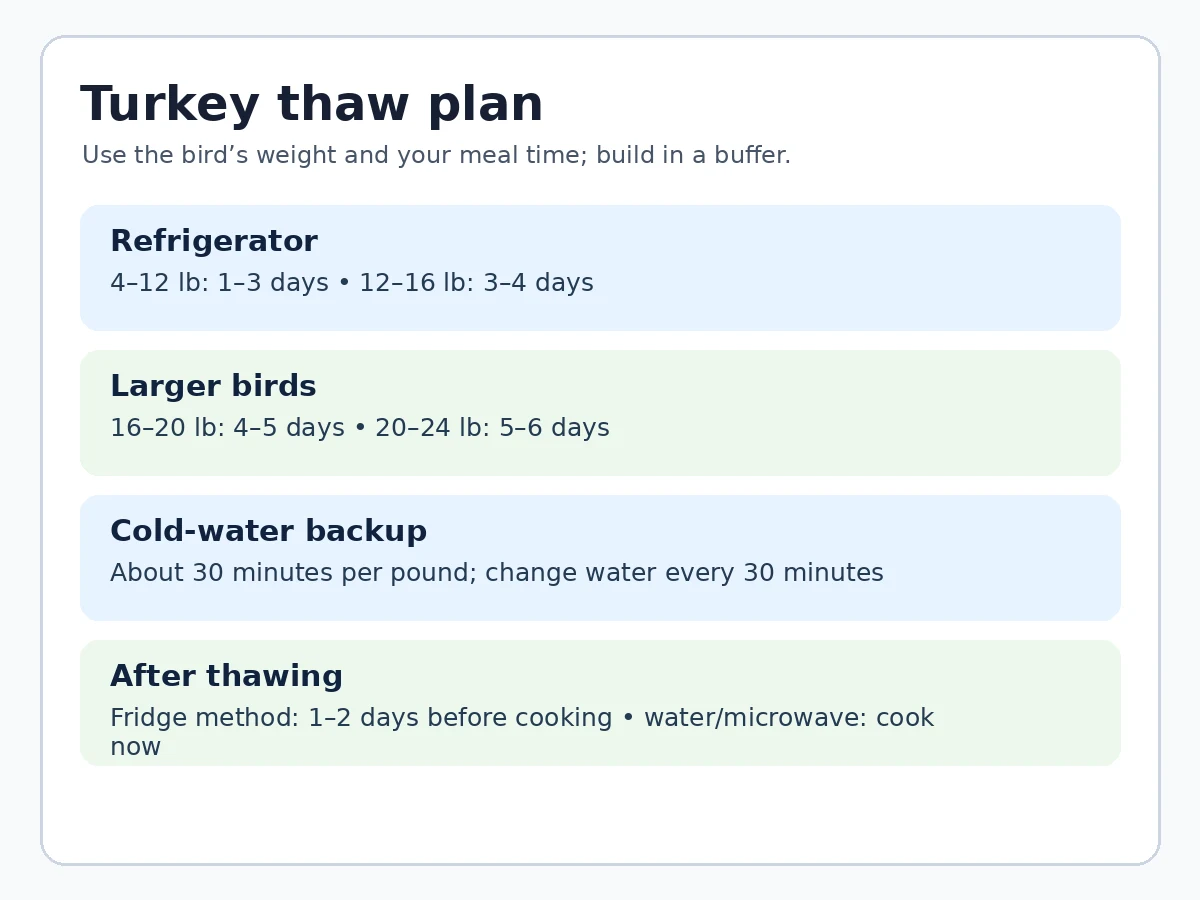
A worked example shows why the range matters. A 16-pound turkey sits at the top of the 12–16-pound row: allow up to four full refrigerator days. Moving it to the refrigerator on Sunday gives Monday, Tuesday, Wednesday and part of Thursday, but an early Sunday transfer is safer than a late-night transfer. A 20-pound bird belongs in the 16–20-pound row and may need five days, so Saturday is the conservative start.
Set up the refrigerator so raw juices cannot spread
- Leave the turkey in its original wrapping and place it in a container or rimmed tray.
- Use the lowest practical shelf so a leak cannot drip onto ready-to-eat food.
- Keep the refrigerator at 40°F (4°C) or below; a separate appliance thermometer is useful when the refrigerator is crowded.
- Clear space before moving the bird. Do not use a porch, garage, car trunk, snowbank or other place where temperature is not controlled.
The CDC warns that raw turkey and its juices can contaminate hands, boards, utensils and other food. Wash hands with soap and water for at least 20 seconds before and after handling the bird, and clean surfaces with hot soapy water. Do not wash raw turkey: splashing water can spread germs around the sink and worktop.
If the turkey is still frozen on Wednesday or Thursday
Do not move it to the counter. Keep the bird wrapped, place it in a leakproof bag and switch to cold-water thawing only if you can keep it fully submerged and change the water every 30 minutes. At 30 minutes per pound, a 16-pound turkey needs about eight hours and a 20-pound turkey about ten hours. Cook it immediately when thawed.
If using a microwave, follow the manufacturer’s size, power and timing instructions and cook immediately. If the bird is only partly thawed at cooking time, use specific USDA guidance for cooking from frozen rather than improvising a time; the center and joints can lag behind the surface.
Cooking checks that the thawing calendar cannot replace
Thawing is only preparation. The CDC holiday-turkey guidance says to roast in an oven set to at least 325°F and verify 165°F (74°C) with a food thermometer in three places, avoiding bone: the thickest breast, where the body and thigh join, and where the body and wing join. A pop-up timer does not replace those readings.
If stuffing is cooked inside the bird, the stuffing center must also reach 165°F. The CDC says cooking stuffing separately in a casserole is the safer option because its temperature is easier to verify.
After the meal: the two-hour clock matters
Refrigerate leftovers at 40°F or below within two hours of cooking. Divide large portions into smaller pieces or shallow containers so they cool promptly. CDC guidance says cooked turkey dishes generally keep three to four days in the refrigerator; reheat leftovers to 165°F.
For the broader cooling step, see NewsThreads247’s guide to refrigerating leftovers promptly.
A short decision checklist
- Know the turkey’s exact packaged weight.
- Count backward from the meal using the federal weight range, then add a buffer.
- Reserve a bottom-shelf tray and verify 40°F/4°C or below.
- Use cold water only with a leakproof bag, 30-minute water changes and immediate cooking.
- Never thaw on a counter.
- Cook to verified temperatures, then refrigerate leftovers within two hours.
Sources and scope
Primary guidance checked November 4, 2026: USDA FSIS safe-thawing answer, FoodSafety.gov meat and poultry charts, and CDC holiday-turkey guidance. This article explains general food-safety planning; people at higher risk of severe foodborne illness should follow advice from their clinician and public-health authorities.