
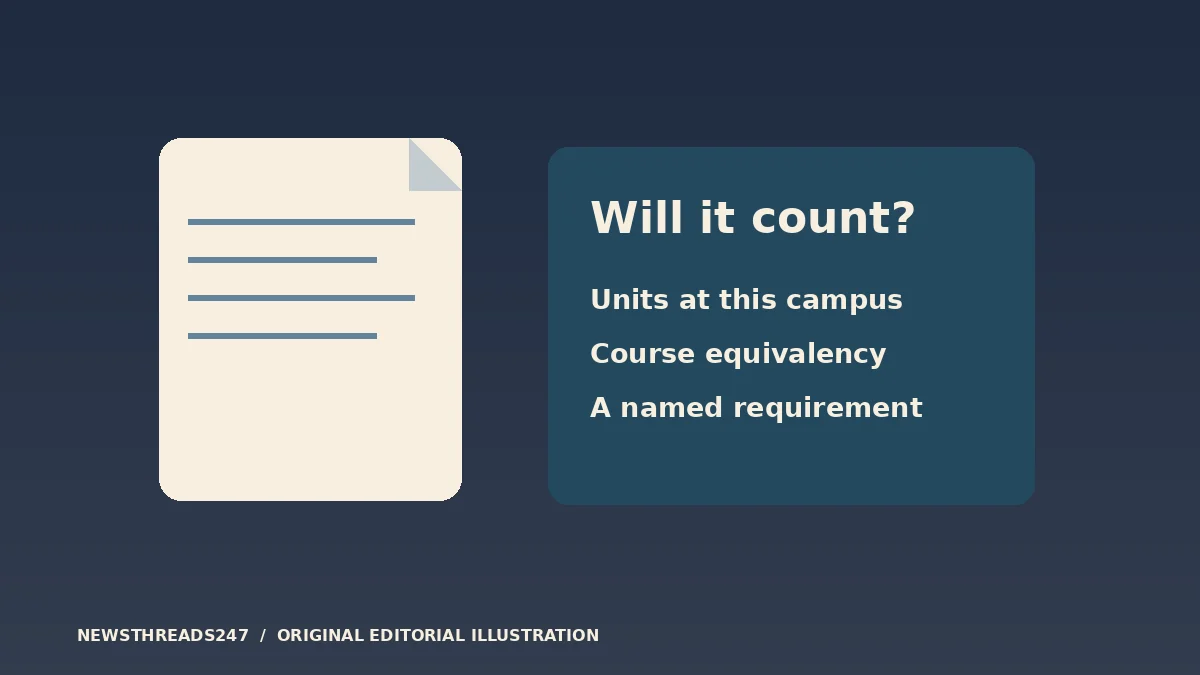
Two colleges can agree that a course is transferable and still leave you needing another class to finish your major. Before enrolling, check whether the course earns units at your destination, matches a specific course there, and satisfies the requirement you want it to fill. Those are three separate decisions. A course can pass the first and still leave you short on the third.
In this article
Ask what the course will count toward
Start with the bachelor’s programme you hope to enter. Open its transfer admission requirements and the degree requirements for your intended major. Put those beside the community college schedule. A class with a familiar title can be a sensible choice for general units and a poor choice for the particular prerequisite you need.
The University of California’s transfer credit guidance separates transferability from the decision to apply a course to a requirement. In practice, a university can accept credits as elective units, accept a course as equivalent to one of its own, or assign it to a general education or major requirement. Some classes meet more than one need. Never assume they do simply because a transfer report shows a positive unit total.
A degree audit is the record that shows where credits were applied after an institution evaluates them. Before transfer, use the published agreement to plan and a written reply from the receiving institution to resolve uncertainty. A good plan names the requirement beside each course. If the notes only say “transfers,” there is more work to do.
In California, open the agreement for both colleges
ASSIST’s student guide explains how California students can consult published articulation agreements. Search for the community college you will attend, the receiving campus and the applicable academic year. For a major prerequisite, choose the agreement for that major if available. For a general education question, consult the appropriate pattern and the campus’s instructions rather than using the major agreement to answer a different question.
Copy the subject and course number exactly. Read any footnote and check whether a sequence must be finished as a group. A laboratory might be a separate class. Two courses may be listed together to satisfy one receiving requirement, and a line for one campus cannot be assumed to apply to another campus. Keep a copy of the page you relied on and record the year it displays.
Outside California, ask the receiving institution what it uses: an articulation agreement, a course-equivalency tool, a registrar review, or a department decision. If an agreement is unavailable, that is an information gap. It does not establish that credit will be denied or that it will be granted.
Try the check on a fictional schedule
Imagine Maya is choosing between two spring courses before applying to an engineering programme. Her first option is a three-unit statistics course accepted by the destination for elective credit. The programme requires a particular calculus course before transfer. Her second option appears in the major agreement as equivalent to that calculus course, provided she also completes a listed companion course. These are invented course descriptions for the example.
The statistics course is not wasted. It may still contribute to graduation units, or fit an elective Maya wants. But it does not solve the admission prerequisite. And signing up for just the calculus course would leave a question if the agreement lists a pair. Maya’s next step is to ask which term she can take the companion, whether a minimum grade applies and whether the combination must be completed before applying or by a later deadline.
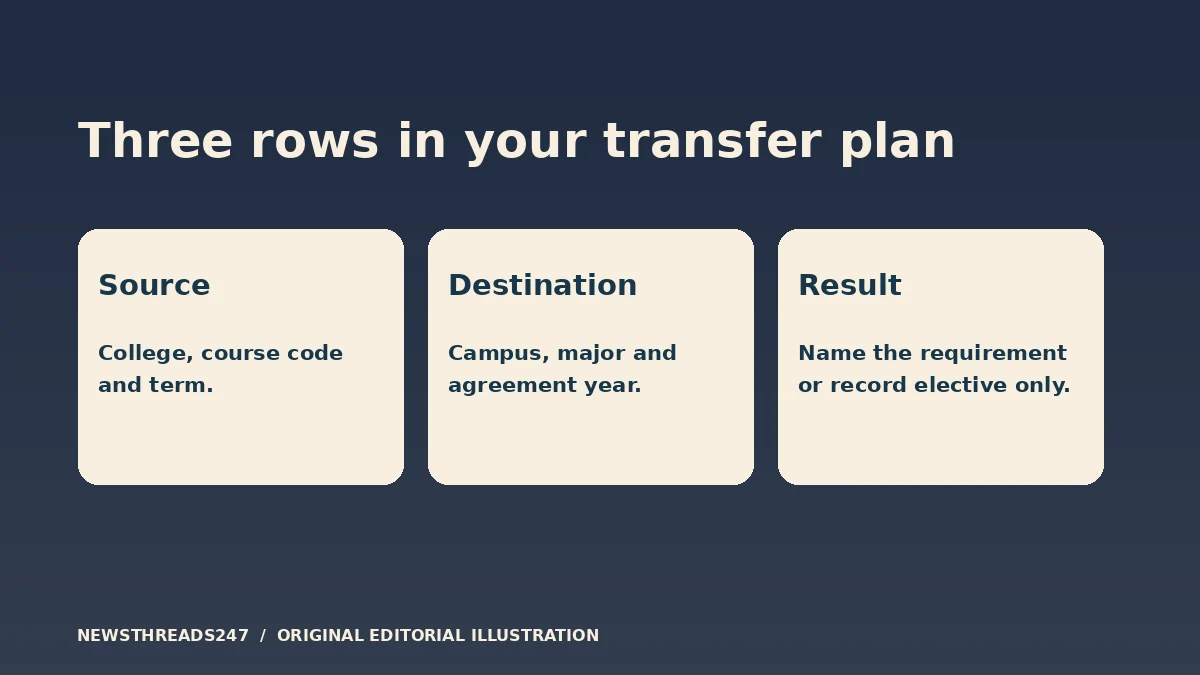
Now suppose Maya considers a second university. She should build a fresh row for the same course, with the second destination and the intended major. If one option counts at both destinations, it may give her more flexibility. If there is no shared choice, a counsellor can help weigh the cost of leaving one requirement for a later term.
Save enough evidence to ask a precise question
Keep the official course description and, if no equivalency is published, the syllabus for the term you take it. Save the number of units and whether there is a lab. Ask the receiving office for the deadline and process for submitting official transcripts. UC Davis’s registrar explains how transfer credit is evaluated and how students can follow up when the record is incomplete.
Try a question like this: “Does course [number], taken at [college] in [term], satisfy [named requirement] for [major and campus], or does it give only elective units?” Include the agreement year if you found one. Ask which office makes the decision if the person you contact can only tell you whether the units transfer.
Credit evaluation does not guarantee admission. It also cannot establish that a programme will meet licensing needs. If you are still deciding whether an institution or programme is suitable, use the college accreditation check for that separate decision.
Check again after the official evaluation
Compare the posted evaluation with the rows in your plan. Mark each course “requirement met,” “elective only” or “still under review,” and follow up on the last two if they affect your timeline. A missing course may mean a transcript is still being processed; an elective posting may be a decision to ask about. Read the institution’s instructions before registering for a repeat.
The best time to do the first check is before you pay for the class. Repeat it if you change major or campus, or if the agreement or requirements change. A one-page plan with the exact requirement, source and next action is more useful than an impressive-looking total of transferable credits.