
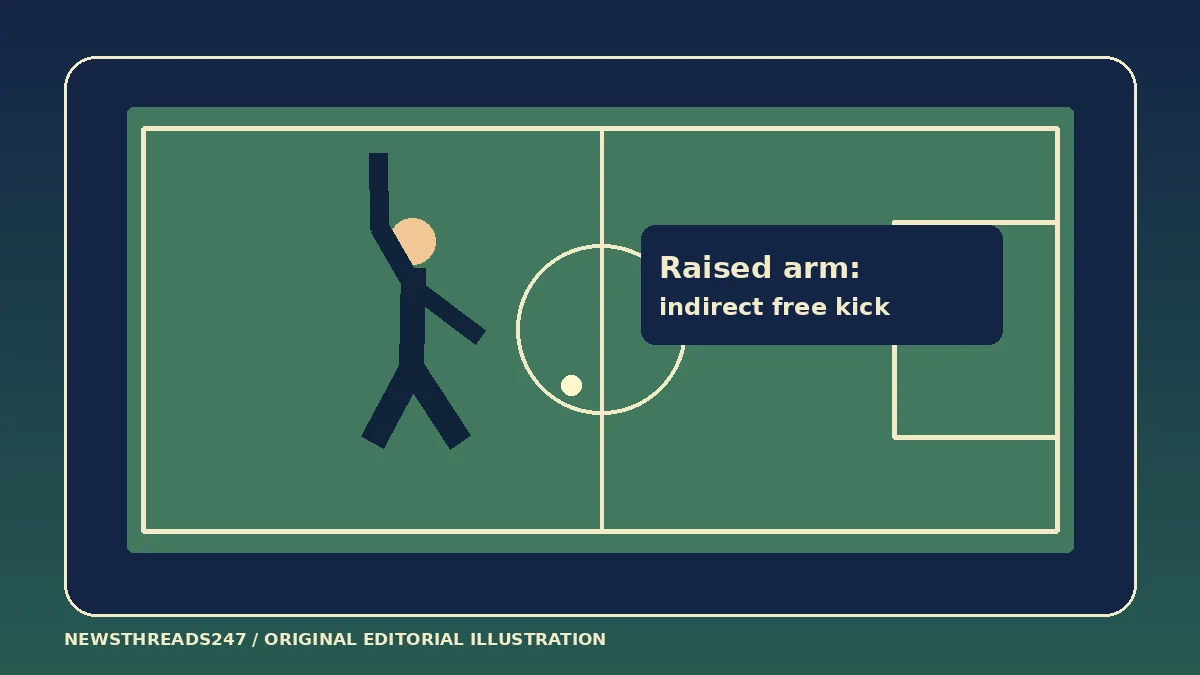
A direct free kick can go straight into the opponents’ goal. An indirect free kick needs a touch from another player first. Watch the referee’s raised arm to identify an indirect restart, then follow the ball: a brief touch from a defender can matter as much as a pass to a teammate.
In this article
Watch the referee before the ball moves
The referee raises an arm above the head to indicate an indirect free kick. Under IFAB Law 13, the signal stays up until the kick has been taken and another player touches it, the ball goes out, or it is clear a goal cannot be scored directly. Do not try to identify every free kick by where the referee points; the raised arm is the useful distinguishing cue here.
There is a specific exception if the referee fails to give that signal and an indirect kick goes straight into goal: the kick is retaken. That is different from an indirect kick correctly signalled and then sent directly into the opponents’ net. In the second case the restart is a goal kick. The ball crossing the line looks identical on replay; the signal and the prior touches decide which rule applies.
If a broadcast replay starts late, you may not see the referee at all. First check the original angle or the restart decision, then count touches. Avoid working backward from a crowd reaction to infer the signal.
A legal touch from another player is enough
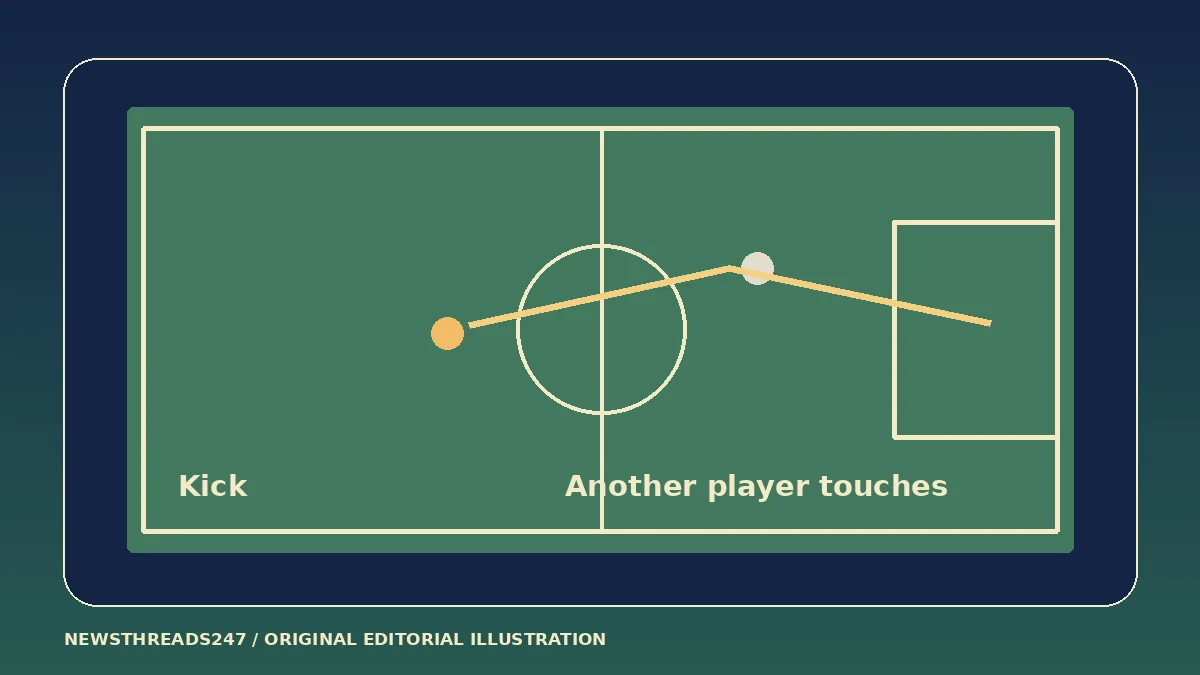
For the purpose of scoring from an indirect kick, the next touch can be from either team. A teammate can tap the stationary ball so it clearly moves and a second player can shoot. If a kick hits a defender before entering, that contact can satisfy the indirect requirement too, provided no separate offence prevents the goal. The second player does not have to control the ball.
Compare a ball that grazes the wall with one that hits the post and goes in. The defender is another player; the post is not. The same applies to a crossbar. A player cannot manufacture the required touch by kicking the ball and then playing it again without another player touching it. The second touch by the kicker normally gives the opponents an indirect free kick; a handball offence can change that restart. Law 13 explains the relevant exceptions.
Watch the ball rather than the run-up in a replay. A wide angle can show who was near it, but a tight angle is often better for deciding whether it actually changed direction off a player. A goal can still be disallowed for another offence, such as offside. The touch requirement is only one part of the decision.
Separate the goal decision from the restart
If a direct kick goes straight into the opponents’ goal, it can score. If a properly signalled indirect kick does the same without another player touching it, the defending team gets a goal kick. If either kind goes straight into the kicking team’s own goal, the opponents get a corner kick. That last rule makes a straight-back mishit different from an own goal scored in open play.
Sometimes a deflection changes which question you should ask. Suppose a defender takes a free kick and sends it directly into their own net without anyone else touching it: the restart is a corner. If it instead takes a legal touch from another player before entering, it no longer went straight in from the kick. Check the rest of the play before assuming the corner provision still applies.
The English FA’s Law 13 page also sets out these outcomes. The governing references here are for association football; formats such as futsal or local small-sided competitions can use their own rules.
Use the offence and the signal together
A foul involving a careless trip is a typical direct-free-kick offence under IFAB Law 12. A direct-free-kick offence committed by a player in their own penalty area can result in a penalty kick. An offside offence normally leads to an indirect free kick, as explained in our offside guide. So the location alone does not tell you which kind of restart you are seeing.
For an attacking indirect free kick awarded for an offence inside the opponents’ goal area, Law 13 puts the kick on the nearest point of the goal-area line parallel to the goal line. That is one reason you may see an unusual close-range setup even though it is neither a penalty nor an ordinary shot from the spot of the offence. Opponent-distance and quick-restart rules can affect the play separately.
Run a short replay check
First, identify the referee’s signal and the original offence if the broadcast shows them. Next, watch the ball from the instant it is kicked and clearly moves. Finally, note the first actual touch by a different player and which goal the ball entered. If those details are missing, say what the footage cannot establish rather than treating a replay angle as definitive.
The illustrations depict invented positions and no real match. Recheck IFAB Laws 12 and 13 after a law edition changes, and look up the organiser’s rules before applying this guide to a different playing format.