
In a standard five-day men’s Test, the side that bats first can enforce the follow-on if it leads by at least 200 runs after the two first innings. That sends the other side straight back in. The lead makes the option available; the captain can still choose to bat again. A first day with no play can change the number you need.
In this article
Subtract the two first-innings totals
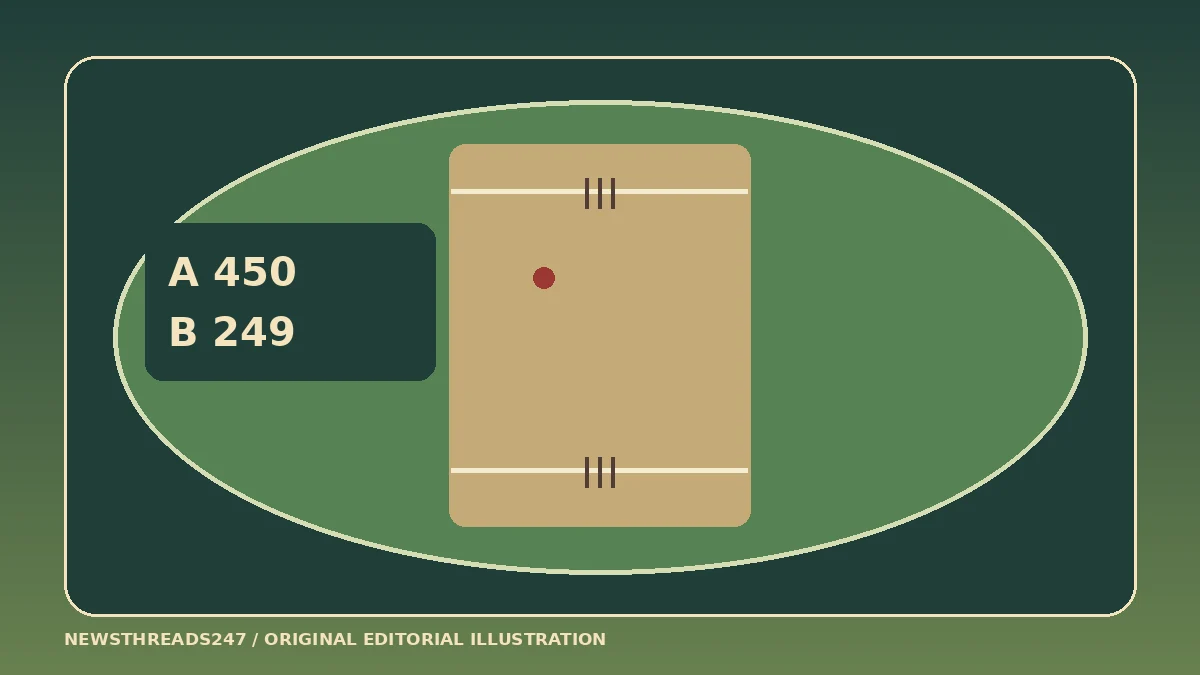
Use the two completed first-innings totals. Suppose Team A bats first and makes 450. Team B replies with 249. Team A’s lead is 201, so in a standard five-day Test it has the choice. A reply of 250 leaves exactly 200, which still qualifies. A reply of 251 leaves 199, one run short. If Team B bats second and takes a first-innings lead of its own, that does not give it the option under this rule.
The governing text for the current men’s World Test Championship is the ICC playing conditions effective October 2026. Clauses 13 and 14 explain the usual order of innings and the follow-on exception. A declaration can end an innings, so do not treat “all out” as the only route to a completed first innings. Conversely, a score shown while a side is still batting is not its completed total.
The relevant margin is the lead on first innings, not the target to win, the run rate or the number of wickets left. If you are following a highlights feed, find the scorecard’s innings headings before doing the subtraction.
Count the first day correctly if rain delays the start
The current WTC conditions list minimum leads of 150 in matches of three or four days, 100 in two-day matches and 75 in one-day matches. Those are provisions for the two-innings conditions in scope; do not apply them to an ODI or a T20 simply because it is played in a day. Other competitions can have their own playing conditions.
If there is no play at all on the scheduled first day, clause 14.3 uses the number of days remaining from the start of play. The day play begins counts as a whole day for that purpose, even if the start is late. For example, if a five-day match loses all of day one and first starts on day two, the remaining duration is four days for this calculation, so the threshold becomes 150.
Compare that with a match that starts late on day one and then stops. The conditions say play counts once the first over has started after the call of Play. An over does not have to be completed. You cannot infer a lower threshold merely because the scorecard shows very few overs or because another day is washed out later. Check when play actually began.
Follow the batting order after the decision
Without the follow-on, the usual sequence is A’s first innings, B’s first, A’s second, then B’s second if required. If A enforces, the sequence becomes A first, B first, B second, and A second only if required. The captain who exercises the option notifies the opposition captain and the umpires. Under the WTC conditions that decision cannot then be changed.
Return to 450 versus 249. If B follows on and is dismissed for 170, its two innings total 419. A has already made 450, so it wins by an innings and 31 runs. If B instead makes 230, its aggregate is 479. A needs 30 to win if it gets to bat its second innings: 29 to draw level on runs and one more to pass B. These examples assume completed innings and time for the result to be achieved.
A follow-on therefore does not guarantee a win or eliminate the leading team’s second innings. It changes who bats next. The time left in the match and what the other side scores still matter.
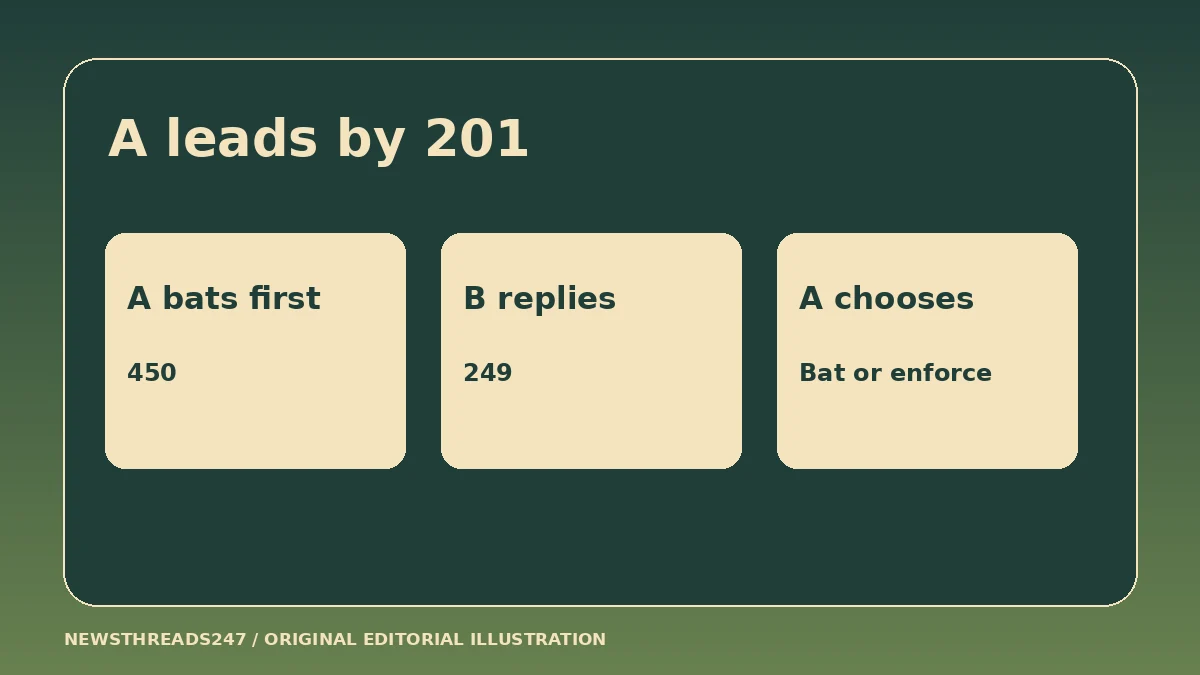
Why might the captain bat again?
Enforcing gives the leading side an immediate chance to take the remaining wickets and can save a batting innings if the opponent cannot erase the deficit. That can matter when time is short. But the bowlers may have just finished a long innings, or the captain may prefer to build a larger margin before asking them to return. Conditions can change as the pitch wears, and forecasts are uncertain. These are tactical reasons a captain might weigh, not claims about a specific match.
When watching a decision, separate what the scorecard proves from what you infer. It proves whether the threshold was met. It does not prove why the captain chose one option. If the team bats again, the follow-on rule has not failed; the choice to decline is part of the rule.
Check three lines on the scorecard
Read the scheduled duration and start-of-play record, identify who batted first, and subtract the completed first-innings totals. Then see whether the next innings belongs to the same batting side or the leading side. Those clues answer most follow-on questions without confusing it with net run rate or the DLS par score in limited-overs cricket.
The examples here are fictional. For a different tournament, a four-day international or a domestic competition, start with the applicable playing conditions listed by the organiser. Recheck this explainer when the ICC publishes a new WTC conditions edition.