
In this article
First decide whether play needed to stop
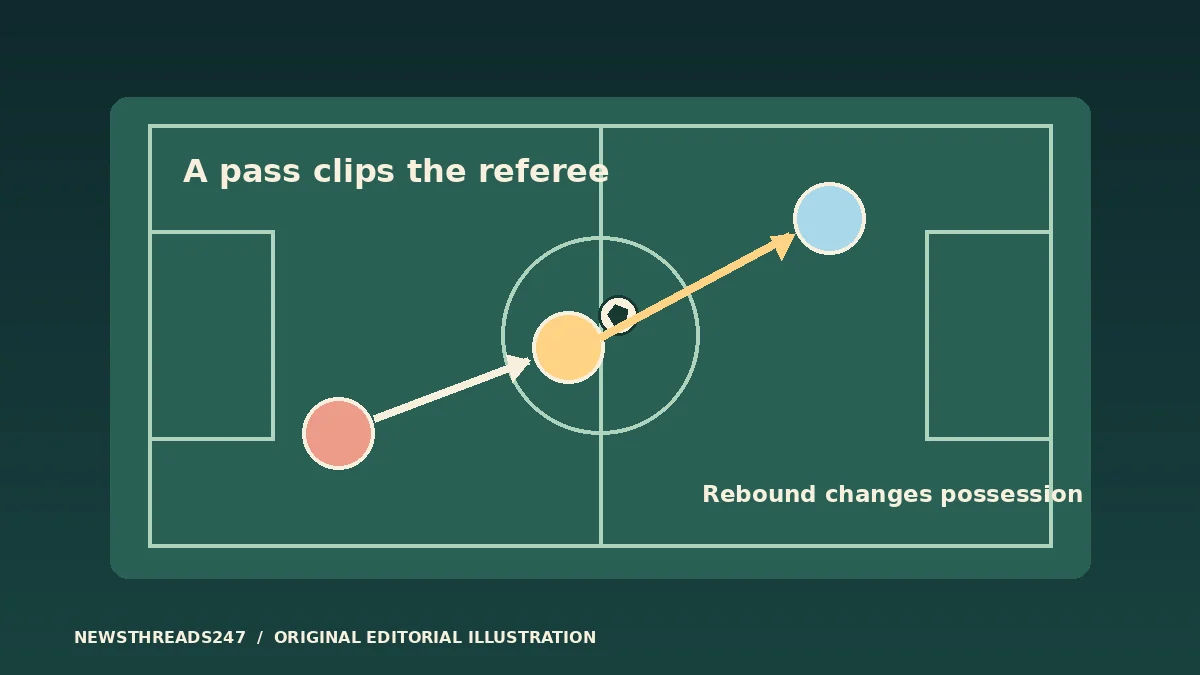
When a pass hits the referee in football, play does not automatically stop. Under IFAB Law 9, the ball must stay on the field and the touch must lead to a change of possession, the start of a promising attack, or the ball going directly into the goal. Those are the three triggers for a dropped ball on contact with a match official. A slight deflection back to the same team, with no promising attack created, can leave play going.
This guide uses the 2026/27 IFAB Laws for association football. Two questions get mixed up during a replay: whether the touch required the whistle, and who should have the restart once play has stopped. A match can be easy to read on the first question and still require a judgement on the second.
There is another distinction at the boundary. IFAB’s Law 9 examples describe a ball that strikes an official and then goes out of play, without another player touching it. The restart is decided as if the official had not touched it. For example, a shot last played by an attacker that clips the referee and goes straight over the goal line wide of the goal ordinarily means a goal kick. That is different from a pass that clips the referee, stays in play and gives the ball to the other team.
Then identify who gets the dropped ball
For a dropped-ball restart, start with the location of the ball, not the place where a player is injured or the point from which a pass began. IFAB Law 8 gives the drop to the defending goalkeeper when the ball was inside the penalty area when play was stopped. When the ball was outside the area, the referee awards it to one player of the side that would have kept or gained possession if that can be determined.
Think of a red defender passing across midfield. The ball hits the referee and lands at a blue forward’s feet. Blue now has it because of the deflection. The referee can stop for the change of possession and, if red would otherwise have retained it, give the dropped ball to red. The player who picked up the loose ball after the deflection does not thereby earn the restart.
Now picture a different pass that was plainly going to a blue player before the referee’s contact sent it back to red and started a promising red attack. If the referee stops play for that attack, blue can be the side that would have gained possession. If the referee cannot tell which team would have kept or gained it, the fallback is the side that last touched the ball. The fallback matters precisely because some replays show a crowded challenge with no clear likely winner.
Find the spot, and separate a restart from fair play
For an ordinary stoppage that needs a dropped ball, Law 8 puts the ball where it was when play stopped. If the ball hit a match official or outside agent and play stopped for that contact, the law specifies the contact spot. That is why the referee may walk back several steps after the ball has already travelled downfield. The IFAB 2026/27 change notes also clarify that outside the area, the referee can consider which side would have taken the restart if the ball would have gone out.
A dropped ball today is assigned to one player. Everyone else from both teams must stay at least four metres away until the ball is in play, and it is in play when it touches the ground. Once it is in play, any player may play it; the designated recipient does not have a guaranteed first touch. If a player touches it before the ground, or it then leaves the field without touching any player, the law calls for another drop.
The choice of team under Law 8 is the referee’s decision. What that team does once the ball is in play is separate. Players may choose to return it as a sporting gesture, but the gesture does not decide who was entitled to the drop. It can make a clip look as if the referee gave the ball to the side that received the voluntary pass rather than to the side shown at the restart.
One player cannot score straight from the drop
The restart is not an indirect free kick. Law 8 requires the dropped ball to touch at least two players before a goal can be scored. If it enters the opponents’ goal without doing so, the restart is a goal kick. If it enters the recipient’s own goal without doing so, the opponents get a corner. A player’s first touch followed by a shot is still contact by just one player.
An offside infringement, by contrast, leads to an indirect free kick; our offside replay guide explains when that infringement is called. The dropped-ball rule also differs from the ordinary case of a shot striking the referee and entering the goal directly: that situation belongs to Law 9’s reasons for stopping play. Check whether the incident you are watching is the original deflection or an attempt after the dropped-ball restart.
Use three frames when watching a replay
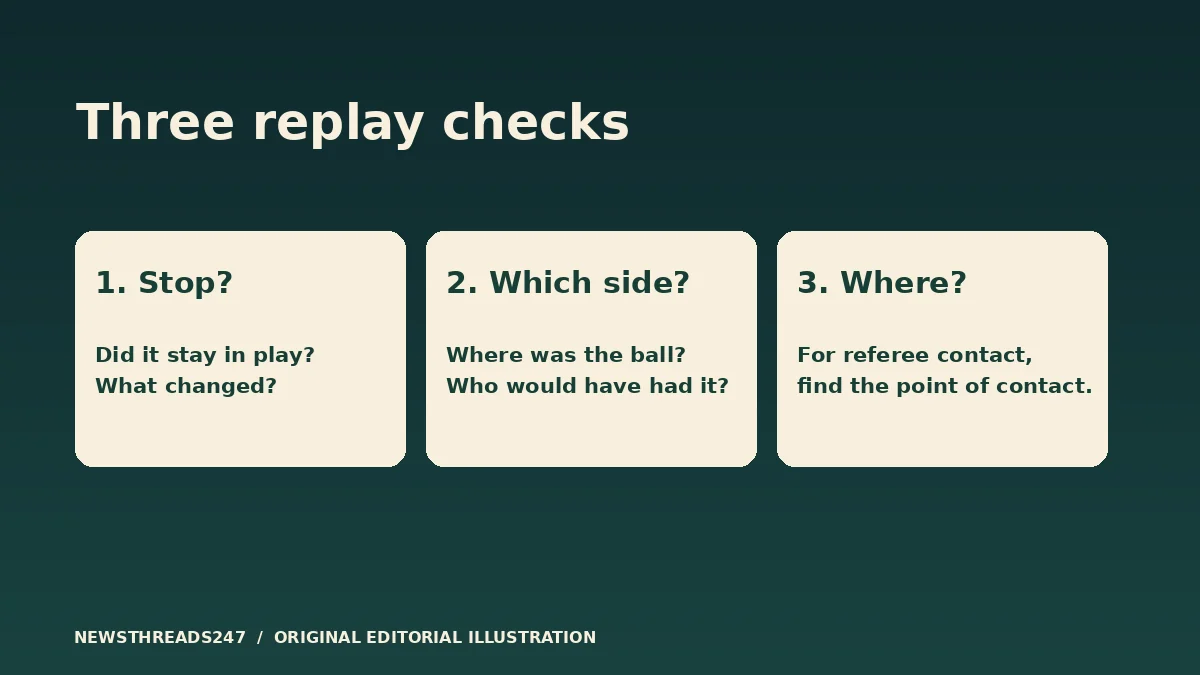
Freeze the clip at the contact and check whether the ball remained in play. Look at where it was headed before the deflection and who had a realistic chance of receiving it. Then watch the referee’s restart location and the player allowed to stand near the ball. If the clip begins after the whistle, it may be impossible to say confidently what triggered the decision.
For clubs and officials, consult the competition’s adopted edition as well as the full 2026/27 IFAB Laws. This guide should be rechecked when IFAB changes Laws 8 or 9. The worked incidents here are fictional and illustrate how the law is applied; they are not rulings on any real match.