
In this article
A spare can look full-size and still be temporary
A temporary spare is a way to get to help after a flat. Start with the instructions for your exact car and the label on the spare assembly. Together they tell you whether you may use it, which wheel position is allowed, what cold pressure it needs and how to drive on it. If you cannot confirm the limits, or the place is unsafe for a wheel change, use roadside assistance.
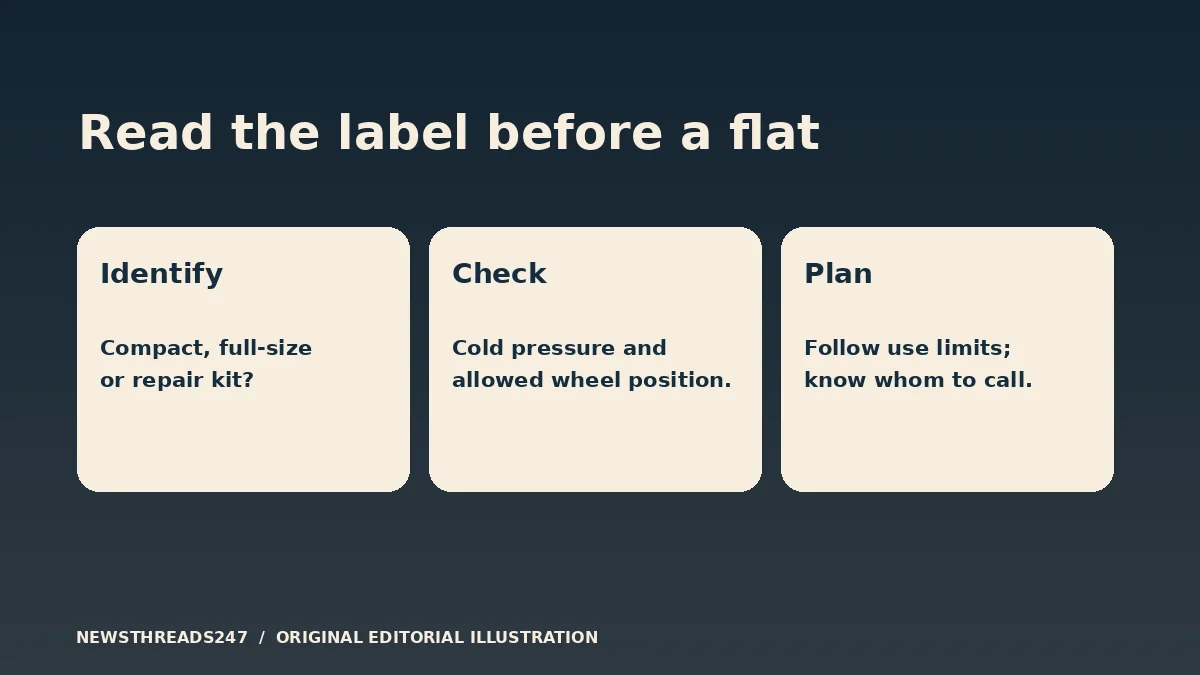
The wheel’s width is a clue, but it cannot settle the question. A compact space saver is usually easy to spot: it looks much narrower than the other tyres and may have a conspicuous speed label. A full-size spare can still be a different wheel-and-tyre assembly, with temporary-use restrictions of its own. Some vehicles come with a sealant kit rather than a wheel; that gives you a different set of choices entirely.
One Ford owner’s manual distinguishes compact spares, full-size dissimilar spares labelled temporary and other dissimilar spares. That is a useful warning against judging by appearance. Its speed and usage rules belong to the vehicle covered by that manual. Look up your own model, year and market before applying anything you read online.
Make a note of four details while you are at home
Type. With the car parked, find what was actually supplied. In a used car, the spare may have been swapped or omitted. Compare the assembly and markings with the manual. If it does not match, ask a workshop or the vehicle maker to identify it before you rely on it.
Cold pressure. Write down the value specified for the spare and its units. Do not copy the front-tyre pressure to a temporary spare. NHTSA’s tyre safety guidance recommends checking the spare along with the road tyres when cold. Michelin India’s tyre FAQ also directs drivers to the temporary spare’s markings for its specific pressure, speed and distance limitations. Use your manual and the label together; ask for help if they disagree or cannot be read.
Allowed position and driving limits. Find the maximum speed, any distance or usage limit, and any instruction about which axle can take the spare. Read the sections on tyres, wheel changing and towing together. If the car has all-wheel drive, check for additional model-specific restrictions rather than assuming the spare can go on any corner.
Tools and access. Confirm you can reach the wheel, jack and wrench and locate any locking-wheel key. Find the illustrated jacking points in the manual. A spare hidden beneath a boot full of holiday luggage still counts as inaccessible when the car is on a busy shoulder.
Use the limits to choose a destination
Imagine a flat just outside town. One repair shop is close but closed; the next is open, and the quickest route there is a high-speed road. The choice is not simply between a short route and a long route. Ask the open shop whether it can handle the tyre, then choose a route on which you can follow the manual’s restrictions without creating a hazard. If no suitable route exists, arrange a tow. An open repair shop ten minutes away is useless if you cannot reach it safely on the spare.
If the label gives a maximum speed, treat that as a ceiling. It does not tell you that the speed is suitable on every road. The same applies to a stated distance limit: it tells you where permission ends, not how far you should plan to drive. Head for the nearest suitable repair option. If your manual does not give a mileage number, the absence of a number does not turn temporary use into ordinary use.
A similar judgement applies to a trailer or a heavily loaded car. A manufacturer may restrict what you can carry or tow on a temporary assembly. Decide what help you need before setting off; leaving a caravan attached or moving luggage around is not a substitute for reading the instruction for your vehicle.
Know when the spare cannot solve the problem
There is no benefit in changing a wheel beside moving traffic when you cannot work safely. Use local roadside emergency guidance, and call assistance if the car is on an exposed shoulder, on unsuitable ground, or has obvious collision or wheel damage. A jack is for the specific wheel-change procedure in your manual. Keep out from under a car supported only by a jack.
Inspect the spare even if the boot has never been opened. A tyre can lose air in storage or degrade with age. Visible damage, missing pressure information or a spare that will not hold air calls for help rather than a trial drive. A tyre pressure warning after fitting a spare also needs interpretation in the manual; certain spare assemblies do not restore the normal monitoring function. The lamp does not replace a pressure check.
If the vehicle only carries sealant and a compressor, check the pre-trip sealant and repair-kit guide. A kit has its own damage exclusions, and a repair that falls outside them is a job for assistance. A spare wheel and a sealant bottle solve different problems; knowing which one you carry keeps you from searching the boot for a tool that was never supplied.
Return to the normal wheel and reset your plan
Ask the tyre shop whether the damaged tyre can be safely repaired and, if it needs replacement, whether the substitute matches the vehicle requirements. Have the temporary spare returned to its storage position and its cold pressure checked. If you used a tool or the locking-wheel key, put it back where you can find it. Make a new note if the wheel, tyres or vehicle configuration has changed.
A good spare plan fits in a single line on your phone: assembly type, correct cold pressure, mounting restrictions, and the assistance number. Keep it with a photograph of the label if that helps. Recheck after buying a used car, replacing the spare or changing wheel size. Those details are easier to gather in a driveway than in the dark next to a flat tyre.