
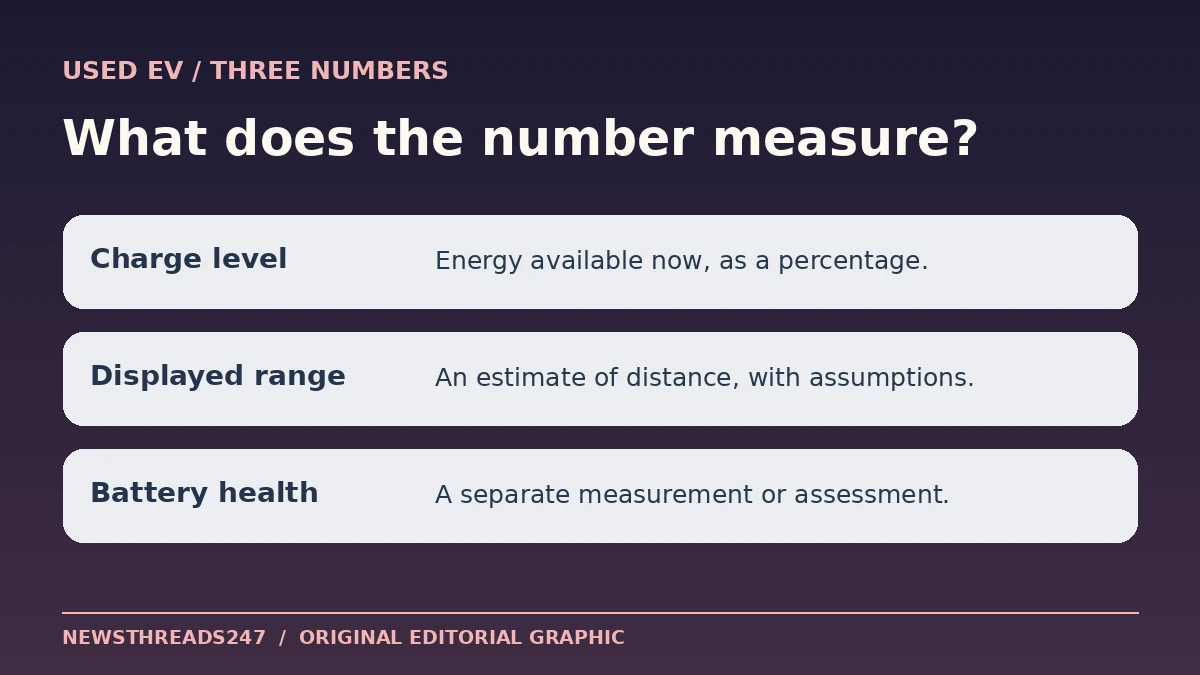
A used EV showing a reassuring range on the dashboard may still need a battery check. Ask for a recent report tied to that vehicle, with the test method and any unresolved warnings. The displayed distance, the current charge level and battery health are three different readings. Understanding which one you are looking at can prevent an expensive mistake.
In this article
Separate charge, range and battery health
Charge level is the percentage of charge the car estimates it has now. Displayed range is an estimate of the distance the car can cover, based on assumptions that vary by vehicle and display. Battery health is a separate assessment of the pack’s condition or energy retention, and the meaning depends on the test. A dashboard showing 100% charge does not say the battery retains 100% of its original usable energy.
The US EPA electric vehicle label guide explains that driving range is an estimate for a full battery and that actual results vary. As one model-family example, Tesla’s range guidance distinguishes its displayed rated range from estimates that use recent consumption. Do not assume every brand calculates its dashboard number the same way, or compare a different market’s rated figure as though it used the same test.
Why two cars can show the same distance
Consider two fictional cars, each fully charged. Car A has 60 kWh of usable energy and is assumed to use 0.20 kWh per mile. Car B has 48 kWh and is assumed to use 0.16 kWh per mile. On that simplified calculation, both cover 300 miles. The result is identical because Car B’s lower energy capacity is paired with lower consumption. These are illustrations, not figures for real models or a way to calculate the health of a car on a test drive.
A short drive may tell you whether the car feels suitable, whether the climate controls work, or whether the charging port gives an error in an ordinary session. It cannot by itself establish the pack’s original capacity or current retention. A range figure recorded in warm city driving and another recorded after a cold highway trip need context before you compare them. Keep the route, conditions and display mode in your notes.
Ask what was measured on this exact car
Request the date, odometer reading, vehicle identification number and test method. Ask whether the result comes from a manufacturer’s diagnostic, an independent test, a data-based estimate or a screenshot of the range display. If the result is a percentage, ask what it is a percentage of. A recent number with a documented method is more informative than a higher number with no explanation.
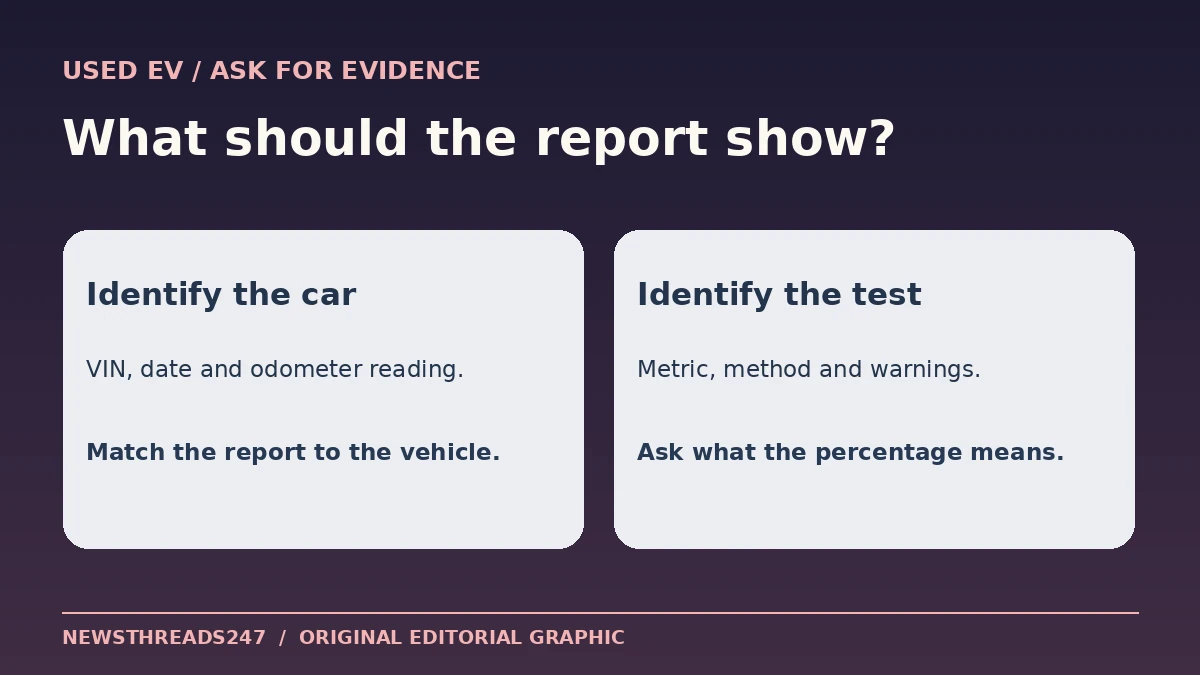
The North American Model 3 owner’s manual describes a Battery Health Test on equipped cars that estimates energy retention compared with when the battery was new. It also lists prerequisites, warns that climate control is disabled during the test, and says the test can take up to 24 hours. That is one manufacturer’s method, not a procedure for every EV. Ask the seller or a qualified service provider to arrange the appropriate check. Do not open a high-voltage pack or ask a seller to run an unfamiliar procedure during a brief viewing.
Keep the warranty and the inspection separate
Ask about active battery or charging warnings and any battery repair or replacement. Request service records that match the VIN. A report can be useful even when it is not a complete diagnosis; a separate inspection can help assess a warning or resolve a discrepancy. A warranty answers what the manufacturer may cover and under which terms. It does not measure the condition of the car in front of you.
Check the warranty document for the exact market, model and ownership status. Verify whether it transfers and whether any battery coverage depends on a threshold, time, mileage or exclusions. For an India-specific example of why terms differ on resale, see our guide to EV battery warranty language in India. Do not apply those terms to a different model or country.
Make the purchase decision on the evidence you have
Write down the range your regular use actually requires, where you would charge and how much margin you need on the longest regular trip. Then compare that requirement with the evidence available for the car. If the seller supplies only a dashboard image, record battery health as unknown. If an active warning or unexplained gap remains, make a qualified inspection a condition of purchase or continue looking.
Battery reports and diagnostic menus can change with the vehicle and software. Check the manufacturer’s current instructions for the specific model, confirm the report still describes the present car and ask for a fresh assessment if important repairs or alerts appeared after the test.